
Why Kārtikeya belongs in your address bar
Every address bar is a choice. When you type Kārtikeya, you are not typing a novelty; you are restoring a name that the early DNS, built for English typewriters, could not carry. The plain ASCII form kartikeya is a leftover of that constraint, not the name itself. This post is the long version of the restoration: where the name comes from, how the Devanagari tradition wrote it, how it is pronounced, what the myths and the material record preserve, and why its Unicode form now lives as a working domain. The claim throughout is simple — the original spelling is not decoration. It is the name.
At a Glance
- Restored name: Kārtikeya
- ASCII form: kartikeya
- Meaning: "Son of Krittika"
- Domain of influence: War, Commander of Gods
- Pantheon: Sanskrit
- Classification: Tier 1
- Original script: कार्तिकेय (Devanagari)
- Live domain: kārttikeya.com
Overview
Kārtikeya (kartikeya) — War, Commander of Gods · Son of Krittika — belongs to the Sanskrit tradition, where it is catalogued under the domain "War, Commander of Gods". The name means "Son of Krittika".
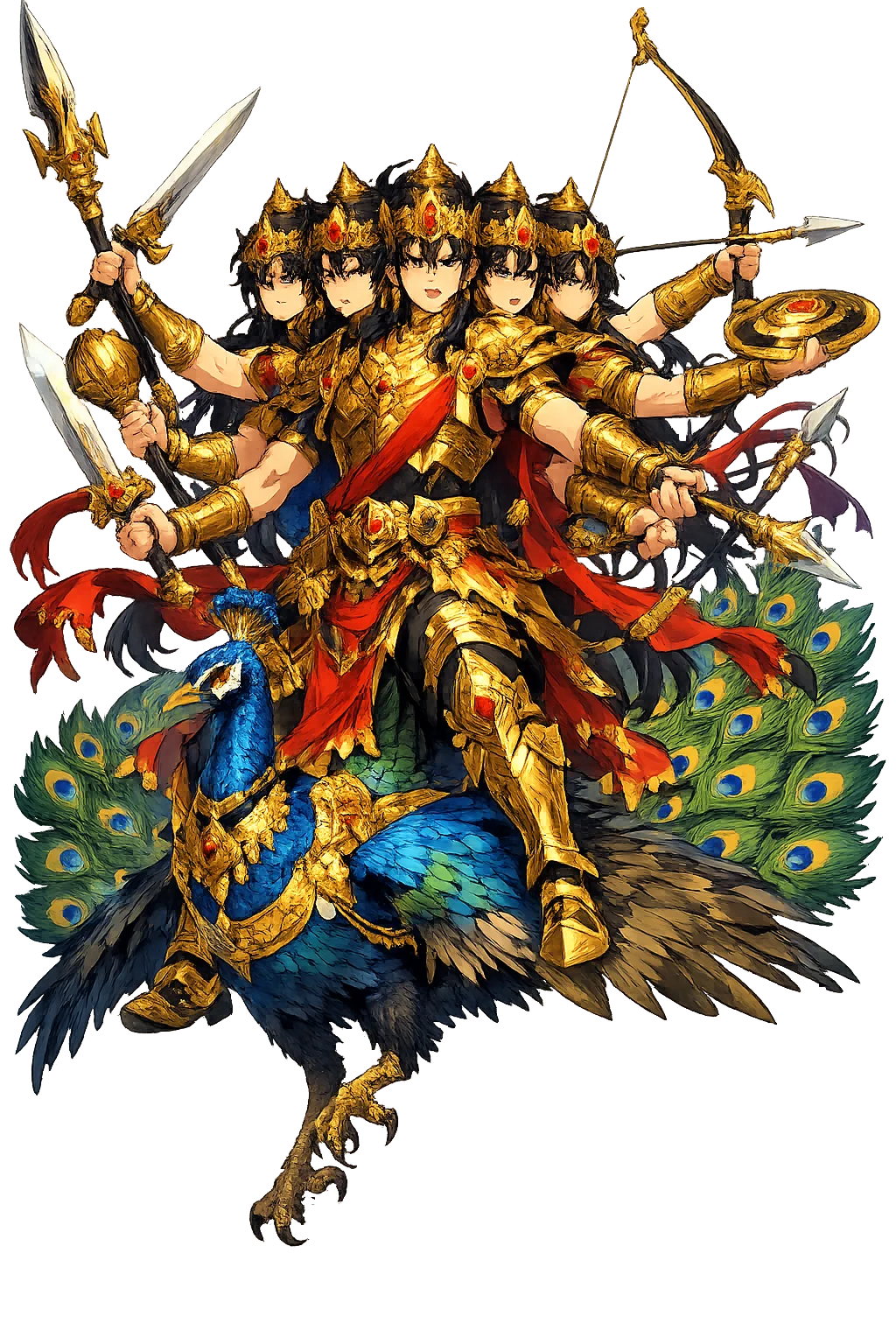
Kārttikeya is India's god of war at his most beautiful: the six-faced son of Śiva, raised by six star-mothers, who took the spear at seven days old and destroyed the demon no god could touch — and who rides his peacock still through the temples of two nations that call him their own.
PuniCodex restores the name as Kārtikeya and serves its temple at kārttikeya.com. The original carries both stress and vowel length, and exactly one historically valid Unicode restoration exists, which places the name in Tier 1. The plain ASCII form kartikeya survives as a modern convenience imposed by the early domain-name system; the restoration, not the fallback, is the form the project defends as philologically complete.
The Name
The name is attested in Devanagari as कार्तिकेय. Etymologically it means "Son of Krittika".
The ASCII form kartikeya survives only because the early domain-name system could not carry diacritics; it is a technological compromise, not an ancient spelling. The Unicode restoration Kārtikeya recovers the vowel length of the original directly in the address bar. The original carries both stress and vowel length, and exactly one historically valid Unicode restoration exists, which places the name in Tier 1.
The letter-by-letter transformation runs:
- k → K — Same, capitalized
- a → ā — Long vowel
- r → r — Same
- t → t — Same
- i → i — Same
- k → k — Same
- e → e — Same
- y → y — Same
- a → a — Same
The project holds the domain kārttikeya.com (xn--krttikeya-5bb.com) as the canonical home of this name.
The Original Script
The name is preserved in Devanagari as कार्तिकेय.
The scholarly transliteration is Kārtikeya.
The rendering proceeds step by step:
- Sanskrit Kārtikeya is written in Devanagari as कार्तिकेय
- IAST transliteration maps each Devanagari vowel and consonant to a Latin equivalent
- Macrons mark long vowels (ā, ī, ū); dots beneath consonants mark retroflex articulation (ṭ, ḍ, ṇ, ṣ)
Pronunciation
The reconstructed pronunciation of the name is /kaːr.t̪i.keː.jɐ/ — Reconstructed Sanskrit.
For the modern speaker, the closest approximation is: KAHR-tih-kay-yah — the first vowel long, e always long in Sanskrit.
Kindred and historical forms of the name:
- Devanagari — कार्त्तिकेय
- IAST standard — Kārttikeya
- Tamil — Murugan (முருகன்)
- Owned form — Kārttikeya
Sanskrit kārtikeya — IAST, with the long ā and the e unmarked (e and o are inherently long in Sanskrit and IAST never macrons them). The restoration Kārttikeya is the correct IAST form; Kārttikēya is a hypercorrection that mistakes the ISO 15919 convention for IAST.
Mythology
Kārttikeya's myths are the war-god's perfect résumé: born for one battle, victorious in seven days, and never outgrown by the cult that made him its own.
The Son of Fire and Stars (The Birth)
The gods, unable to face the demon Tāraka, needed Śiva's son — but Śiva would not marry. From the fire of his third eye the seed fell through Agni and the Gaṅgā to the reeds, where the six Kṛttikā stars (the Pleiades) found and nursed the child. Born of flame, carried by water, raised by stars: the war-god's lineage is the elements themselves conspiring against the demon.
Seven Days Old, Commander of the Gods (The Battle)
The Mahābhārata and the Purāṇas race the clock: appointed commander (senāpati) of the gods' armies as a week-old child, given the spear (vel) by his mother, Kārttikeya led the assault on Tāraka's fortress and killed the demon who had bullied heaven for a thousand years. The war the adults could not win, the infant finished — the tradition's proof that force without freshness is only habit.
South to Murugan (The Cult)
His second great myth is his own migration: southward into Tamil country he became Murugan, "the Beautiful," the beloved of the Tamil people — god of the hills, of love as well as war, married to the tribal girl Vaḷḷi and the cultivated Devayānai. The Sanskrit war-god and the Tamil hill-god are one: the commander who conquered a whole second civilization without drawing the spear.
Thaipusam (The Festival)
His living myth is the most extreme devotion in Hinduism: at Thaipusam, millions of his devotees carry milk-pots, pull chariots with hooks in their skin, and pierce cheeks and tongues with small spears (vel) — the body offered to match the god's own gift. From Palani to Batu Caves in Malaysia, the war-god's festival is among the largest religious gatherings on earth.
Symbols & Iconography
The iconography associated with Kārtikeya concentrates in a small set of recurring attributes, each a compressed statement about the name:
- The vel (spear) — Focused force — the weapon that ends what the gods could not
- The six faces — Total sight — the commander who misses nothing
- The peacock — Pride harnessed to war — beauty as battle-standard
Archaeology & Evidence
His iconography is fixed from the Kushan period (the six-headed Shanmukha coins of the Yaudheyas, 2nd c. BCE–1st c. CE) — among the oldest datable god-images in India. The Palani temples of Tamil Nadu, the Kataragama complex in Sri Lanka, and Malaysia's Batu Caves (272 steps, the world's tallest Murugan statue at 42.7 m) map his living empire. The Yaudheya republic's Shanmukha coinage proves his cult is older than most of the pantheon's temples.
Realm & Domain
Kārttikeya is India's god of war at his most beautiful: the six-faced son of Śiva, raised by six star-mothers, who took the spear at seven days old and destroyed the demon no god could touch — and who rides his peacock still through the temples of two nations that call him their own.
The Vel
His spear — the lance of victory over the unconquerable.
The Six Mothers
The Kṛttikās — the Pleiades who nursed him, giving him his name.
Six Faces
Ṣaṇmukha: the six-faced god who sees every direction at once.
The Peacock
His mount — the war-bird whose dance is also a weapon.
Across Cultures
His Tamil identity (Murugan) is the subcontinent's great syncretic achievement: a Sanskrit god fully naturalized in Dravidian soil, then exported with Tamil migration — to Sri Lanka (Kataragama, shared with Buddhists and Muslims), Malaysia, Singapore, Mauritius, South Africa, and Fiji. The Kataragama shrine's multifaith pilgrimage — Hindu, Buddhist, Muslim, and Vedda devotees at one altar — is his unique achievement among Hindu gods: the commander of everyone's armies.
Within the Sanskrit tradition, closely related names in the corpus include [[amsa|Aṃśa]], [[daksa|Dakṣa]], [[dhatr|Dhātṛ]], [[durga|Durgā]], [[ganesha|Gaṇeśa]], and [[ganga|Gaṅgā]].
Cultural Legacy
"Murugan" is the most-loved male deity of Tamil Nadu; his six Palani hill-temples are among India's busiest; Thaipusam at Batu Caves draws a million-plus annually. His vel decorates everything from Tamil school emblems to the Sri Lankan Kataragama flag. The war-god who was born in a week is also the one who never grew old — the eternal youth of two civilizations, still riding the peacock.
The Scholarly Record
The account of Kārtikeya given in this edition rests on the witnesses and reference works listed below. Lexica and etymological dictionaries secure the form and meaning of the name; the literary and religious texts supply the narrative evidence.
- Mahābhārata, Vyāsa; translated by Kisari Mohan Ganguli, 400 BCE. Full text
- Purāṇas, Various; Internet Sacred Text Archive selections, 300. Full text
- Monier Monier-Williams, A Sanskrit-English Dictionary, Oxford; Cologne Digital Sanskrit Dictionaries, 1899. Full text
- Monier-Williams Sanskrit-English Dictionary, Oxford, 1899. Full text
- Cambridge Ancient History, Multiple volumes, 1970. Full text
- Oxford Classical Dictionary, 4th ed., Oxford University Press, 2012. Full text
A Meditation
Kārttikeya is the god of arriving exactly as needed. Six mothers, one spear, seven days: nothing in his story wastes a moment. He asks the commander's question, which is also every late-starter's and every young team's: what are you waiting to grow up for — and what would you take on, if you knew you were already enough?
The spear has not dulled: the six hills still fill, the milk-pots still rise, and the Tamil grandmother teaching her grandson his first prayer says the name both nations own. The commander's real conquest was never Tāraka's fortress — it was the calendar, where his day is kept by more people than most gods' years.
The Pleiades still rise over Palani in his season, the six star-mothers keeping their appointment with the son. Astronomy and affection never separated in his cult: look up, the stars; look down, the hills; look inward, the spear. Three temples, one war-god, no waiting.
The peacock deserves its own line: the war-bird that eats the serpent, dancing at his approach in the temple murals — pride made useful, display made dangerous. His whole household is like that: six mothers, six faces, one spear, zero hesitation. The week-old general is the pantheon's permanent reminder that readiness is a decision, not an age.
The rooster on his banner crows for the war he never had to fight twice: one battle, properly timed, permanently won. The hills, the spear, the six, the stars — everything about him is an argument for doing the decisive thing early and well, and then, like a good commander, letting the calendar do the remembering.
The Unicode Restoration
Kārtikeya is classified as Tier 1: the original carries both stress and length, and only one valid Unicode restoration exists. The ASCII fallback kartikeya still resolves everywhere, but it is the restored form that carries the name's full information. Across the 9 characters of the name, the restoration adjusts 1: 1 mark of length (ā). That is the whole thesis of this temple: the marks are the message.
Character by Character
The journey from kartikeya to Kārtikeya, one character at a time:
- k → K — Same, capitalized
- a → ā — Long vowel
- r → r — Same
- t → t — Same
- i → i — Same
- k → k — Same
- e → e — Same
- y → y — Same
- a → a — Same
The Domain Name
The restored name is live as a working domain: kārttikeya.com, which the DNS carries in punycode form as xn--krttikeya-5bb.com — an ASCII-compatible encoding that lets a non-ASCII name travel the global network without breaking older infrastructure. The visitor sees Kārtikeya; the machines see the encoding. That duality is the engineering compromise on which the entire restoration rests, and it is why a name written the way its own tradition wrote it in Devanagari can now be typed into any browser on earth.
The Sanskrit Pantheon
Kārtikeya is one of 92 entries the PuniCodex lexicon catalogues under the Sanskrit pantheon. The Pantheon page gathers the tradition's major figures in one place, and the Lexicon lets you filter all 924 restorations by tradition, tier, or script — the fastest way to see where this name sits among its kin.
Frequently Asked Questions
What does Kārtikeya mean? The traditional gloss is "Son of Krittika."
Which tradition does Kārtikeya belong to? Kārtikeya is catalogued in the Sanskrit pantheon of the PuniCodex lexicon.
Why is Kārtikeya classified as Tier 1? Because the original carries both stress and length, and only one valid Unicode restoration exists — and the marks in the restored spelling preserve exactly that evidence.
Is Kārtikeya a working domain? Yes — kārttikeya.com resolves today and routes to this temple.
What is the punycode for kārttikeya.com? The DNS encoding is xn--krttikeya-5bb.com; browsers perform the translation automatically, so visitors only ever see the restored name.
Typing Kārtikeya
You do not need a special keyboard to use this restoration. The PuniCodex Type Tool converts the ASCII form kartikeya into Kārtikeya as you type, and the browser extension offers the same conversion inside any text field. Copy the restored form, paste it into the address bar, and the DNS does the rest.
Sister Temples
Other temples in the Sanskrit pantheon include Pṛthivī, Rāvaṇa, and Satī — each with its own restoration story, its own scholarly record, and its own place in the lexicon.
Why This Restoration Matters
Restoring Kārtikeya is part of a larger effort to make the web multilingual by default. The PuniCodex project does not ask users to learn a new alphabet; it asks the infrastructure to respect the alphabets that already exist. Every section of this post — the script, the sound, the myths, the evidence — converges on the same point: the marks in Kārtikeya are information, and information deserves an address of its own. A single Unicode domain is a small proof, but it is a proof that scales: every name restored makes the next one easier, and every visit to kārttikeya.com is a vote for the restored form.
Explore Further
This post is one doorway into the temple. The home page carries the full character breakdown and the ambient canvas; the lore page tells the myths in long form; the Scholarly Edition preserves the sources, pronunciation data, and revision history; and the patron wall supports the restoration directly. For the wider map, browse the Lexicon, explore the Pantheon, or return to the PuniCodex blog.
Related Names
Sources
The full scholarly apparatus — every citation, revision, and review — lives in the Scholarly Edition. Key references for this post:
- Mahābhārata, Vyāsa; translated by Kisari Mohan Ganguli, 400 BCE.
- Purāṇas, Various; Internet Sacred Text Archive selections, 300.
- Monier Monier-Williams, A Sanskrit-English Dictionary, Oxford; Cologne Digital Sanskrit Dictionaries, 1899.
- Cambridge Ancient History, Multiple volumes, 1970.
- Oxford Classical Dictionary, 4th ed., Oxford University Press, 2012.
- Ṛgveda (Agni hymns); Atharvaveda; Taittirīya Saṃhitā.
- Subala/Skanda Upaniṣads; Śvetāśvatara Upaniṣad.
- Skanda Purāṇa; Mahābhārata (Śalya-parvan); Kāṇḍa Purāṇam.
- Kanda Śaṣṭi Kavasam; Subrahmanya Bhujanga.
- Lexicon authorities for this entry: MW, RV.