The Authentic Orthography
War, Commander of Gods · The Commander of the Gods
Unicode restoration and ASCII comparison
कार्त्तिकेय
The name in its original Sanskrit form. Kārttikeya (कार्त्तिकेय) is attested in the source tradition — “Son of Krittika”. Its macron-length vowels carry the full phonetic and orthographic weight of the source tradition.
kartikeya
Reduced to plain kartikeya, the name loses everything that made it specific: macron-length vowels. What remains is an ASCII string that machines can parse but that no longer speaks with its original voice.
Kārttikeya
The Unicode restoration recovers what ASCII flattened. Kārttikeya restores macron-length vowels, returning the name to its original written dignity. The domain encodes to Punycode, but the browser displays the truth.
Kārttikeya.com → xn--krttikeya-5bb.com
The non-ASCII characters in Kārttikeya are encoded while the ASCII remains visible. To the DNS, it is Punycode. To humanity, it is Kārttikeya.
How Kārttikeya travels from ancient script to the modern URL
How Kārttikeya was spoken
War, Youth, the Spear, and the Six-Faced One
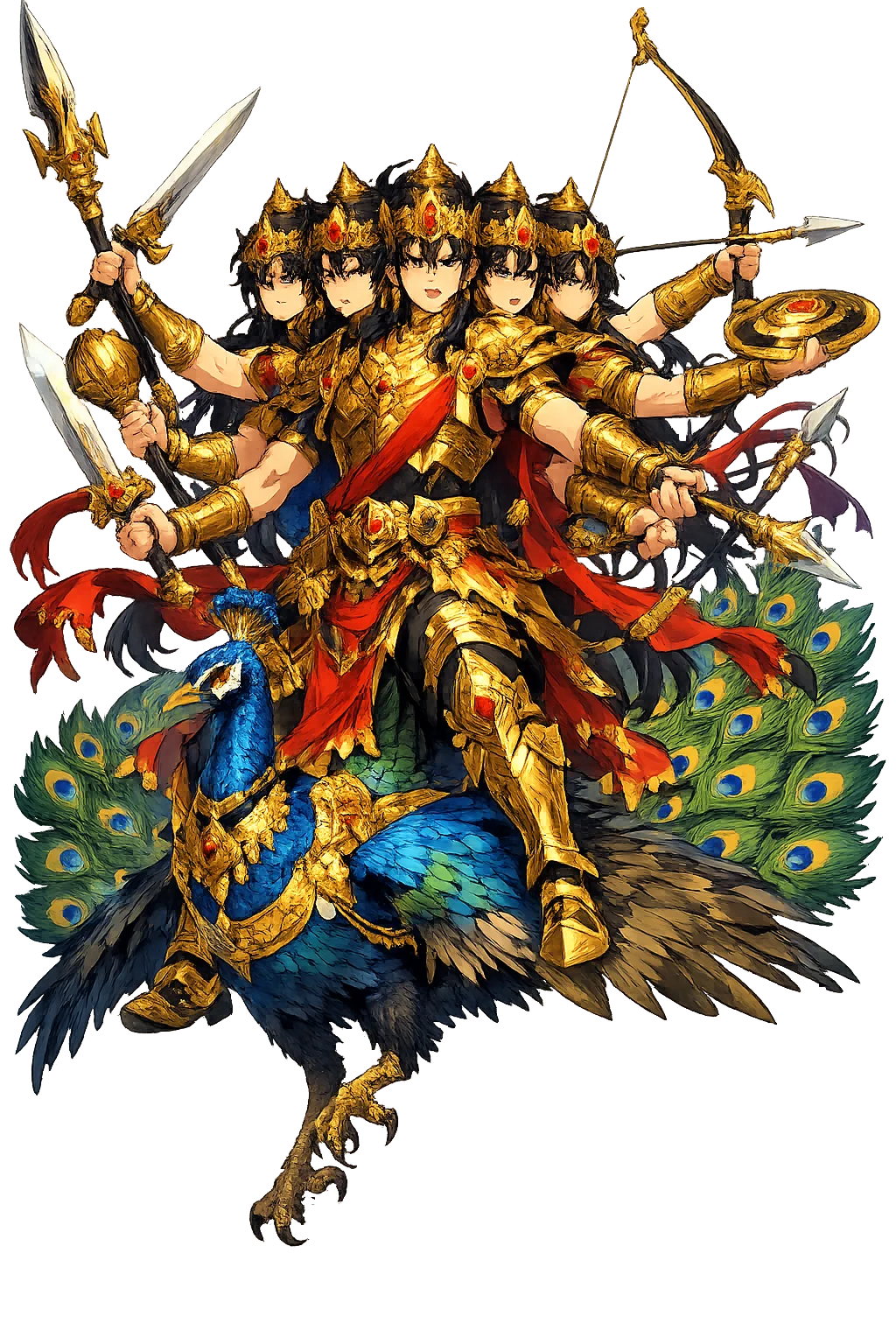
Kārttikeya is India's god of war at his most beautiful: the six-faced son of Śiva, raised by six star-mothers, who took the spear at seven days old and destroyed the demon no god could touch — and who rides his peacock still through the temples of two nations that call him their own.
His spear — the lance of victory over the unconquerable.
The Kṛttikās — the Pleiades who nursed him, giving him his name.
Ṣaṇmukha: the six-faced god who sees every direction at once.
His mount — the war-bird whose dance is also a weapon.
Stories of Kārttikeya
Kārttikeya's myths are the war-god's perfect résumé: born for one battle, victorious in seven days, and never outgrown by the cult that made him its own.
The gods, unable to face the demon Tāraka, needed Śiva's son — but Śiva would not marry. From the fire of his third eye the seed fell through Agni and the Gaṅgā to the reeds, where the six Kṛttikā stars (the Pleiades) found and nursed the child. Born of flame, carried by water, raised by stars: the war-god's lineage is the elements themselves conspiring against the demon.
The Mahābhārata and the Purāṇas race the clock: appointed commander (senāpati) of the gods' armies as a week-old child, given the spear (vel) by his mother, Kārttikeya led the assault on Tāraka's fortress and killed the demon who had bullied heaven for a thousand years. The war the adults could not win, the infant finished — the tradition's proof that force without freshness is only habit.
His second great myth is his own migration: southward into Tamil country he became Murugan, "the Beautiful," the beloved of the Tamil people — god of the hills, of love as well as war, married to the tribal girl Vaḷḷi and the cultivated Devayānai. The Sanskrit war-god and the Tamil hill-god are one: the commander who conquered a whole second civilization without drawing the spear.
His living myth is the most extreme devotion in Hinduism: at Thaipusam, millions of his devotees carry milk-pots, pull chariots with hooks in their skin, and pierce cheeks and tongues with small spears (vel) — the body offered to match the god's own gift. From Palani to Batu Caves in Malaysia, the war-god's festival is among the largest religious gatherings on earth.
Kārttikeya is the god of arriving exactly as needed. Six mothers, one spear, seven days: nothing in his story wastes a moment. He asks the commander's question, which is also every late-starter's and every young team's: what are you waiting to grow up for — and what would you take on, if you knew you were already enough?
Enter Extended Lore