PuniCodex

Extended Lore

कार्त्तिकेय Kārttikeya

Etymology · Phonology · Orthography · Cultural Legacy · Primary Sources

Tier 1 Kārttikeya.com
Kārttikeya — War, Commander of Gods
01

Quick Facts

Essential information about Kārttikeya, War, Commander of Gods

Original Scriptकार्त्तिकेय
Unicode RestorationKārttikeya
Reconstructed Pronunciation/kaːr.t̪i.keː.jɐ/
PantheonSanskrit
DomainWar, Commander of Gods
MeaningSon of Krittika
ClassificationTier 1
Primary DomainKārttikeya.com
Sacred SymbolsThe vel (spear), The six faces, The peacock
02

Etymology & Word Family

From original script to Unicode restoration

Original Script कार्त्तिकेय Kārttikeya — "Son of Krittika"
Unicode Restoration Kārttikeya Restored stress, length, and script
Modern ASCII kartikeya Plain-ASCII fallback

Sanskrit kārtikeya — IAST, with the long ā and the e unmarked (e and o are inherently long in Sanskrit and IAST never macrons them). The restoration Kārttikeya is the correct IAST form; Kārttikēya is a hypercorrection that mistakes the ISO 15919 convention for IAST.

03

Unicode Character Breakdown

Character-by-character philological analysis

CharacterUnicodeNameBlockPhonetic Role
KU+004BLatin Capital Letter KBasic LatinSame, capitalized
āU+0101Latin Small Letter A with MacronLatin Extended-ALong vowel
rU+0072Latin Small Letter RBasic LatinSame
ttU+0074Character U+0074Basic LatinGeminate tt of क्त (Kārttikeya)
iU+0069Latin Small Letter IBasic LatinSame
kU+006BLatin Small Letter KBasic LatinSame
eU+0065Latin Small Letter EBasic LatinSame
yU+0079Latin Small Letter YBasic LatinSame
aU+0061Latin Small Letter ABasic LatinSame

The Tier 1 classification reflects how much of the original phonology this restoration preserves — stress and vowel length for Greek names, distinctive letters and diacritics for every other tradition.

04

Cultural Significance

From ancient cult to modern Unicode

Ancient Domain

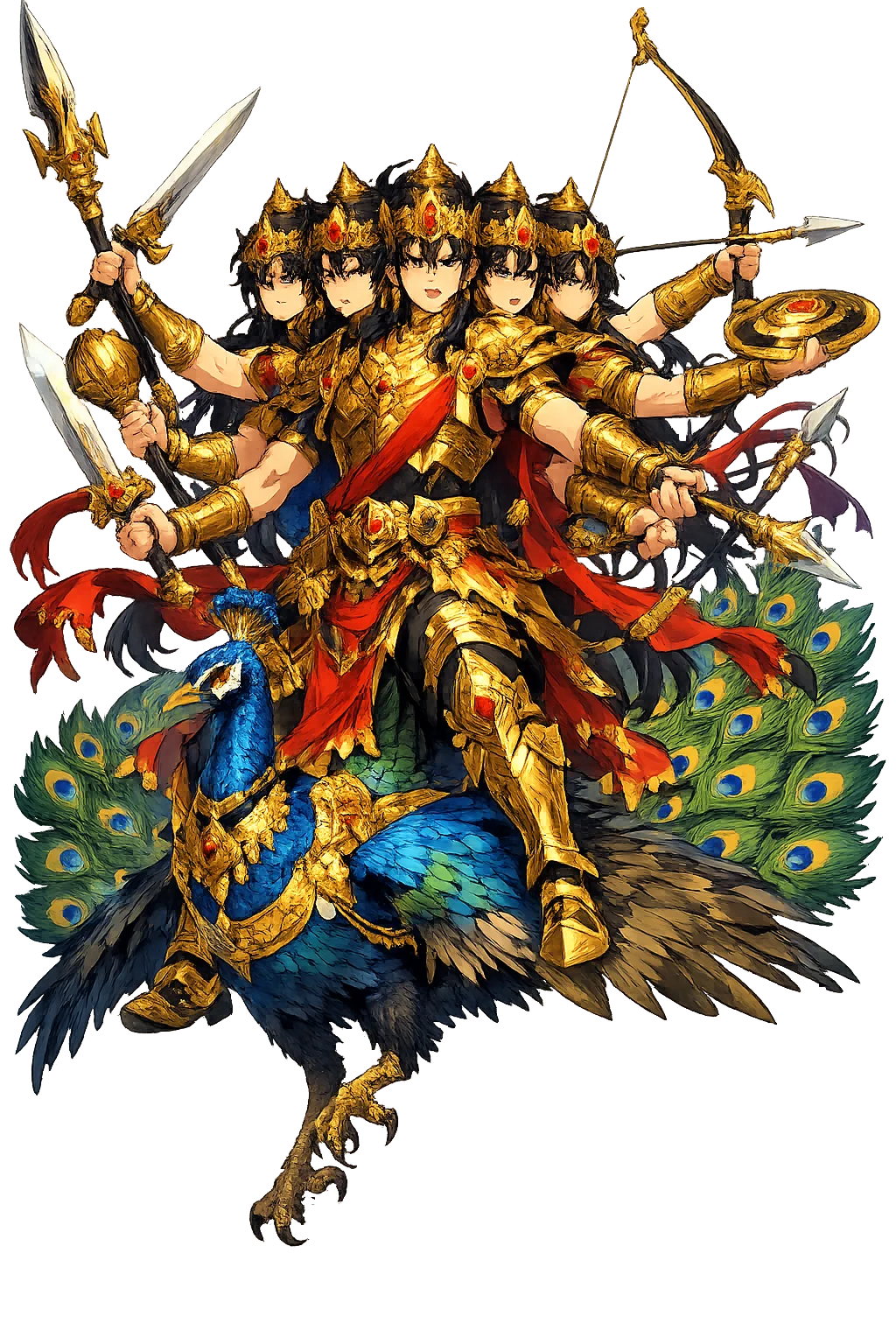
Kārttikeya is India's god of war at his most beautiful: the six-faced son of Śiva, raised by six star-mothers, who took the spear at seven days old and destroyed the demon no god could touch — and who rides his peacock still through the temples of two nations that call him their own.

Kārttikeya in Later Traditions

His Tamil identity (Murugan) is the subcontinent's great syncretic achievement: a Sanskrit god fully naturalized in Dravidian soil, then exported with Tamil migration — to Sri Lanka (Kataragama, shared with Buddhists and Muslims), Malaysia, Singapore, Mauritius, South Africa, and Fiji. The Kataragama shrine's multifaith pilgrimage — Hindu, Buddhist, Muslim, and Vedda devotees at one altar — is his unique achievement among Hindu gods: the commander of everyone's armies.

Modern Legacy

"Murugan" is the most-loved male deity of Tamil Nadu; his six Palani hill-temples are among India's busiest; Thaipusam at Batu Caves draws a million-plus annually. His vel decorates everything from Tamil school emblems to the Sri Lankan Kataragama flag. The war-god who was born in a week is also the one who never grew old — the eternal youth of two civilizations, still riding the peacock.

Unicode Restoration as Cultural Act

Restoring Kārttikeya in a domain name is more than orthographic accuracy. It is a statement that the internet should recognize the full range of human writing — not only the ASCII keyboard.

05

Frequently Asked Questions

Common questions about Kārttikeya, War, Commander of Gods, and Unicode restoration

01How do you pronounce Kārttikeya?

In reconstructed pronunciation, Kārttikeya is /kaːr.t̪i.keː.jɐ/ — approximately KAHR-tih-kay-yah — the first vowel long, e always long in Sanskrit..

02What does Kārttikeya mean?

Kārttikeya means Son of Krittika in the sanskrit tradition.

03What are the symbols of Kārttikeya?

Kārttikeya is associated with The vel (spear) (Focused force — the weapon that ends what the gods could not), The six faces (Total sight — the commander who misses nothing), The peacock (Pride harnessed to war — beauty as battle-standard).

04Why restore Kārttikeya in Unicode?

Plain ASCII kartikeya strips the stress, length, and script that make the name specific. Unicode restoration returns the name to its original written dignity.

05What is the most important myth about Kārttikeya?

The gods, unable to face the demon Tāraka, needed Śiva's son — but Śiva would not marry. From the fire of his third eye the seed fell through Agni and the Gaṅgā to the reeds, where the six Kṛttikā stars (the Pleiades) found and nursed the child. Born of flame, carried by water, raised by stars: the war-god's lineage is the elements themselves conspiring against the demon.

06

Scholarly Sources

The philological foundations of this restoration

Every claim on this page is grounded in established scholarship. The orthographic restorations follow disciplinary convention. The etymological chain follows the best available reference works. This is not invention — it is resurrection through scholarship.

Lexicography & Philology

  • MW
  • RV

Primary Texts

  • The Ṛgveda; the Śatapatha Brāhmaṇa; the early Upaniṣads; the Śiva Purāṇa and Liṅga Purāṇa.

Archaeology & Art History

  • Material evidence — iconography, inscriptions, and temple archaeology — for Kārttikeya and related cults.
  • His iconography is fixed from the Kushan period (the six-headed Shanmukha coins of the Yaudheyas, 2nd c. BCE–1st c. CE) — among the oldest datable god-images in India. The Palani temples of Tamil Nadu, the Kataragama complex in Sri Lanka, and Malaysia's Batu Caves (272 steps, the world's tallest Murugan statue at 42.7 m) map his living empire. The Yaudheya republic's Shanmukha coinage proves his cult is older than most of the pantheon's temples.

Religious Studies

  • Mahabharata
  • Puranas
  • Monier-Williams
  • MW
  • Cambridge
  • Oxford
Return

The Surface Awaits

You have traced the name from its earliest attestation to its Unicode restoration. Now return to the myth. The story is where the name lives.

Back to Lore
Kārttikeya mascot