
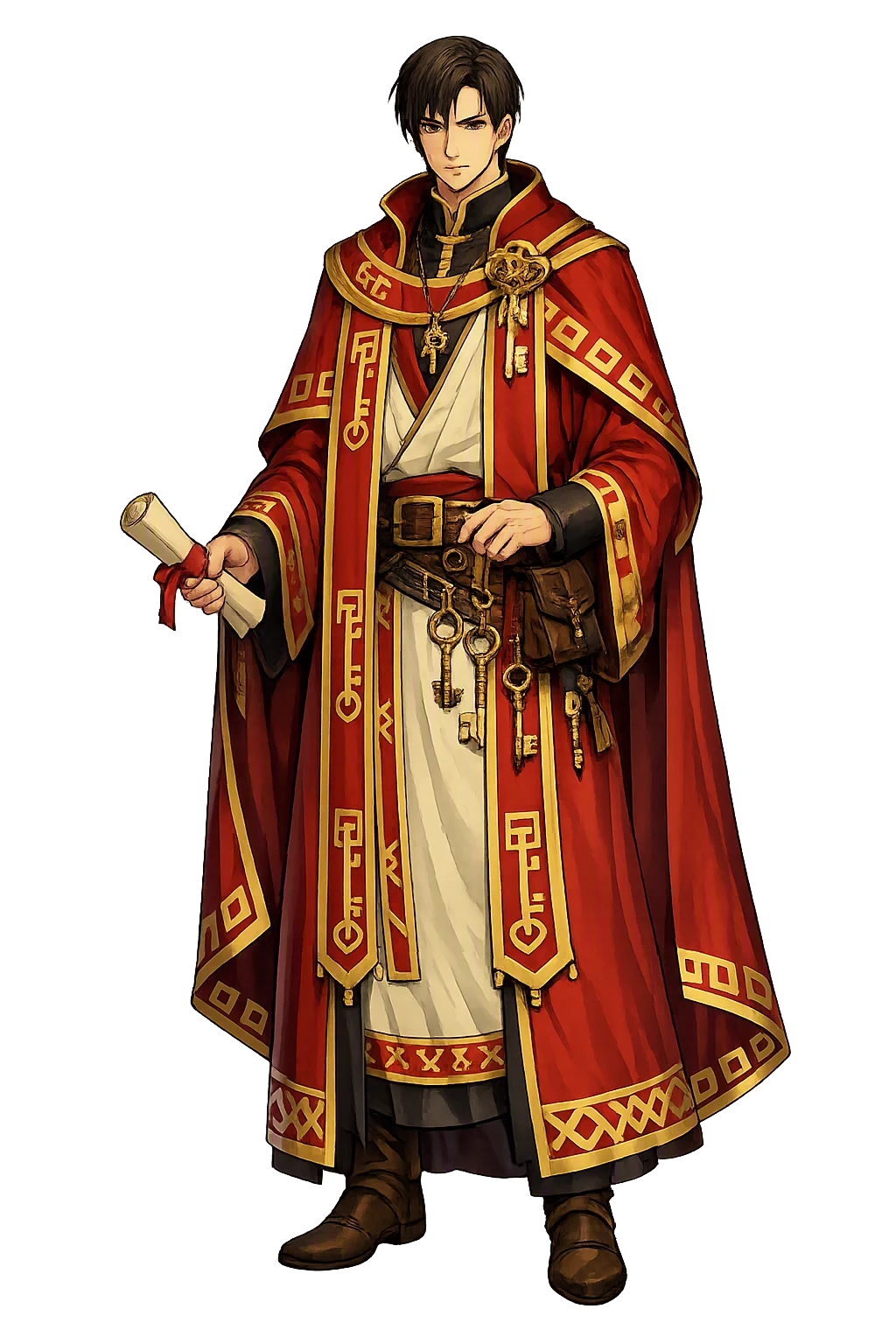
Why Kai belongs in your address bar
Every address bar is a choice. When you type Kai, you are not typing a novelty; you are restoring a name that the early DNS, built for English typewriters, could not carry. The plain ASCII form kai is a leftover of that constraint, not the name itself. This post is the long version of the restoration: where the name comes from, how the Celtic transcription tradition wrote it, how it is pronounced, what the myths and the material record preserve, and why its Unicode form now lives as a working domain. The claim throughout is simple — the original spelling is not decoration. It is the name.
At a Glance
- Restored name: Kai
- ASCII form: kai
- Meaning: "Unknown"
- Domain of influence: Seneschal, Steward
- Pantheon: Celtic
- Classification: Tier 2
Overview
Kai (kai) — Seneschal, Steward · Cei, Sir Kay — is the Welsh Cei, Arthur's first companion and the oldest named member of his warband after Arthur himself: the tall man of Culhwch ac Olwen who could hold his breath nine nights and nine days under water, go nine nights and nine days without sleep, deal a wound no physician could heal, grow as tall as the tallest tree in the forest, and carry so much heat that rain dried a handbreadth around his hand and his companions lit their fires from him.
The medieval record gives him two shapes. The Welsh stratum — Culhwch ac Olwen, the dialogue poem Pa Gur, the triads — remembers a wonder-hero who kills giants by cunning and fights monsters no one else will face; Geoffrey of Monmouth's Historia Regum Britanniae (c. 1136) euhemerizes him as Caius dapifer, Kay the steward, duke of Anjou, dead of his wound in the Roman war and buried at Chinon, the castle he built. The French and English romances kept the steward and spent the magic: Chrétien's Keu and Malory's Sir Kay are the seneschal with the sharp tongue, Arthur's foster-brother.
PuniCodex restores the name as Kai — identical to the ASCII input apart from the capital, because the Middle Welsh manuscript forms (Cei, Kei, Kai) write no diacritic. The mechanical rule therefore places it in Tier 2: nothing distinctive is lost in transit, a statement about orthography and never about the hero. No domain is claimed: the plain-ASCII kai.com is registered to a third party outside the collection and is watched for release.
The Name
The name is attested in Middle Welsh as Cei, with the manuscript spelling variants Kei and Kai — the same orthographic latitude Middle Welsh shows elsewhere between c/k and ei/ai. His patronymic is fixed: Cei mab Kynyr, 'Cei son of Cynyr', his father Cynyr Ceinvarfawc, 'Fair-beard', also of Arthur's court; his standing epithet is Cei Hir, 'the Tall'. The warrior-list in Culhwch ac Olwen preserves one further personal note: his mother's prophecy that his heart would be cold — the oldest root of the coldness and sharp tongue the romances later made his character.
The etymology is genuinely unsettled, and the lexicon's gloss 'Unknown' is the honest report. The standard conjecture connects the name with Latin Caius — Geoffrey of Monmouth writes Caius dapifer, and if the borrowing runs from Latin into Welsh, the steward's name is a Roman given name wearing a Welsh office; but the direction and date of the borrowing have been argued both ways, and no native Welsh etymology has won acceptance. This edition registers the dispute rather than settling it.
The ASCII form kai loses nothing, because the normalized Middle Welsh spelling is already plain Latin letters; the restoration is therefore a matter of canonical reference, not rescued diacritics, and the name is classified Tier 2 by the project's mechanical rule.
The letter-by-letter transformation runs:
- k → K — Same, capitalized
- a → a — Same
- i → i — Same
The project holds no domain for this name: kai.com is registered to a third party outside the PuniCodex collection and is watched for release. The temple lives at its canonical lexicon address.
The Original Script
The name is preserved in medieval Welsh manuscripts in the Latin alphabet as Cei, with the spelling variants Kei and Kai — Middle Welsh in Insular script, attested c. 12th–14th c. CE, in the Black Book of Carmarthen, the White Book of Rhydderch, and the Red Book of Hergest. Wales used the Latin alphabet for its vernacular from the earliest written records; there is no earlier monumental script for this name, and no ogham stone has ever been read with it.
The scholarly rendering proceeds step by step:
- Middle Welsh was written in the Latin alphabet using Insular minuscule; the spellings Cei, Kei, and Kai require no diacritic, the variation between c/k and ei/ai being ordinary scribal latitude.
- The standing forms of reference — Cei mab Kynyr, 'son of Cynyr', and the epithet Cei Hir, 'the Tall' — are fixed by the Mabinogion and the triads.
- Geoffrey of Monmouth's Latin Caius is the euhemerizing Latinization, not the original writing system; the French Keu and English Kay are the romance reflexes.
- The Unicode restoration Kai is therefore identical to the ASCII form apart from the capital; the temple form is a canonical reference, not a rescued spelling.
One caution attaches to the record: the etymology is unsettled — the Caius connection is the standard conjecture, not a demonstrated derivation — and this edition registers the lexicon's gloss 'Unknown' accordingly.
Pronunciation
The reconstructed pronunciation of the name is /kəi/ — Middle Welsh Reconstruction.
Phoneme by phoneme:
- K- — Voiceless velar stop [k], as in English 'keep'; the manuscripts write it with either c or k
- -ai — The falling diphthong [əi], a neutral first element gliding to [i] — the sound of Modern Welsh ei and of the English name Kay
For the modern speaker, the closest approximation is: 'KAY' — one syllable, exactly the English name Kay; the whole name is a single beat.
Kindred and historical forms of the name:
- Middle Welsh — Cei, also written Kei and Kai; Cei mab Kynyr, 'son of Cynyr'; the epithet Cei Hir, 'the Tall'
- Latin — Caius, Geoffrey of Monmouth's 'Caius dapifer'
- Old French — Keu, also Kex, Chrétien de Troyes' seneschal
- English — Kay, Malory's Sir Kay the seneschal, Arthur's foster-brother
Kai is Tier 2 because the restoration preserves nothing ASCII loses: the letters of the manuscript form are the letters of the keyboard. The capital alone marks the temple form.
Mythology
Kai's mythology lives in the oldest stratum of Welsh Arthurian tradition: Culhwch ac Olwen gives him the tale's largest dossier after Arthur, and Pa Gur remembers exploits the prose never told.
The First Companion (Culhwch ac Olwen)
When Culhwch comes to Arthur's court to win Olwen daughter of Ysbaddaden Chief Giant, the first companion named is Cei son of Cynyr. The warrior-list fixes his peculiarities: nine nights and nine days under water; nine nights and nine days without sleep; a wound from his sword no physician could heal; stature like the tallest tree when it pleased him; and the heat that dried rain a handbreadth around his hand and fired his companions' fuel. The list also preserves his mother's prophecy that his heart would be cold — the oldest trace of the character the romances would inherit.
The Salmon and the Sword (Culhwch ac Olwen)
Two of the hardest anoethau fall to Cei. To free Mabon son of Modron from Caer Loyw, the company follows the oldest animals to the Salmon of Llyn Llyw, and Cei and Bedwyr ride up the Severn on the salmon's shoulders; while Arthur's men assault the fort, Cei carries Mabon away on the salmon's back. And at the hall of Wrnach the giant — no guest had ever left it alive — Cei claims to be a master polisher of swords, burnishes the giant's blade, asks to hold it to test the work, and strikes off Wrnach's head with his own sword. The wonder-hero's greatest feats are won with a craftsman's hands.
The Beard of Dillus and the Englyn (Culhwch ac Olwen)
The beard of Dillus the Bearded was wanted to leash the whelp Drudwyn. Cei dug a pit, tricked Dillus into it, plucked the beard with wooden tweezers, and killed him afterward — and Arthur sang an englyn mocking Cei for taking from a living man what he could never have taken from a healthy one. The tale records the consequence in a line: because of that englyn there was enmity between Cei and Arthur ever after, and Cei took no part in the hunt of Twrch Trwyth. The closing tally keeps the ending: Gwyddog son of Menestyr slew Cei, and Arthur slew Gwyddog and his brothers to avenge him — the rift repaired only in vengeance.
Nine Witches and the Cat of Anglesey (Pa Gur; the Triads)
The fragmentary dialogue poem Pa Gur yv y Porthaur?, preserved in the Black Book of Carmarthen, shows Arthur and the gatekeeper Glewlwyd Mighty-grasp trading boasts, and the boasts are Cei's: Cei pierced nine witches, and Cei the Fair went to Anglesey to destroy the monstrous cat Cath Palug — the beast the triads say was born of the sow Henwen and raised by the sons of Palug as one of the island's plagues. The poem breaks off in the middle of that account.
Caius Dapifer (Historia Regum Britanniae)
Geoffrey of Monmouth Latinizes him as Caius dapifer — Kay the steward — gives him Anjou at the plenary court of Caerleon, marches him as duke through the Roman war, and buries him at Chinon, the castle he himself had built, mourned by the army. The magic is gone; the office Geoffrey fixed to the name proved more durable than any peculiarity.
Symbols & Iconography
Kai's attributes are the oldest regalia in the Arthurian corpus — powers, not possessions, fixed in the warrior-list of Culhwch ac Olwen and the fragments of early verse:
- The nine days' breath — Nine nights and nine days under water; nine nights and nine days without sleep — endurance past the human limit
- The fire in his hands — Heat enough to keep his hand dry a handbreadth in the hardest rain, and to serve as fuel for his companions' fire in the bitterest cold
- The unhealable sword — A wound from Cei's sword no physician could heal — the mark of the warrior in the oldest stratum
- The beard of Dillus — Plucked with wooden tweezers from the living giant to leash the hound Drudwyn — the quest won by cunning, and the englyn that ended the fellowship
- Cei Hir, 'the Tall' — Tall as the tallest tree in the forest when it pleased him — stature as the visible sign of the older, larger hero
Archaeology & Evidence
Kai is a literary figure: no inscription, ogham stone, or Romano-British dedication names him, and Welsh tradition generally left texts rather than cult monuments for its heroes. His manuscript witnesses are exact and early: Pa Gur survives in the Black Book of Carmarthen (c. 1250), the oldest substantial manuscript of Welsh verse; Culhwch ac Olwen survives in a fragmentary copy in the White Book of Rhydderch (Peniarth 4–5, c. 1350) and complete in the Red Book of Hergest (Jesus College MS 111, c. 1375–1425). The companion witness to this stratum, the Otherworld-raid poem Preiddeu Annwn, is preserved in the Book of Taliesin (Peniarth 2, early 14th c.).
The Latin attestations precede the surviving Welsh codices: Lifris of Llancarfan's Vita Cadoci (c. 1100) already knows Arthur, Cai, and Bedwyr as a standing trio, and Geoffrey's Historia (c. 1136) fixes the seneschal. The places of the tales — Caer Loyw on the Severn, the Anglesey of Cath Palug — remain on the map; the tall man himself left nothing in stone.
Realm & Domain
Kai is catalogued under the domain 'Seneschal, Steward' — the office Geoffrey of Monmouth fixed to the name and the romances never let him leave. But the office is older than Geoffrey: the Welsh attributes already describe a steward's powers written in mythic scale.
Seneschal
Caius dapifer — Kay the steward — is Geoffrey's formula: master of Arthur's household, holder of Anjou, the officer who answers the gate and keeps the hall. Chrétien's Keu and Malory's Sir Kay inherit the office entire: the seneschal of Arthur's court in every language the legend entered.
Steward
The Welsh attribute-list reads like a steward's duty enlarged to divine scale: he does not merely endure the cold, he is fuel for the company's fire; whatever he carries stays dry a handbreadth around his hand; his sleeplessness keeps the watch no one else can keep. Provision, warmth, and vigilance — the whole duty of a household's keeper.
The Keeper of the Sword
The one martial attribute the list allows him — the wound no physician could heal — and the tale's one sword-story, the winning of Wrnach's blade by a sword-polisher's craft, both belong to the keeper of weapons rather than the charge of horse.
Across Cultures
Kai is less a figure who absorbed other gods than one whom each retelling rewrote — the tradition's own syncretism, worked on a single name across four centuries. The Welsh stratum gives the wonder-hero; Geoffrey of Monmouth euhemerizes him into Caius dapifer, a duke and steward of recognizable twelfth-century type; Chrétien de Troyes turns the steward's sharpness into Keu's venomous tongue; and Malory resolves the arc into Sir Kay, Arthur's foster-brother — loyal, loud, and forever outmatched.
Within the Welsh corpus his standing partner is Bedwyr — 'Cei and Bedwyr' is the oldest formula of Arthurian companionship, riding the salmon together, working the Wrnach deception together. Scholars including Mac Cana have noted that the tale-patterns around the pair — the raid on a giant's stronghold for a treasure, the hunt of the enchanted boar Twrch Trwyth — have close Irish analogues, though no Irish cycle preserves Cei himself. The transformation of the tall man into the seneschal is the lesson the handbooks keep: the Arthurian legend domesticated its oldest figures, and Kai is the type-case.
Cultural Legacy
The steward outlived the giant-killer. Malory's Sir Kay — the foster-brother who claims he drew the sword from the stone, confesses, and is made seneschal at Arthur's coronation — fixed the English image: blunt, envious, brave enough, and indispensable to the household. Chrétien's Keu had already made him the court's satirist, and the romances of every language kept that register. T. H. White's The Sword in the Stone made Kay the human counterweight to the Wart — the brother who gets the crown's shadow instead of the crown — and carried the foster-brother reading to a modern audience.
In Welsh the name never left: Cai remains a living given name, and the Mabinogion's Cei Hir is still the tall man of the oldest Arthurian tale. Modern scholarship treats the arc from wonder-hero to comic steward as one of the great case-studies in how the Arthurian legend domesticated its oldest figures — and the recovery of the Welsh Cei behind the romance Kay as one of its standard correctives.
The Scholarly Record
The account of Kai given in this edition rests on the witnesses and reference works listed below. Culhwch ac Olwen supplies the narrative spine; Pa Gur and the triads the early verse; Geoffrey and Lifris the Latin record; Chrétien and Malory the romance transformation.
- Jones, Gwyn, and Thomas Jones, trans., The Mabinogion, rev. ed. (London: Everyman, 1993), 'Culhwch ac Olwen'.
- Bromwich, Rachel, and D. Simon Evans, eds., Culhwch and Olwen: An Edition and Study of the Oldest Arthurian Tale (Cardiff: University of Wales Press, 1992).
- Sims-Williams, Patrick, 'The Early Welsh Arthurian Poems', in The Arthur of the Welsh, ed. Rachel Bromwich, A. O. H. Jarman, and Brynley F. Roberts (Cardiff: University of Wales Press, 1991), 33–71.
- Bromwich, Rachel, ed. and trans., Trioedd Ynys Prydein: The Triads of the Island of Britain, 4th ed. (Cardiff: University of Wales Press, 2014).
- Haycock, Marged, ed. and trans., Legendary Poems from the Book of Taliesin (Aberystwyth: CMCS, 2007).
- Geoffrey of Monmouth, Historia Regum Britanniae, ed. and trans. Neil Wright and Julia C. Crick, 5 vols. (Cambridge: D. S. Brewer, 1984–91).
- Wade-Evans, A. W., ed. and trans., Vitae Sanctorum Britanniae et Genealogiae (Cardiff: University of Wales Press, 1944), Vita Cadoci.
- Malory, Sir Thomas, Le Morte Darthur, ed. P. J. C. Field, 2 vols. (Cambridge: D. S. Brewer, 2013).
- White, T. H., The Sword in the Stone (London: Collins, 1938).
- Evans, D. Simon, A Grammar of Middle Welsh (Dublin: Dublin Institute for Advanced Studies, 1964).
- Mac Cana, Proinsias, Celtic Mythology (London: Hamlyn, 1970).
- Koch, John T., ed., Celtic Culture: A Historical Encyclopedia, 5 vols. (Santa Barbara: ABC-CLIO, 2006), s.v. Cei.
A Meditation
Kai is the patron of the unglamorous power: the one who keeps the fire, the stores, the hall — the office that lets everyone else be heroic. His oldest attributes are a steward's attributes written in mythic scale. He does not merely endure the cold; he is fuel for the company's fire. He does not merely keep dry; whatever he carries stays dry a handbreadth around. The seneschal of the romances is the same figure after the magic has been spent: the man who knows where everything is kept, who answers the gate, whose sharp tongue is the friction of service worn into habit.
And the tradition is honest about the cost. His mother's prophecy said his heart would be cold; Arthur's englyn mocked the feat no one else could perform; the fellowship ended in a vengeance taken too late. Kai asks the question every household and every court must answer: what do you owe the one who keeps the fire — and what does keeping it do to the heart?
The Unicode Restoration
Kai is classified as Tier 2: the restoration needs no distinctive letters or diacritics its ASCII form would lose. The ASCII fallback kai still resolves everywhere, but it is the restored form that carries the name's full information. That is the whole thesis of this temple: the marks are the message.
Why This Restoration Matters
Restoring Kai is part of a larger effort to make the web multilingual by default. The PuniCodex project does not ask users to learn a new alphabet; it asks the infrastructure to respect the alphabets that already exist. Every section of this post — the script, the sound, the myths, the evidence — converges on the same point: the marks in Kai are information, and information deserves an address of its own. A single Unicode domain is a small proof, but it is a proof that scales: every name restored makes the next one easier, and every visit to the temple is a vote for the restored form.
Explore Further
This post is one doorway into the temple. The home page carries the full character breakdown and the ambient canvas; the lore page tells the myths in long form; the Scholarly Edition preserves the sources, pronunciation data, and revision history; and the patron wall supports the restoration directly. For the wider map, browse the Lexicon, explore the Pantheon, or return to the PuniCodex blog.
Related Names
Sources
The full scholarly apparatus — every citation, revision, and review — lives in the Scholarly Edition. Key references for this post:
- Jones, Gwyn, and Thomas Jones, trans., The Mabinogion, rev. ed. (London: Everyman, 1993), 'Culhwch ac Olwen'.
- Geoffrey of Monmouth, Historia Regum Britanniae, ed. and trans. Neil Wright and Julia C. Crick, The Historia Regum Britannie of Geoffrey of Monmouth, 5 vols. (Cambridge: D. S. Brewer, 1984–91).
- Koch, John T., ed., Celtic Culture: A Historical Encyclopedia, 5 vols. (Santa Barbara: ABC-CLIO, 2006), s.v. Cei.
- Jones, Gwyn, and Thomas Jones, trans., The Mabinogion, rev. ed. (Everyman, 1993), 'Culhwch ac Olwen', on the manuscript spellings.
- Lexicon authorities for this entry: Arthurian legend, MacKillop.