
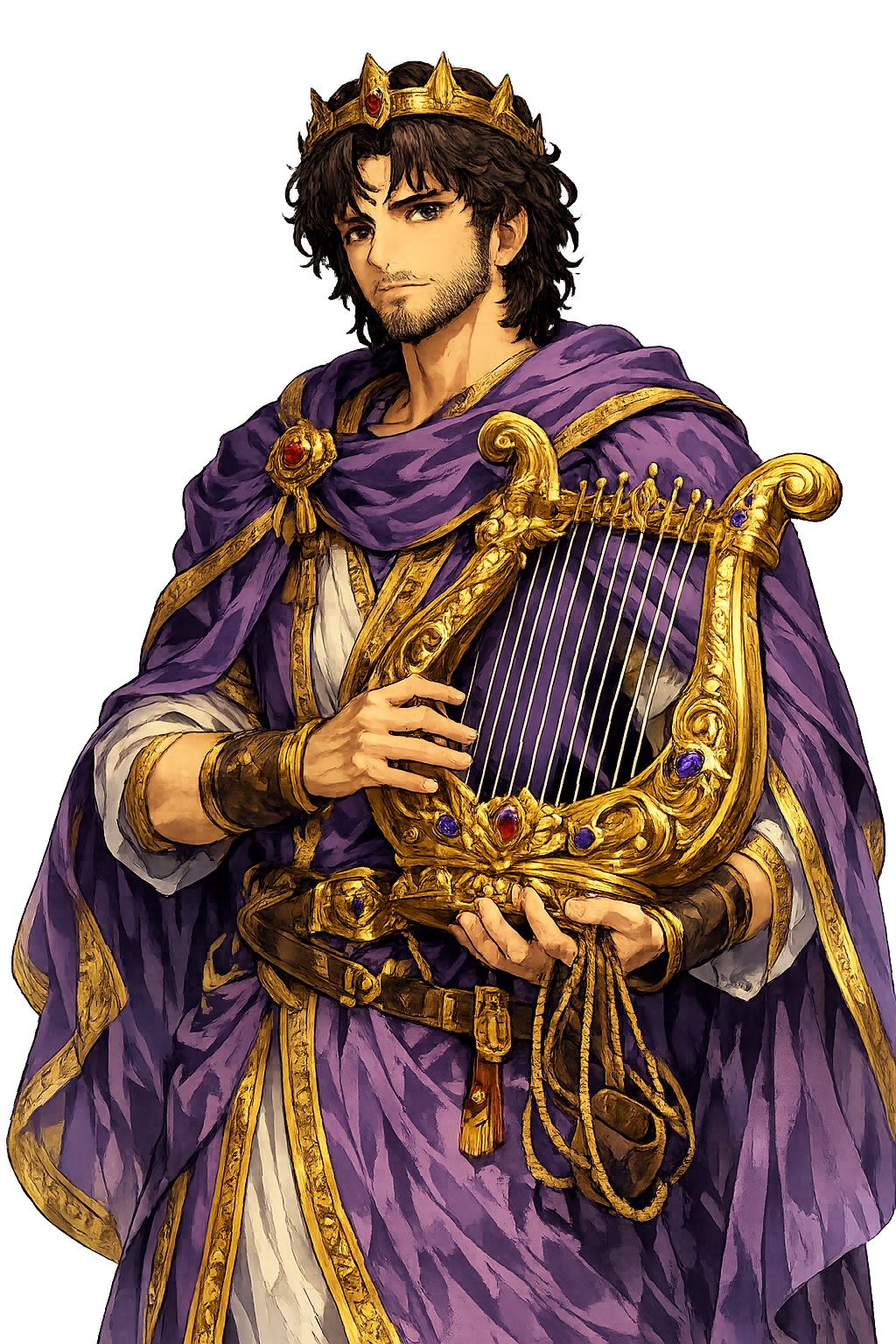
Dāwîḏ, translated into industries: what the archetype actually does
If the stories are true in the way that matters, they should show up in the world without being invoked. Dāwîḏ shows up constantly.
Dāwîḏ's mythology is a study in contrast: shepherd and king, poet and killer, beloved of God and adulterer, fugitive and founder. The narratives that surround him are among the most psychologically acute in the Hebrew Bible.
The pattern atlas — which maps every flagship temple to the industries its archetype demonstrably resonates with, each match argued and open to challenge — seats this temple in 4 industries. This file reads those seats the way they were earned: through the myths.
At a Glance
- Temple: Dāwîḏ
- Pantheon: Canaanite
- Domain of influence: King, Psalmist
- Pattern seats: 4
- Sectors touched: Society & Spirit · Commerce & Governance · Culture & Entertainment
- Strongest seat: Faith & Spiritual Organizations
- Series: The Resonance Files, No. 62 of 271
The Myth at Work
Anointed in Secret. The prophet Samuel is sent to Bethlehem to anoint a new king from among Jesse's sons. One by one the tall and impressive brothers pass by, but YHWH rejects them. — hold that image; the industries below are where it goes to work.
David and Goliath. The Philistine champion Goliath challenges Israel to single combat. David, still a boy, refuses Saul's armor and goes out with a staff, a sling, and five stones. — that is not just a story. It is a business model, four thousand years early.
The Seats
Each of these is argued in the atlas with a weight and a why-line. What the atlas cannot fit in one line is the whole myth — so here is each seat with its story restored.
Faith & Spiritual Organizations
Religious institutions, faith media, and devotional services. (Sector: Society & Spirit)
The why-line says it in one breath: The shepherd-king and sweet psalmist of Israel; the Psalter carries his name and Jerusalem carries his city. That is not a resemblance; it is the same act, performed in a newer building.
Leadership, Governance & Public Administration
Government, executive leadership, and statecraft. (Sector: Commerce & Governance)
The model king; statecraft with a harp and a sling. Swap the costume and the sentence is indistinguishable from the myth. That is what a resonance seat means.
Music, Arts & Performance
Music, theatre, dance, and the performing arts. (Sector: Culture & Entertainment)
The harp-playing psalmist king. — the atlas stops there, out of discipline. The myth keeps going: the function Dāwîḏ performs in the stories is precisely the function this industry sells.
Writing, Publishing & Media
Books, journalism, and content platforms. (Sector: Culture & Entertainment)
The why-line says it in one breath: The psalmist; devotional publishing’s bestselling voice. That is not a resemblance; it is the same act, performed in a newer building.
Read the myth again after the seats and it stops sounding ancient: Dāwîḏ's mythology is a study in contrast: shepherd and king, poet and killer, beloved of God and adulterer, fugitive and founder. The age changed. The work did not.
The Method, Stated Plainly
None of this is numerology. A seat exists only where the match can be argued from the deity's documented domains and deeds — weighted, published, and falsifiable. The full derivation, the weights, and the challenge process are public on the methodology page. If a seat in this file reads wrong, the atlas itself tells you how to prove it — and the correction becomes part of the record.
For the Ones Who Work There
If you work in faith & spiritual organizations, leadership, governance & public administration, or any trade this temple holds a seat in, this is the honest version of what a placement means: your industry beside the story it has been re-telling all along — on the temple floor itself, before an audience that came specifically to read it. The patron tier and the advertising terms describe the mechanics; the resonance above describes the fit. The story is the pitch; the seats are just where it already works.
The File Continues
This is one of 271 Resonance Files — the third dispatch from every flagship temple, where the myths meet the markets. The temple's founding dispatch tells the name's story; its Restoration File tells the spelling's; the blog index holds the whole archive.
Continue the series — previous: Dakṣa (read it) · next: Dažbog (read it).
The Resonance Files are argued from the same canonical record as the pattern atlas itself: the lexicon, the lore catalog, and the cited sources. Every seat can be challenged at the methodology page — and the challenge is the point.