
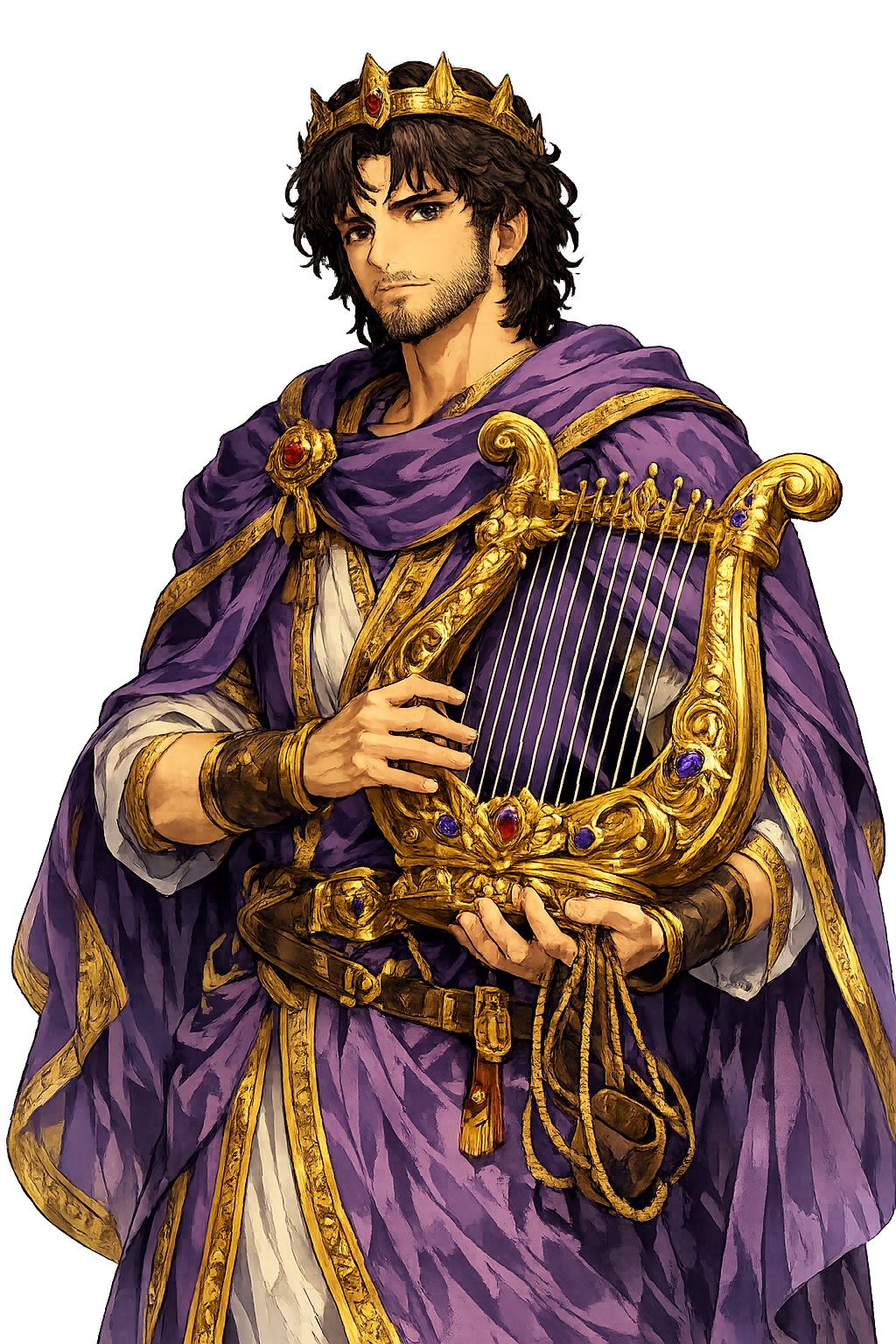
The name Dāwîḏ and the world it opens
A name is a door. Dāwîḏ opens onto an entire world: the domain of king, psalmist, a Canaanite tradition, and centuries of storytelling, worship, and scholarship. This post walks through that world room by room — the name and its roots, the original script, the sound of it, the myths, the symbols, the sites, the afterlife across cultures — and ends at the newest room of all: a Unicode domain that makes the whole structure addressable. david gets you to the same building, but only the restored form tells you why it was built.
At a Glance
- Restored name: Dāwîḏ
- ASCII form: david
- Meaning: "Second king of Israel"
- Domain of influence: King, Psalmist
- Pantheon: Canaanite
- Classification: Tier 2
- Original script: דָּוִד (Hebrew)
- Live domain: dāwîḏ.com
Overview
Dāwîḏ (Hebrew דָּוִד; English David) is the second king of Israel and the Hebrew Bible's paradigm of kingship: the shepherd anointed in secret at Bethlehem, the slayer of Goliath, the fugitive who twice spares Saul, the conqueror who makes Jerusalem his capital, and the recipient of the divine promise that his house and throne will endure forever (2 Samuel 7). Later tradition credits him with the Psalter — seventy-three psalms bear the superscription le-Dāwid, 'of David' — and both Jewish and Christian messianism await a 'son of David'.
The name is traditionally explained from the root d-w-d, 'to love', hence 'beloved', though some scholars treat it as a hypocoristic (shortened) form of a longer name or connect it with a theophoric element; the consonantal form is old, appearing as bytdwd, 'House of David', on the ninth-century BCE Tel Dan Stele.
PuniCodex restores the name as Dāwîḏ, transcribing the Tiberian Masoretic pointing: the macron marks the long qamets [ɔː], the circumflex the long ḥireq-yod [iː], and the dot under ḏ the spirantized final dalet [ð]. Because the restoration preserves vowel length but does not mark stress position, the name is classified Tier 2 (macron-preserving). The temple is served at dāwîḏ.com; the ASCII form david, descending from Greek Δαυίδ and Latin David, remains the fallback imposed by the early domain-name system.
The Name
The name is attested in Biblical Hebrew as דָּוִד (Dāwîḏ), pointed in the Tiberian tradition with a long qamets, a ḥireq-yod, and an undageshed final dalet. Its etymology is debated. The traditional derivation takes it from the root d-w-d, 'to love', yielding 'beloved' — plausibly a qal passive participle or a hypocoristic (shortened) form of a longer theophoric name; other proposals connect it with the kinship term dôd, 'uncle, beloved one', or with an otherwise unattested divine name. The consonantal form dwd is independently ancient: the Tel Dan Stele's bytdwd, 'House of David', attests the dynastic name in ninth-century BCE Aramaic epigraphy.
The English form David descends from the Septuagint's Δαυίδ through Latin and preserves nothing of the Tiberian vocalization. PuniCodex restores Dāwîḏ: the macron on ā marks the long qamets, the circumflex on î the long hireq-yod, and the dot under ḏ the spirantized final dalet. The restoration preserves vowel length but not stress position, which places the name in Tier 2 (macron-preserving).
The letter-by-letter transformation runs:
- d → D — Same, capitalized
- a → ā — Macron: long vowel
- v → w — Waw w
- i → î — Circumflex: long vowel
- d → ḏ — Dalet with line below
The project holds the domain dāwîḏ.com (xn--dw-rja8e207q.com) as the canonical home of this name.
The Original Script
The name is preserved in Hebrew as דָּוִד — Northwest Semitic abjad, attested Biblical Hebrew, c. 1000–500 BCE, in Israel / Judah. The script is written right-to-left.
The scholarly transliteration is Dāwîḏ (BHS / SBL academic), giving the normalized reading /daːˈwiːd/ or /dɔːˈviːd/.
The rendering proceeds step by step:
- The Masoretic spelling דָּוִד (Dāwîḏ) is preserved in the Biblia Hebraica Stuttgartensia.
- The first dalet carries a dagesh (דּ) because it follows a silent shewa at the beginning of the word, marking the stop /d/.
- The vav (ו) with qāmeṣ and ḥīreq points indicates the diphthongal sequence /awī/.
- The name is traditionally explained as from the root d-w-d 'beloved', though some scholars connect it to a Northwest Semitic theophoric element.
The Hebrew name is written דָּוִד: the initial dalet carries a dagesh (plosive [d]) and a long qamets, while the final dalet is spirantized to [ð] because it lacks dagesh. The medial waw functions as a consonant [w] with hireq-yod giving the long [iː]. PUNICODEX renders the name as Dāwîḏ: the macron marks the long vowel, the circumflex marks the long [iː] in traditional scholarly transcription, and the dot under the final ḏ marks the spirantized dalet. This is a Tier-2 restoration that preserves registrable Latin characters while signaling Tiberian phonetics.
Pronunciation
The reconstructed pronunciation of the name is /dɔːˈwiːð/ — Biblical Hebrew (Tiberian/Masoretic).
Phoneme by phoneme:
- dā- — Voiced alveolar plosive [d] — dalet with dagesh — followed by long [ɔː], the qamets gadol under ד.
- -wî- — Labio-velar approximant [w], the waw functioning as a consonant, plus long [iː] from the hireq-yod combination.
- -ḏ — Voiced dental fricative [ð] — spirantized dalet without dagesh. Some reading traditions keep the final consonant plosive [d], so the exact realization is uncertain.
For the modern speaker, the closest approximation is: 'daw-EEDH' — draw out the first 'aw' like 'dawn'; the middle sound is 'wee' with a glide; the final consonant is a soft 'th' as in 'this'.
Kindred and historical forms of the name:
- Hebrew root — d-w-d, 'beloved, uncle' — the name is a qal passive participle or hypocoristic
- Aramaic — דָּוִד (Dāwîḏ), identical in the Targumim
- Arabic — Dāwūd (دَاوُود), the Qur'anic king and prophet
BHS points the royal name דָּוִד (1 Samuel 16:13). The initial dalet carries a dagesh (plosive [d]) and a long qamets [ɔː]; the medial waw functions as a consonant [w] with hireq [iː]; the final dalet is spirantized [ð] in Tiberian because it lacks dagesh, though the phonetic realization of a final fricative is debated. HALOT s.v. דָּוִד; TDOT s.v. David.
Mythology
Dāwîḏ's mythology is a study in contrast: shepherd and king, poet and killer, beloved of God and adulterer, fugitive and founder. The narratives that surround him are among the most psychologically acute in the Hebrew Bible.
Anointed in Secret (1 Samuel 16)
The prophet Samuel is sent to Bethlehem to anoint a new king from among Jesse's sons. One by one the tall and impressive brothers pass by, but YHWH rejects them. The youngest, David, is kept in the fields tending sheep. Samuel anoints him, and 'the spirit of the LORD rushed upon David from that day forward.' Kingship begins in obscurity.
David and Goliath (1 Samuel 17)
The Philistine champion Goliath challenges Israel to single combat. David, still a boy, refuses Saul's armor and goes out with a staff, a sling, and five stones. 'You come to me with a sword and with a spear,' he says, 'but I come to you in the name of the LORD of hosts.' A single stone sinks into the giant's forehead, and David beheads him with his own sword. The story becomes the archetype of the weak overcoming the strong.
The Fugitive Prince (1 Samuel 18–31)
David's popularity awakens Saul's jealousy. He flees into the wilderness, gathers a band of outlaws, and twice spares Saul's life when he could have killed him. His friendship with Saul's son Jonathan is intense and tragic; Jonathan recognizes that David, not he, will be king. These years forge David's reputation as both a skilled warrior and a man of mercy.
Bathsheba and the Prophet's Rebuke (2 Samuel 11–12)
At the height of his power, David sees Bathsheba bathing, sleeps with her, and arranges the death of her husband Uriah the Hittite. The prophet Nathan confronts him with a parable about a rich man who steals a poor man's lamb. David condemns himself; the child born of the adultery dies, and the royal house is promised turmoil. Psalm 51, 'Create in me a clean heart, O God,' is traditionally ascribed to this moment.
Absalom's Rebellion (2 Samuel 15–18)
David's son Absalom steals the hearts of Israel and drives his father from Jerusalem. David weeps as he flees, cries out 'O my son Absalom, my son, my son!' when the rebellion is crushed, and returns to the city across the Kidron Valley. The story turns the king into a figure of public grief and private failure, even in victory.
Symbols & Iconography
The iconography associated with Dāwîḏ concentrates in a small set of recurring attributes, each a compressed statement about the name:
- Lyre / kinnor — The instrument of the Psalms and the sound that calms an afflicted king
- Sling and stone — The weapons of the underdog; the defeat of Goliath by faith and skill
- Crown — Kingship over Judah and Israel, and later the symbol of the Davidic line
- Ark of the Covenant — The sacred chest David brings to Jerusalem, making the city a religious as well as political capital
- Star of David (later emblem) — A medieval and modern symbol that claims descent from and allegiance to the house of David
Archaeology & Evidence
The Tel Dan Stele (ninth century BCE) contains the phrase bytdwd, 'House of David,' the earliest extra-biblical reference to the Davidic dynasty. The Mesha Stele may also allude to the 'House of David,' though the reading is disputed. Excavations in the City of David have uncovered Iron Age fortifications, the Siloam Tunnel, and residential quarters, but the scale of David's united kingdom remains contested between 'high chronology' and 'low chronology' interpretations. Khirbet Qeiyafa, a fortified site on the Judah-Philistia border, has been proposed by some as evidence of an early tenth-century Judahite state, though this is debated.
Realm & Domain
Dāwîḏ is the shepherd who slays a giant and becomes the paradigm of kingship. His story is Israel's national epic in miniature: anointed in secret, hunted by the king he is destined to replace, triumphant in battle, flawed in power, and remembered above all as the sweet singer of Israel. The Psalter carries his name; Jerusalem carries his city.
The Shepherd's Sling
With a stone and a sling he fells the Philistine champion Goliath, refusing Saul's armor because he has not tested it (1 Samuel 17).
The Royal Musician
His lyre soothes Saul's tormenting spirit and becomes the emblem of the Psalms attributed to him (1 Samuel 16; Psalms).
Captor of Jerusalem
He captures the Jebusite stronghold and makes it his capital, bringing the ark into the city (2 Samuel 5–6).
The Davidic Covenant
YHWH promises that David's house and throne will endure forever, a promise later read as messianic prophecy (2 Samuel 7).
Across Cultures
David's afterlives divide the traditions. In Judaism he is the 'sweet singer of Israel' (2 Samuel 23:1), the traditional author of the Psalter, and — as Chronicles recasts him — the planner of the Temple and founder of its liturgical music; Jewish eschatology awaits the messianic 'son of David'. Christianity receives that hope directly: the Gospels derive Jesus' genealogy from David, locate his birth in Bethlehem as 'the city of David', and take the acclamation 'Son of David' as a messianic title. In Islam, Dāwūd is prophet and king at once: he receives the Zabūr (the Psalms), is taught to fashion coats of mail from softened iron, is addressed as God's khalīfa on earth, and slays Jālūt — Goliath (Q 2:251; 34:10–11; 38:17–26). Across all three traditions the same complex figure persists: beloved, flawed, and foundational.
Within the corpus, the figures most closely bound to his story are the covenant lawgiver Mōšeh, whose charter his monarchy inherits, and his son and successor Šəlōmōh, who builds the Temple David was forbidden to build (1 Chronicles 28:3).
Cultural Legacy
Dāwîḏ gave the West one of its most enduring books of prayer and poetry. The Psalms have been recited in temples, churches, and mosques for millennia; their language of lament, thanksgiving, and royal trust shaped later liturgy and literature. The 'David and Goliath' narrative became shorthand for any victory of the weak over the strong, while the Star of David became the emblem of Judaism and later the state of Israel. Michelangelo's marble David, Renaissance Florence's civic ideal, reimagines the shepherd boy as the concentrated power of republican virtue. In popular culture, David is king, poet, sinner, and hero all at once.
The Scholarly Record
The account of Dāwîḏ given in this edition rests on the witnesses and reference works listed below. The lexica fix the form and possible derivations of the name; the books of Samuel supply the narrative; the Psalter preserves the tradition of his authorship; and the modern studies map the contested ground between the biblical portrait and the recoverable history.
- HALOT s.v. דָּוִד — form, pointing, and etymological options.
- TDOT s.v. David — theological profile of the name and figure.
- 1–2 Samuel — the primary narrative source for the life and reign.
- Psalms — seventy-three superscriptions le-Dāwid, the seed of his image as psalmist.
- McCarter, 1 Samuel / 2 Samuel (Anchor Bible, 1980–1984) — the standard historical-critical commentaries.
- Halpern, David's Secret Demons (2001) — a skeptical reading of the biblical portrait as apology.
- Baden, The Historical David (2013) — a counter-case for a historical tenth-century king.
A Meditation
Dāwîḏ is the king who never stops being a poet. Even when he holds a crown, he reaches for a lyre; even when he holds power, he is undone by desire and restored by lament. His greatness lies not in moral perfection but in the capacity to be named and to name himself — to hear Nathan's parable and say, 'I have sinned against the LORD.'
Modern politics rarely tolerates such public contrition, yet David's story suggests that legitimacy depends on it. The poet-king is the ruler who remembers that power is borrowed and that the song outlasts the sword. To meditate on Dāwîḏ is to meditate on the possibility that art and authority, violence and vulnerability, can inhabit a single life without being reconciled.
The Unicode Restoration
Dāwîḏ is classified as Tier 2: the original preserves at least one philological feature that ASCII cannot encode. The ASCII fallback david still resolves everywhere, but it is the restored form that carries the name's full information. Across the 5 characters of the name, the restoration adjusts 4: 2 marks of length (ā, î); 2 further adjustments (w, ḏ). That is the whole thesis of this temple: the marks are the message.
Character by Character
The journey from david to Dāwîḏ, one character at a time:
- d → D — Same, capitalized
- a → ā — Macron: long vowel
- v → w — Waw w
- i → î — Circumflex: long vowel
- d → ḏ — Dalet with line below
The Domain Name
The restored name is live as a working domain: dāwîḏ.com, which the DNS carries in punycode form as xn--dw-rja8e207q.com — an ASCII-compatible encoding that lets a non-ASCII name travel the global network without breaking older infrastructure. The visitor sees Dāwîḏ; the machines see the encoding. That duality is the engineering compromise on which the entire restoration rests, and it is why a name written the way its own tradition wrote it in Hebrew can now be typed into any browser on earth.
The Canaanite Pantheon
Dāwîḏ is one of 12 entries the PuniCodex lexicon catalogues under the Canaanite pantheon. The Pantheon page gathers the tradition's major figures in one place, and the Lexicon lets you filter all 895 restorations by tradition, tier, or script — the fastest way to see where this name sits among its kin.
Why This Restoration Matters
A door only matters if people walk through it. dāwîḏ.com is open, and everything behind it — the myths, the scholarship, the canvas, the patrons — hangs on the restored spelling. The PuniCodex project bets that the web will make room for names as they were actually written, and Dāwîḏ is one of its standing proofs. Visit, share, cite, type it yourself: each use is a small rehearsal for a web where no name has to hide its marks to be found.
Explore Further
This post is one doorway into the temple. The home page carries the full character breakdown and the ambient canvas; the lore page tells the myths in long form; the Scholarly Edition preserves the sources, pronunciation data, and revision history; and the patron wall supports the restoration directly. For the wider map, browse the Lexicon, explore the Pantheon, or return to the PuniCodex blog.
Related Names
Sources
The full scholarly apparatus — every citation, revision, and review — lives in the Scholarly Edition. Key references for this post:
- 1 Samuel 16–1 Kings 2 (primary David narrative); Masoretic psalm superscriptions le-Dāwid.
- HALOT s.v. דָּוִד; Biran & Naveh, "An Aramaic Stele Fragment from Tel Dan", Israel Exploration Journal 43 (1993).
- Khan, The Tiberian Pronunciation Tradition of Biblical Hebrew (2020).
- Biblia Hebraica Stuttgartensia (BHS), 1 Samuel 16:13 and passim.
- Lexicon authorities for this entry: Abraham.