
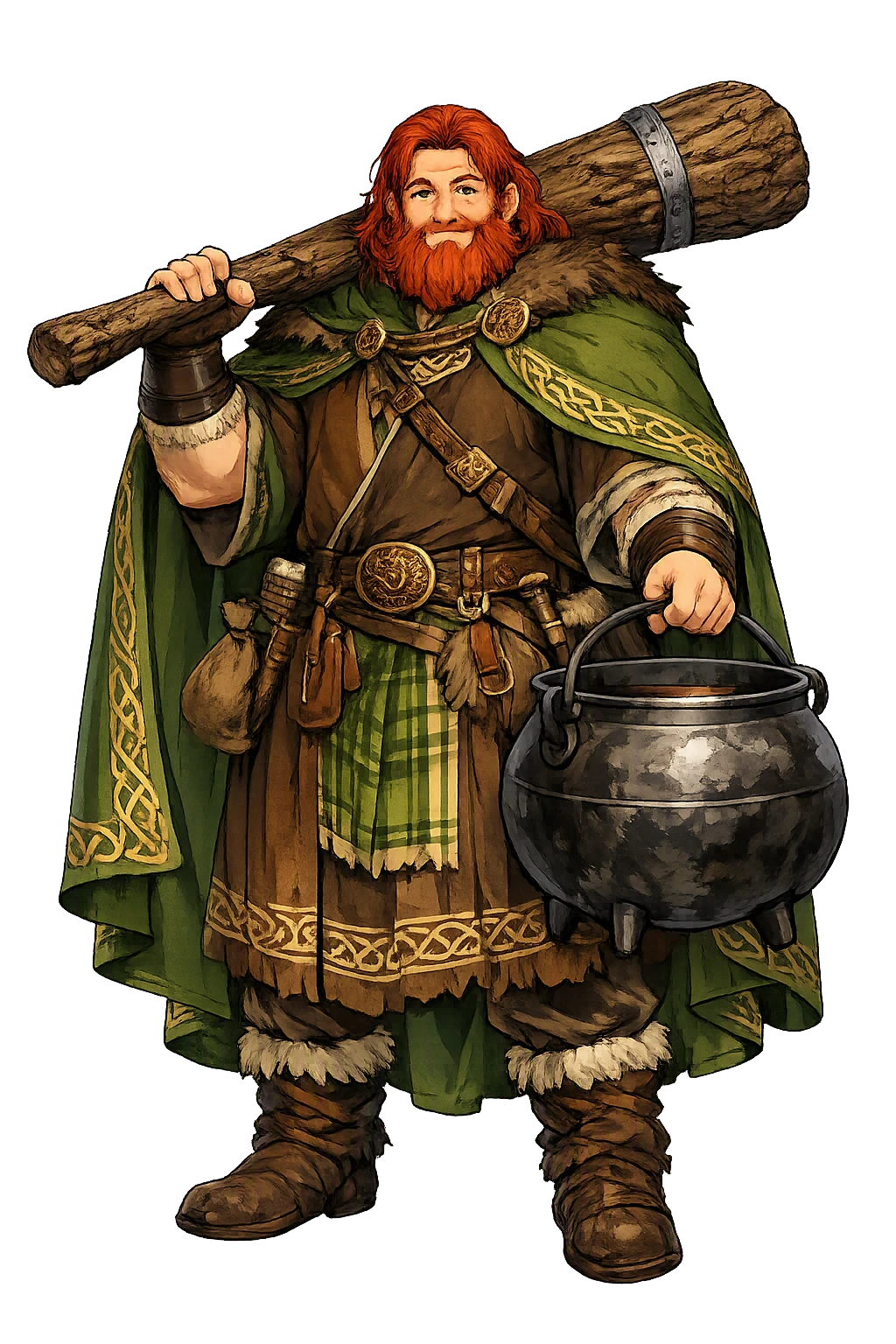
Where Dagda works now: the myths behind the markets
The myths did not retire. They moved offices. This is the file on where Dagda works now.
The Dagda's dossier is the largest of any Túatha Dé Danann god: he is king, laborer, glutton, lover, harper, and father, and Cath Maige Tuired gives him the war's two strangest set-pieces — the porridge pit before the battle and the harp on the enemy's wall after it.
The pattern atlas — which maps every flagship temple to the industries its archetype demonstrably resonates with, each match argued and open to challenge — seats this temple in 3 industries. This file reads those seats the way they were earned: through the myths.
At a Glance
- Temple: Dagda
- Pantheon: Celtic
- Domain of influence: Abundance, Strength, Magic
- Pattern seats: 3
- Sectors touched: Energy & Natural World · Culture & Entertainment · Commerce & Governance
- Strongest seat: Agriculture, Food & Harvest
- Series: The Resonance Files, No. 90 of 406
The Myth at Work
The Cauldron from Murias. When the Túatha Dé Danann came to Ireland, the tradition says, they came from four cities of the north of the world — Falias, Gorias, Finias, and Murias — and each city yielded a treasure. From Murias came the Dagda's cauldron, and the poem of the four jewels fixes its fame in one line: no company ever went away from it unthankful. — that is not just a story. It is a business model, four thousand years early.
The Builder of Bres' Forts. When the half-Fomorian Bres was made king and laid the Túatha Dé Danann under tribute, the greatest of them were put to work like serfs: Ogma carried the firewood, and the Dagda was set to building raths around Bres' stronghold, laboring every day at the forts of a usurper. There the satirist Cridenbél found him, and demanded the three best bits of the Dagda's ration every night — for a satirist's curse could raise blisters on a king's face, and no one dared refuse him. — that is not just a story. It is a business model, four thousand years early.
The Seats
Each of these is argued in the atlas with a weight and a why-line. What the atlas cannot fit in one line is the whole myth — so here is each seat with its story restored.
Agriculture, Food & Harvest
Farming, grain, food production, and agtech. (Sector: Energy & Natural World)
The cauldron of plenty — the undryable pot that feeds multitudes; abundance personified. Swap the costume and the sentence is indistinguishable from the myth. That is what a resonance seat means.
Music, Arts & Performance
Music, theatre, dance, and the performing arts. (Sector: Culture & Entertainment)
The why-line says it in one breath: Owner of the harp Uaithne — the three strains (grief, joy, sleep) are Irish music’s divine charter. That is not a resemblance; it is the same act, performed in a newer building.
Leadership, Governance & Public Administration
Government, executive leadership, and statecraft. (Sector: Commerce & Governance)
The why-line says it in one breath: Father-figure and king of the Tuatha Dé Danann — eighty years of rule in the Lebor Gabála. That is not a resemblance; it is the same act, performed in a newer building.
The Long Employment
The Dagda rode the Celtic revival better than almost any Irish god. Lady Gregory's Gods and Fighting Men (1904) carried Cath Maige Tuired into English — porridge pit, ford, and harp complete — and made him the genial giant of a generation's reading, the counterweight to Yeats's more ethereal Sidhe. The age changed. The work did not.
The Method, Stated Plainly
Skeptical? Good — the system is built for you. Every seat in this file carries its why-line and its weight, the full derivation is public at the methodology page, and the challenge process is part of the design. Falsifiable is not a posture here; it is the mechanism.
For the Ones Who Work There
If you work in agriculture, food & harvest, music, arts & performance, or any trade this temple holds a seat in, this is the honest version of what a placement means: your industry beside the story it has been re-telling all along — on the temple floor itself, before an audience that came specifically to read it. The patron tier and the advertising terms describe the mechanics; the resonance above describes the fit.
The File Continues
One of 406 Resonance Files — the series where the pantheon goes to work. Read the founding dispatch for the name, the Restoration File for the spelling, or the whole archive end to end.
Continue the series — previous: Dāgān (read it) · next: Dakṣa (read it).
The Resonance Files are argued from the same canonical record as the pattern atlas itself: the lexicon, the lore catalog, and the cited sources. Every seat can be challenged at the methodology page — and the challenge is the point.