
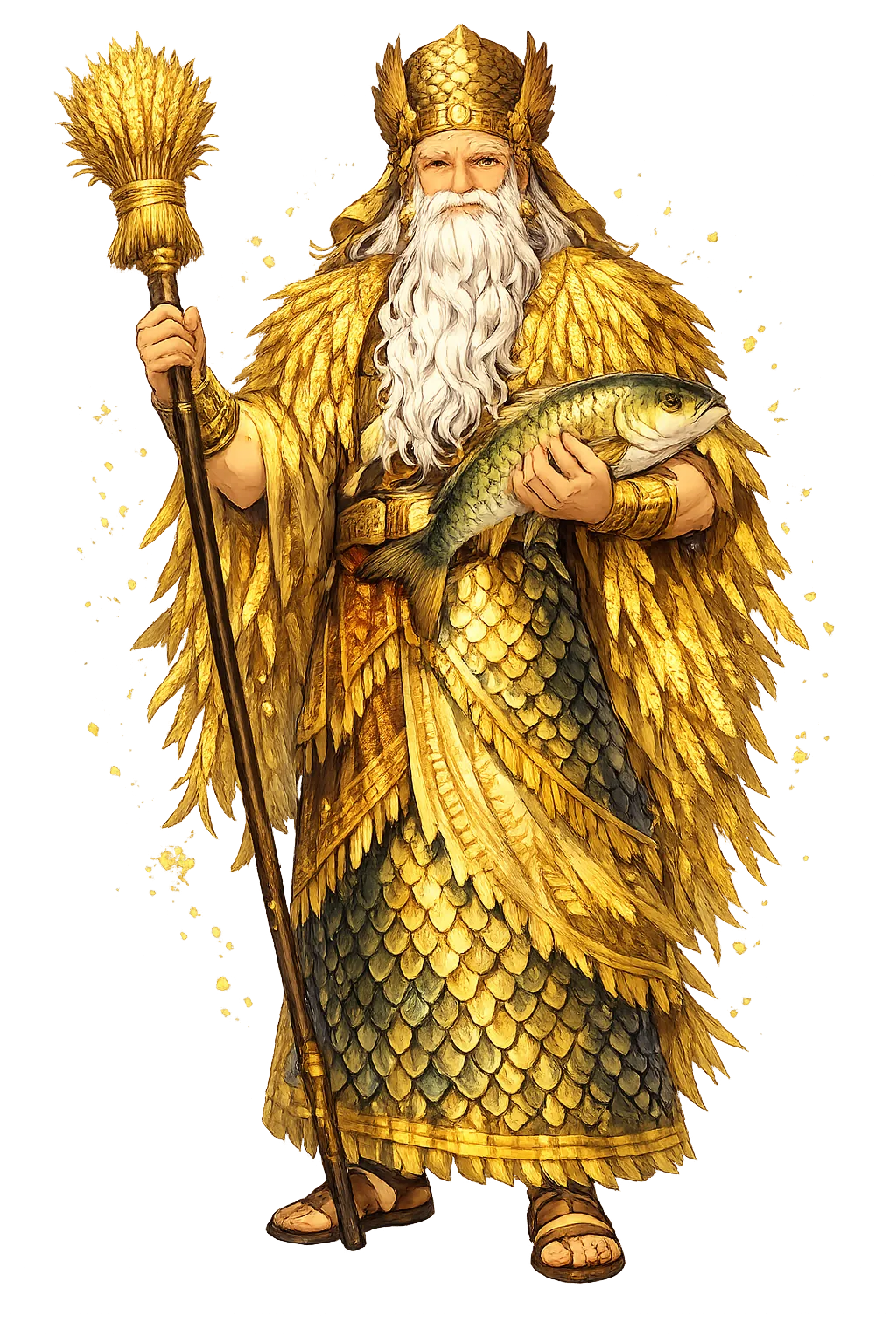
The working life of Dāgān: from the myths to the modern trades
The myths did not retire. They moved offices. This is the file on where Dāgān works now.
Dāgan is a father figure rather than a warrior. In the Ugaritic texts he receives offerings and grants blessings; in the Hebrew Bible he is a foreign god whose temple symbolizes Philistine power. His myths are few, but his cultural importance is immense: he is the god of the staple crop on which every Near Eastern society depended.
The pattern atlas — which maps every flagship temple to the industries its archetype demonstrably resonates with, each match argued and open to challenge — seats this temple in 4 industries. This file reads those seats the way they were earned: through the myths.
At a Glance
- Temple: Dāgān
- Pantheon: Phoenician
- Domain of influence: Grain, Fertility
- Pattern seats: 4
- Sectors touched: Energy & Natural World · Commerce & Governance · Culture & Entertainment
- Strongest seat: Agriculture, Food & Harvest
- Series: The Resonance Files, No. 60 of 271
The Myth at Work
Dāgan's Blessing. Ugaritic ritual texts record sacrifices and offerings to Dāgan, especially at the time of planting and harvest. In KTU 1. — hold that image; the industries below are where it goes to work.
Samson and the Temple of Dagon. Judges 16:23–30 describes the Philistine nobility gathering in the temple of Dagon at Gaza to offer a great sacrifice. They bring Samson to entertain them, but he prays for strength, seizes the two central pillars, and pulls the temple down upon himself and his captors. — hold that image; the industries below are where it goes to work.
The Seats
Each of these is argued in the atlas with a weight and a why-line. What the atlas cannot fit in one line is the whole myth — so here is each seat with its story restored.
Agriculture, Food & Harvest
Farming, grain, food production, and agtech. (Sector: Energy & Natural World)
The why-line says it in one breath: His name is the word for grain itself. That is not a resemblance; it is the same act, performed in a newer building.
Finance, Wealth & Commerce
Banking, investment, and commercial enterprise. (Sector: Commerce & Governance)
The granary’s surplus was the ancient world’s first stored wealth; his name is the commodity. Swap the costume and the sentence is indistinguishable from the myth. That is what a resonance seat means.
Gaming, Fantasy & Entertainment IP
Video games, streaming franchises, and fantasy worlds. (Sector: Culture & Entertainment)
The why-line says it in one breath: Lovecraft and a hundred RPGs made ‘Dagon’ a fish-god; the grain god’s strangest afterlife. That is not a resemblance; it is the same act, performed in a newer building.
Wine, Brewing & Hospitality
Vineyards, craft beverage, and hospitality venues. (Sector: Culture & Entertainment)
The why-line says it in one breath: Grain is the mash; the oldest brewed drink starts in his field. That is not a resemblance; it is the same act, performed in a newer building.
The Long Employment
Dāgan survives in the Bible as the Philistine god toppled by Samson, and his name echoes in the Hebrew word for grain. In modern fantasy and role-playing games, 'Dagon' often appears as a tentacled or fish-like sea monster, a distortion of the ancient grain god produced by medieval iconographic confusion. The age changed. The work did not.
The Method, Stated Plainly
The atlas is not a horoscope. Seats are earned from the sources — argued, weighted, published — and every one of them can be challenged at the methodology page. A match that cannot survive an argument does not survive review. That is the whole trick: the patterns are claims, and claims can be tested.
For the Ones Who Work There
If you work in agriculture, food & harvest, finance, wealth & commerce, or any trade this temple holds a seat in, this is the honest version of what a placement means: your industry beside the story it has been re-telling all along — on the temple floor itself, before an audience that came specifically to read it. The patron tier and the advertising terms describe the mechanics; the resonance above describes the fit.
The File Continues
One of 271 Resonance Files — the series where the pantheon goes to work. Read the founding dispatch for the name, the Restoration File for the spelling, or the whole archive end to end.
Continue the series — previous: Koîos (read it) · next: Dakṣa (read it).
The Resonance Files are argued from the same canonical record as the pattern atlas itself: the lexicon, the lore catalog, and the cited sources. Every seat can be challenged at the methodology page — and the challenge is the point.