
Why Dagda is spelled that way — and what it costs to get it right
There is a version of this name the early internet had to settle for: dagda. This is the file on how Dagda replaced it.
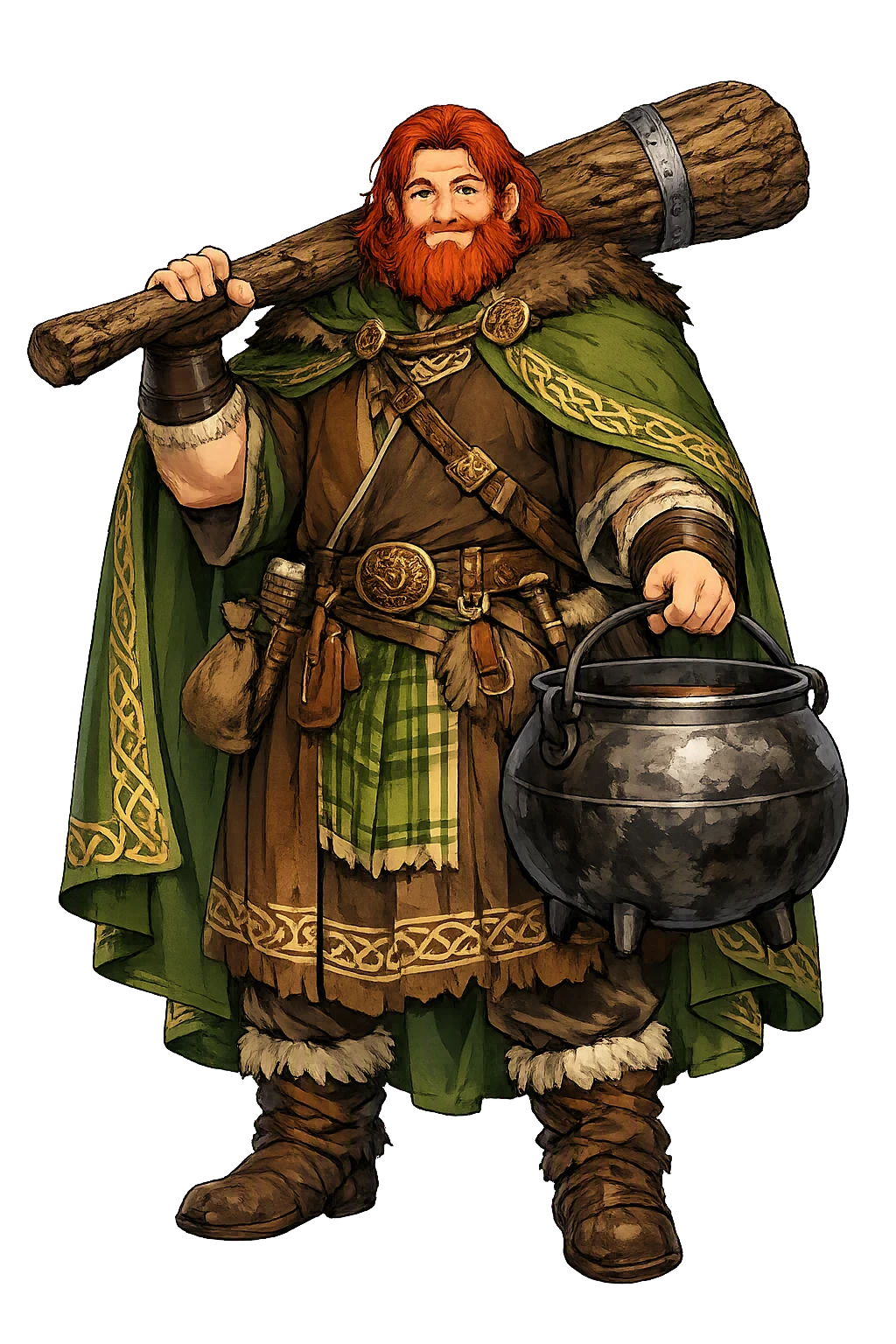
The Dagda's dossier is the largest of any Túatha Dé Danann god: he is king, laborer, glutton, lover, harper, and father, and Cath Maige Tuired gives him the war's two strangest set-pieces — the porridge pit before the battle and the harp on the enemy's wall after it.
At a Glance
- Restored name: Dagda
- ASCII form: dagda
- Meaning: "The Good God (from Old Irish Dagde)"
- Domain of influence: Abundance, Strength, Magic
- Pantheon: Celtic
- Classification: Tier 2
- Original script: —
- Series: The Restoration Files, No. 116 of 548
The Name Before the Marks
Spoken, the name runs `/ˈdaɣ.ða/` — 'DAH-ghah' — stress the first syllable; let the g melt into a voiced gargle and the d into the soft 'th' of 'this'. Modern Irish 'an Dagda' keeps the same shape.
The Temple That Stands Now
The restored name is not a plaque; it is an address. The temple of Dagda lives at /dagda/, with its mythology in the lore halls, its peer-reviewed record in the Scholarly Edition, and its place in the pattern atlas on the patterns floor.
One decisive feature survives — a single, honest mark — which places the restoration in Tier-2: exact, and exactly labeled.
Where the Name Stood First
The Dagda is a textual god: no ogham stone names him, no votive inscription invokes him, and Irish paganism generally left literature rather than dedications. His manuscript witnesses are exact — Cath Maige Tuired survives uniquely in the sixteenth-century British Library MS Harley 5280, which is the basis of Gray's edition, while Lebor Gabála Érenn is preserved in the Book of Leinster and its sister codices. His mythic address, by contrast, is one of the most famous pieces of architecture in Europe: Brú na Bóinne, the Bend of the Boyne, where the passage tomb of Newgrange (c. 3200 BCE) has stood for five thousand years on the site the tales call the Dagda's Brug and Óengus's síd. The nearest material kin of his iconography is Gaulish: the altar from Sarrebourg showing Sucellos with his mallet and pot beside Nantosuelta is the standard comparison for the good god with the club and the vessel — comparative evidence, never identification. The temple on the web is the newest of these addresses — the first one that fits in a pocket.
The Archetype at Work
The pattern atlas seats this temple in 3 industries, each match argued and weighted: Agriculture, Food & Harvest (the cauldron of plenty — the undryable pot that feeds multitudes; abundance personified.); Music, Arts & Performance (owner of the harp Uaithne — the three strains (grief, joy, sleep) are Irish music’s divine charter.); Leadership, Governance & Public Administration (father-figure and king of the Tuatha Dé Danann — eighty years of rule in the Lebor Gabála.). The Resonance File reads those seats through the myths themselves.
The File Continues
The temple's founding dispatch tells the name's story; its Resonance File reads the myths into the industries; the blog index holds the whole archive.
Continue the series — previous file: Dāgān (read it here) · next file: Dakṣa (read it here).
The Restoration Files are written from the same canonical record as the temples themselves: the lexicon, the lore catalog, the pattern atlas, and the cited scholarly sources. If a file ever disagrees with its temple, the temple is right — tell us, and the file will be corrected.