
Why Dāgān is spelled that way — and what it costs to get it right
There is a version of this name the early internet had to settle for: dagan. This is the file on how Dāgān replaced it.
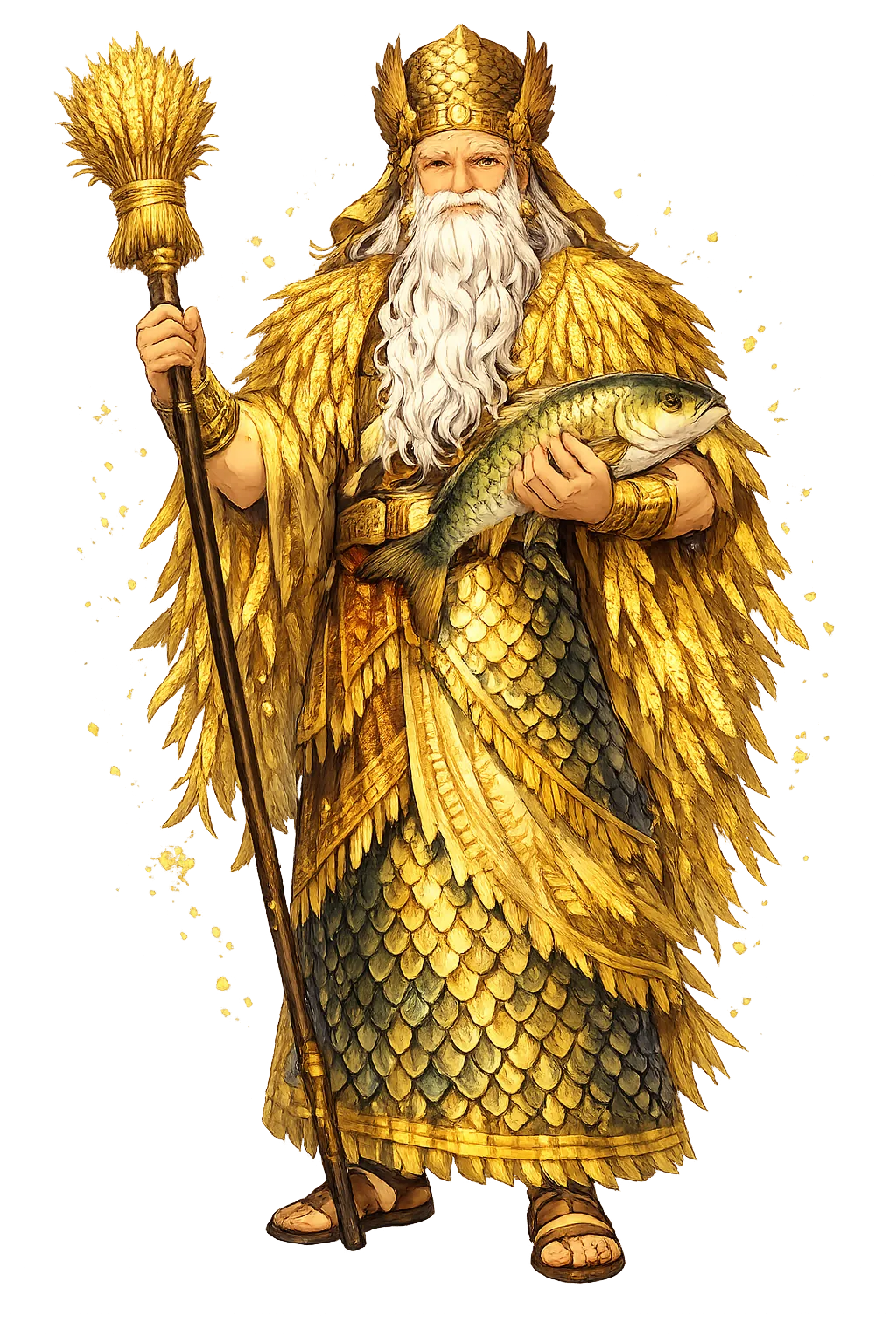
Dāgan is a father figure rather than a warrior. In the Ugaritic texts he receives offerings and grants blessings; in the Hebrew Bible he is a foreign god whose temple symbolizes Philistine power. His myths are few, but his cultural importance is immense: he is the god of the staple crop on which every Near Eastern society depended.
At a Glance
- Restored name: Dāgān
- ASCII form: dagan
- Meaning: "Grain"
- Domain of influence: Grain, Fertility
- Pantheon: Phoenician
- Classification: Tier 1
- Original script: 𐤃𐤂𐤍
- Series: The Restoration Files, No. 60 of 271
The Name Before the Marks
Strip Dāgān to dagan and 2 pieces of evidence vanish:
- a → ā — Macron: long /aː/: the vowel length the ASCII form cannot show.
- a → ā — Macron: long /aː/ (Dāgān): the vowel length the ASCII form cannot show.
None of these marks is decoration. Each one is a fact about how the name was spoken, and each one is checkable against the scholarly record the temple cites.
Spoken, the name runs `/daːˈɡaːn/` — dAH-ghan — both the first 'a' is long like 'father,' and the second 'a' is short; stress falls on the long first syllable.
The Temple That Stands Now
The restored name is not a plaque; it is an address. The temple of Dāgān lives at /sites/dagan/, with its mythology in the lore halls, its peer-reviewed record in the Scholarly Edition, and its place in the pattern atlas on the patterns floor.
What survives here cannot be shown in ASCII: a feature of the original that the fallback alphabet flattens. That is the Tier-1 test, and this name passes it without argument.
Where the Name Stood First
A major temple to Dāgan has been identified at Ugarit, and references to his cult appear throughout the Ugaritic tablets. The Mari archives from the Euphrates valley record royal offerings and divine messages involving Dāgan. In the Levant, Philistine sites such as Tel Miqne (Ekron) and Gaza preserve material culture associated with his cult, though the biblical story of Samson's destruction of Dagon's temple cannot be verified archaeologically. The later 'fish-god' Dagon is a medieval iconographic development without ancient Near Eastern support. The temple on the web is the newest of these addresses — the first one that fits in a pocket.
The Archetype at Work
The pattern atlas seats this temple in 4 industries, each match argued and weighted: Agriculture, Food & Harvest (his name is the word for grain itself.); Finance, Wealth & Commerce (the granary’s surplus was the ancient world’s first stored wealth; his name is the commodity.); Gaming, Fantasy & Entertainment IP (lovecraft and a hundred RPGs made ‘Dagon’ a fish-god; the grain god’s strangest afterlife.). The Resonance File reads those seats through the myths themselves.
The File Continues
The temple's founding dispatch tells the name's story; its Resonance File reads the myths into the industries; the blog index holds the whole archive.
Continue the series — previous file: Koîos (read it here) · next file: Dakṣa (read it here).
The Restoration Files are written from the same canonical record as the temples themselves: the lexicon, the lore catalog, the pattern atlas, and the cited scholarly sources. If a file ever disagrees with its temple, the temple is right — tell us, and the file will be corrected.