
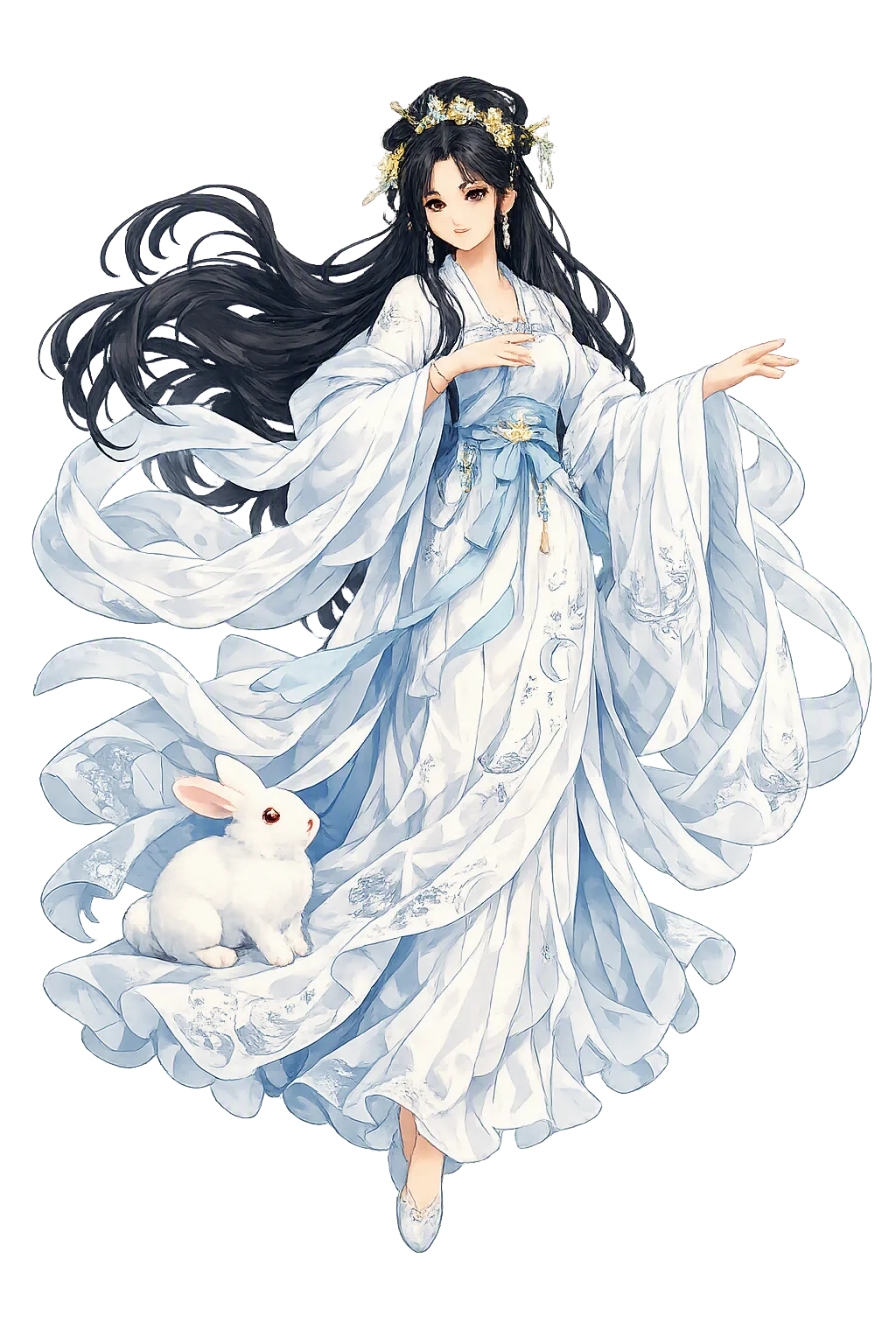
Cháng'é walks into a space, astronomy & celestial science firm
Somewhere right now, in a space, astronomy & celestial science office, someone is doing exactly what the myths describe — and has never heard of Cháng'é. This file is the introduction.
Before the Office, the Story
The Elixir of Immortality. The core myth, fixed in the Huáinánzǐ (c. 2nd century BCE), begins with the archer Hòuyì, who had shot down nine of the ten suns and so received from Xīwángmǔ, Queen Mother of the West, the elixir of immortality. Cháng'é took it and floated up to the moon, where she became its goddess.
From Héng'é to Cháng'é. The goddess was originally 姮娥 Héng'é. Under the Han, her name was altered to avoid the naming taboo on the personal name of Emperor Wen, Liú Héng 劉恆: the graph 姮 was replaced by the synonymous 常, and Héng'é became Cháng'é. It is a rare case where imperial censorship is legible inside a divine name itself — a goddess renamed so that a mortal emperor's name could remain unspoken.
At a Glance
- Temple: Cháng'é
- Pantheon: Chinese
- Domain of influence: Moon, Immortality, Mid-Autumn
- Pattern seats: 3
- Sectors touched: Technology & Innovation · Society & Spirit · Home & Lifestyle
- Strongest seat: Space, Astronomy & Celestial Science
- Series: The Resonance Files, No. 56 of 287
The Reveal, Seat by Seat
Space, Astronomy & Celestial Science
Now read the why-line with the office in mind: China's lunar exploration program flies her name — the Chang'e orbiters and sample-return landers are the moon goddess made mission architecture. The people doing this work did not borrow the archetype. They re-derived it — the way Cháng'é was always going to be re-derived wherever moon, immortality, mid-autumn matters.
Faith & Spiritual Organizations
The Mid-Autumn moon altar is still set for her each year — mooncakes, incense, and the goddess in the full moon. Nobody in that trade worships at this temple. They just keep its hours.
Food & Hospitality
The mooncake is her festival's edible icon — an entire pastry economy rises with her moon each autumn. Nobody in that trade worships at this temple. They just keep its hours.
Not the First Rebrand
The rabbit in the moon is older than any single nation's telling of it. Buddhist tradition carried the śaśajātaka — the tale of the rabbit who offered itself as food and was set in the moon as a reward — from India into East Asia, and scholars commonly link the Chinese moon rabbit to this transmission, though the Jade Rabbit's elixir-pounding is China's own elaboration. The office is only the latest translation.
The Method, Stated Plainly
Skeptical? Good — the system is built for you. Every seat in this file carries its why-line and its weight, the full derivation is public at the methodology page, and the challenge process is part of the design. Falsifiable is not a posture here; it is the mechanism.
For the Ones Who Work There
For a sponsor in space, astronomy & celestial science, the fit here is not adjacency — it is inheritance. Your trade already tells this story every working day; the temple simply holds the original. The patron tier and the advertising terms carry the mechanics; the myths above carry the reason.
The File Continues
This is one of 287 Resonance Files — the third dispatch from every flagship temple, where the myths meet the markets. The temple's founding dispatch tells the name's story; its Restoration File tells the spelling's; the blog index holds the whole archive.
Continue the series — previous: Cerēs (read it) · next: Cháos (read it).
The Resonance Files are argued from the same canonical record as the pattern atlas itself: the lexicon, the lore catalog, and the cited sources. Every seat can be challenged at the methodology page — and the challenge is the point.