
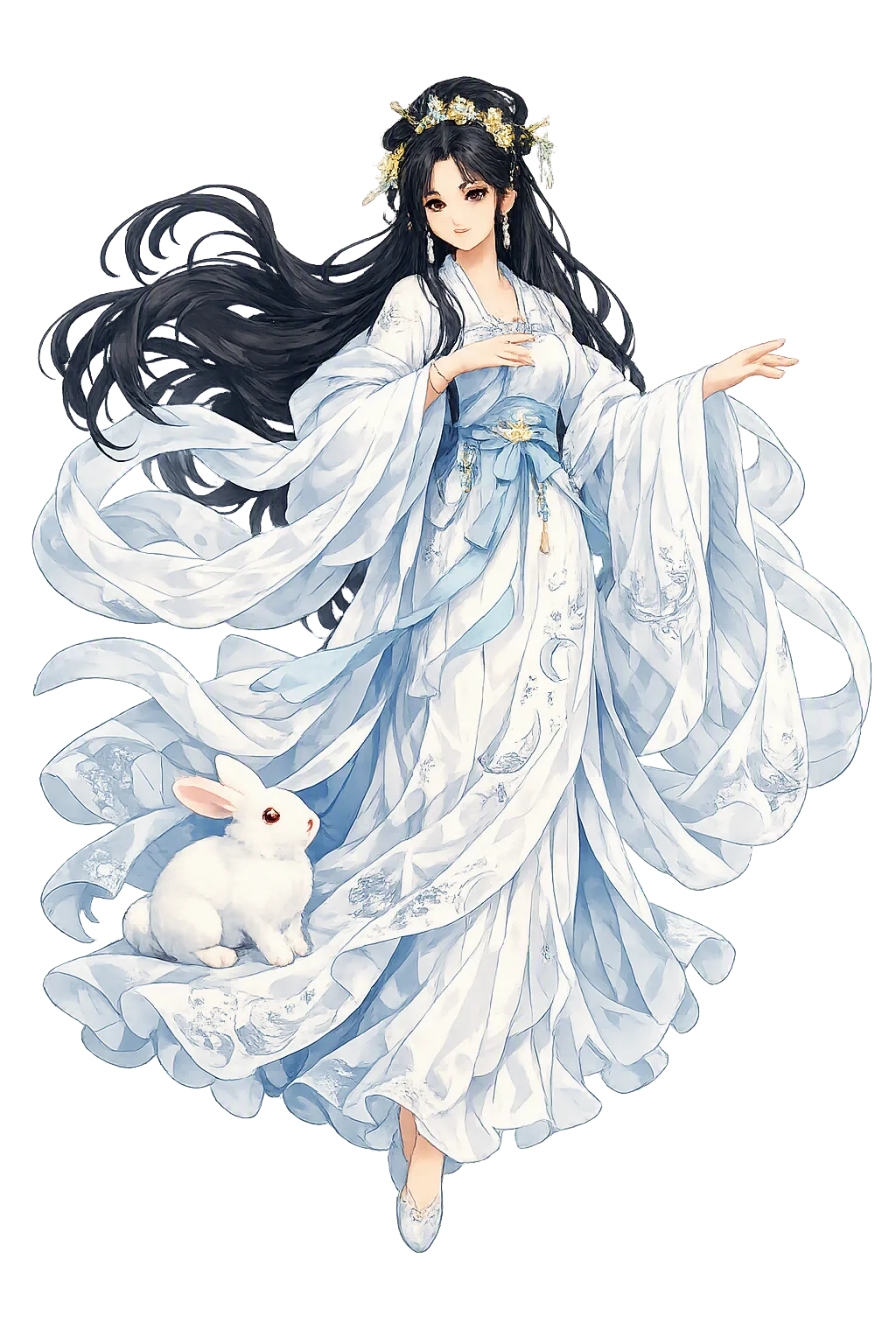
The name Cháng'é and the world it opens
A name is a door. Cháng'é opens onto an entire world: the domain of moon, immortality, mid-autumn, a Chinese tradition, and centuries of storytelling, worship, and scholarship. This post walks through that world room by room — the name and its roots, the original script, the sound of it, the myths, the symbols, the sites, the afterlife across cultures — and ends at the newest room of all: a Unicode domain that makes the whole structure addressable. change gets you to the same building, but only the restored form tells you why it was built.
At a Glance
- Restored name: Cháng'é
- ASCII form: change
- Meaning: "The Moon goddess who drank the elixir of immortality"
- Domain of influence: Moon, Immortality, Mid-Autumn
- Pantheon: Chinese
- Classification: Tier 1
- Original script: 嫦娥 (Chinese characters)
- Live domain: chángé.com
Overview
Cháng'é (change) — Moon, Immortality, Mid-Autumn · The Moon goddess who drank the elixir of immortality — belongs to the Chinese tradition, where it is catalogued under the domain "Moon, Immortality, Mid-Autumn". The name means "The Moon goddess who drank the elixir of immortality".
Cháng'é is the woman who swallowed forever and paid for it with the earth. Wife of the archer Hòuyì, who shot nine suns out of the sky, she came into possession of the elixir of immortality — a gift of the Queen Mother of the West, Xīwángmǔ — and drank it. Whether she acted to keep the drug from a treacherous disciple or out of her own longing, the sources divide; what they agree on is the result: her body grew light, the ground let go of her, and she rose through the night until the moon received her. There she remains, the goddess of the cold luminary, in the Guǎnghán Palace — the Palace of Vast Cold.
She is not alone up there. The Jade Rabbit stands beside her, pounding the elixir with mortar and pestle, and the woodcutter Wú Gāng swings his axe at a cassia tree that heals each wound as it is struck. Once a year, at the full moon of the eighth month, all of China looks up at her: the Mid-Autumn Festival, when families reunite, mooncakes are cut, and the distance between heaven and earth is measured in shared light.
PuniCodex restores the name as Cháng'é and serves its temple at chángé.com. The restoration preserves at least one distinctive feature — a diacritic or a distinctive letter — that the ASCII form loses, and exactly one historically valid Unicode restoration exists, which places the name in Tier 1. The plain ASCII form change survives as a modern convenience imposed by the early domain-name system; the restoration, not the fallback, is the form the project defends as philologically complete.
The Name
The name is attested in Chinese characters as 嫦娥. Etymologically it means "The Moon goddess who drank the elixir of immortality".
The ASCII form change survives only because the early domain-name system could not carry diacritics; it is a technological compromise, not an ancient spelling. The Unicode restoration Cháng'é recovers the stress accent of the original directly in the address bar. The restoration preserves at least one distinctive feature — a diacritic or a distinctive letter — that the ASCII form loses, and exactly one historically valid Unicode restoration exists, which places the name in Tier 1.
The letter-by-letter transformation runs:
- c → C — Same, capitalized
- h → h — Same
- a → á — Stress on a
- n → n — Same
- g → g — Same
- e → é — Stress on e
The project holds the domain chángé.com (xn--chng-6na4c.com) as the canonical home of this name.
The Original Script
The name is written in Chinese characters as 嫦娥. This original script is the form against which the ASCII fallback change and the PuniCodex restoration Cháng'é are measured: the restoration preserves its pitch accent of the written form, so that a reader typing the modern address still speaks the ancient name.
The original script is 嫦娥, written identically in traditional and simplified Chinese; the earlier form of the name is 姮娥, altered under the Han naming taboo on Emperor Wen's personal name. Pinyin Cháng'é (Tone 2 + Tone 2) is the Modern Standard Mandarin reading, recorded in the Unihan Database and standard dictionaries. The apostrophe is part of standard Hanyu Pinyin orthography, separating the two syllables so the name cannot be misread as a single syllable or wrongly divided; the display form Cháng'é keeps it, while the registrable domain label drops it, since IDN labels cannot contain an apostrophe — the tone-marked vowels alone carry the restoration into the domain system.
Pronunciation
The reconstructed pronunciation of the name is /ʈʂʰaŋ˧˥ ɤ˧˥/ — Modern Standard Mandarin (Pinyin).
Phoneme by phoneme:
- cháng — Syllable with aspirated retroflex affricate [ʈʂʰ] (tongue curled back, strongly aspirated), final [aŋ] (open central vowel + velar nasal), and Tone 2 (rising, ˧˥).
- é — Open syllable with close-mid back unrounded vowel [ɤ] and Tone 2 (rising, ˧˥). Pinyin 'e' in isolation corresponds to IPA [ɤ].
For the modern speaker, the closest approximation is: CHAHNG-UH — both syllables rise in tone, as in a questioning intonation; 'ch' is an aspirated retroflex with the tongue curled back, and 'é' is close to the vowel of 'her' with the r removed.
Kindred and historical forms of the name:
- Traditional — 嫦娥
- Simplified — 嫦娥
- Wade-Giles — Ch'ang²-o²
- Cantonese — soeng⁴ ngo⁴
- Former name — 姮娥 Héng'é (Wade-Giles Heng²-o²)
- Related terms — 廣寒宮 Guǎnghán Gōng (Palace of Vast Cold); 玉兔 Yùtù (Jade Rabbit); 中秋節 Zhōngqiūjié (Mid-Autumn Festival)
嫦娥 denotes the Chinese goddess of the moon. The Modern Standard Mandarin reading is Cháng'é — cháng (Tone 2) and é (Tone 2) — as recorded in the Unihan Database (Unicode Consortium, kMandarin) and standard Mandarin dictionaries. The goddess's earlier name was 姮娥 Héng'é; under the Han it was altered to Cháng'é to observe the naming taboo on the personal name of Emperor Wen (Liú Héng 劉恆), the graph 常 cháng ('constant') replacing the tabooed homophone 姮 héng. The tone-marked Pinyin restoration Cháng'é preserves the citation rising tone on both syllables; in connected speech the contour may be compressed, but the lexical tones remain Tone 2.
Mythology
Cháng'é's story is short and inexhaustible: one ascent, endlessly retold. The early sources preserve a bare skeleton — an elixir, a flight, a moon — and two thousand years of poets, painters, and festival-goers have hung their longing on it.
The Elixir of Immortality (Huainanzi)
The core myth, fixed in the Huáinánzǐ (c. 2nd century BCE), begins with the archer Hòuyì, who had shot down nine of the ten suns and so received from Xīwángmǔ, Queen Mother of the West, the elixir of immortality. Cháng'é took it and floated up to the moon, where she became its goddess. The sources divide on her motive: in some versions she drinks to keep the elixir from Féngméng, Hòuyì's treacherous disciple; in others she drinks out of her own longing for deathlessness. Scholarship preserves both strands rather than adjudicating between them — the myth holds theft and sacrifice in suspension.
From Héng'é to Cháng'é (Naming Taboo)
The goddess was originally 姮娥 Héng'é. Under the Han, her name was altered to avoid the naming taboo on the personal name of Emperor Wen, Liú Héng 劉恆: the graph 姮 was replaced by the synonymous 常, and Héng'é became Cháng'é. It is a rare case where imperial censorship is legible inside a divine name itself — a goddess renamed so that a mortal emperor's name could remain unspoken.
The Jade Rabbit and the Woodcutter (Lunar Folklore)
Her court on the moon is small and eternal. The Jade Rabbit (玉兔) stands at her side, pounding the elixir of immortality with mortar and pestle — the same work, night without end. Beside the palace grows a cassia tree that heals every wound the moment it is struck; the woodcutter Wú Gāng was condemned to fell it, and so he chops forever at a trunk that will not fall. Companionship, labor, and futility share one silver landscape.
The Mid-Autumn Moon (Festival)
At the full moon of the eighth lunar month, China keeps the Mid-Autumn Festival (中秋節). Families gather, mooncakes are cut into wedges like the phases returning to round, and eyes turn upward to the brightest moon of the year — to her. The festival reads her exile backward: the goddess who can never come home becomes the patroness of everyone who can.
Symbols & Iconography
The iconography associated with Cháng'é concentrates in a small set of recurring attributes, each a compressed statement about the name:
- The full moon — Her dwelling and her face; completeness, distance, and the reunion it mirrors
- The Jade Rabbit — Her companion (玉兔), who pounds the elixir of immortality with mortar and pestle — labor without end in her service
- Mortar and pestle — The ceaseless preparation of the elixir she carried to heaven
- The cassia tree — The self-healing tree Wú Gāng chops forever beside her palace — punishment and persistence in a single image
- The mooncake — The round pastry of Mid-Autumn, cut and shared as an edible likeness of the moon she rules
Archaeology & Evidence
The flight to the moon is attested remarkably early. An early version of the story circulated in the Guǐcáng (歸藏), a divination text known from medieval quotations and from Qin-dynasty bamboo slips excavated at Wangjiatai in Hubei (tomb closed c. 3rd century BCE), in which Héng'é takes the elixir and ascends. The Huáinánzǐ (c. 139 BCE) gives the first full surviving account. Pictorial evidence is nearly as old: the painted silk funeral banner from Mawangdui Tomb 1 (sealed 168 BCE) depicts the moon disk with its toad and rabbit, and Han pictorial stones — notably from the Nanyang region — show Cháng'é in flight toward the moon, her robes streaming. Later dynasties rendered her on mirrors, ceramics, and festival prints, and moon-gazing scenes became a staple of Ming and Qing painting.
Realm & Domain
Cháng'é is the woman who swallowed forever and paid for it with the earth. Wife of the archer Hòuyì, who shot nine suns out of the sky, she came into possession of the elixir of immortality — a gift of the Queen Mother of the West, Xīwángmǔ — and drank it. Whether she acted to keep the drug from a treacherous disciple or out of her own longing, the sources divide; what they agree on is the result: her body grew light, the ground let go of her, and she rose through the night until the moon received her. There she remains, the goddess of the cold luminary, in the Guǎnghán Palace — the Palace of Vast Cold.
She is not alone up there. The Jade Rabbit stands beside her, pounding the elixir with mortar and pestle, and the woodcutter Wú Gāng swings his axe at a cassia tree that heals each wound as it is struck. Once a year, at the full moon of the eighth month, all of China looks up at her: the Mid-Autumn Festival, when families reunite, mooncakes are cut, and the distance between heaven and earth is measured in shared light.
The Moon
Her dwelling and her domain; the full moon of Mid-Autumn is read as her face, brightest and roundest when mortal eyes seek reunion.
The Archer Hòuyì
Her husband, who shot down nine of the ten suns and received the elixir of immortality from Xīwángmǔ — the gift that divided them forever.
The Palace of Vast Cold
The Guǎnghán Palace (廣寒宮), her luminous and solitary court on the moon, shared with the Jade Rabbit and the woodcutter Wú Gāng.
Reunion under the Full Moon
The Mid-Autumn Festival (中秋節): mooncakes, moon-gazing, and the gathering of families — the night her separation sanctifies mortal togetherness.
Across Cultures
The rabbit in the moon is older than any single nation's telling of it. Buddhist tradition carried the śaśajātaka — the tale of the rabbit who offered itself as food and was set in the moon as a reward — from India into East Asia, and scholars commonly link the Chinese moon rabbit to this transmission, though the Jade Rabbit's elixir-pounding is China's own elaboration. Taoist religion absorbed Cháng'é into its celestial bureaucracy, where she is often identified with the sovereign of the yin luminary (太陰). Japan received the moon rabbit without the elixir: there he pounds mochi instead, and the autumn moon-viewing custom (tsukimi) echoes Mid-Autumn without keeping its goddess. Korea's harvest festival Chuseok and Vietnam's Tết Trung Thu share the same full-moon night of cakes, lanterns, and family gathering — the festival traveled further than the myth, and in each harbor took local form.
Within the Chinese tradition, closely related names in the corpus include Bāguà, Fúxī, Guāndì, Guānyīn, Hòuyì, and Lóng.
Cultural Legacy
Cháng'é has been China's shorthand for beautiful distance since the poets claimed her. Sū Shì's Mid-Autumn lyric closes with the wish that, though a thousand miles apart, we may share chánjuān 嬋娟 — the lovely one, the moon, her. The Mid-Autumn Festival remains one of the great holidays of the Chinese world, and the mooncake its edible emblem. In 2020 the animated film Over the Moon carried her to global audiences as a pop-diva goddess still waiting for Hòuyì. Most remarkably, she has gone back: China's lunar exploration program is named for her, and the probes Cháng'é 1 through 6 (2007–2024) orbited the moon, landed on it, achieved the first landing on its far side (Cháng'é 4), and returned samples to earth (Cháng'é 5 and 6). No other deity in this lexicon has been so literally restored to her own heaven.
The Scholarly Record
The account of Cháng'é given in this edition rests on the witnesses and reference works listed below. Lexica and etymological dictionaries secure the form and meaning of the name; the literary and religious texts supply the narrative evidence.
- Huainanzi, Liu An; Chinese Text Project, 139 BCE. Full text
- Shanhaijing (Classic of Mountains and Seas). Full text
- Werner, Myths and Legends of China (1922). Full text
- Chang'e — Encyclopaedia Britannica. Full text
- Chang'e — Wikipedia. Full text
- Mid-Autumn Festival — Wikipedia. Full text
- Chinese Lunar Exploration Program — Wikipedia. Full text
- Unihan Database (Unicode Consortium). Full text
A Meditation
Cháng'é teaches that every ascent is also a departure. She took the one thing everyone is told to want — endless life — and found that it cost the one thing that makes life bearable: the person she left below. The myth refuses to resolve her motive, and that refusal is its honesty; we have all swallowed things half in longing and half in self-defense, and only later learned which. Her moon is the most beautiful object in the Chinese night precisely because it is the far side of reunion — the light by which the separated recognize one another.
To name a domain Cháng'é is to claim that paradox: the cold palace and the warm festival, the exile and the homecoming, the goddess who cannot return and the probes that returned for her. It is a name for anyone who understands that distance is not the opposite of devotion but, too often, its price.
The Unicode Restoration
Cháng'é is classified as Tier 1: the restoration preserves at least one distinctive feature — a diacritic or a distinctive letter — that the ASCII form loses. The ASCII fallback change still resolves everywhere, but it is the restored form that carries the name's full information. Across the 6 characters of the name, the restoration adjusts 2: 2 marks of stress (á, é). That is the whole thesis of this temple: the marks are the message.
The Domain Name
The restored name is live as a working domain: chángé.com, which the DNS carries in punycode form as xn--chng-6na4c.com — an ASCII-compatible encoding that lets a non-ASCII name travel the global network without breaking older infrastructure. The visitor sees Cháng'é; the machines see the encoding. That duality is the engineering compromise on which the entire restoration rests, and it is why a name written the way its own tradition wrote it in Chinese characters can now be typed into any browser on earth.
Why This Restoration Matters
A door only matters if people walk through it. chángé.com is open, and everything behind it — the myths, the scholarship, the canvas, the patrons — hangs on the restored spelling. The PuniCodex project bets that the web will make room for names as they were actually written, and Cháng'é is one of its standing proofs. Visit, share, cite, type it yourself: each use is a small rehearsal for a web where no name has to hide its marks to be found.
Explore Further
This post is one doorway into the temple. The home page carries the full character breakdown and the ambient canvas; the lore page tells the myths in long form; the Scholarly Edition preserves the sources, pronunciation data, and revision history; and the patron wall supports the restoration directly. For the wider map, browse the Lexicon, explore the Pantheon, or return to the PuniCodex blog.
Related Names
Sources
The full scholarly apparatus — every citation, revision, and review — lives in the Scholarly Edition. Key references for this post:
- Huainanzi, Liu An; Chinese Text Project, 139 BCE.
- Shanhaijing (Classic of Mountains and Seas).
- Werner, Myths and Legends of China (1922).
- Chang'e — Encyclopaedia Britannica.
- Chang'e — Wikipedia.
- Mid-Autumn Festival — Wikipedia.
- Lexicon authorities for this entry: Huainanzi, Chinese folklore.