
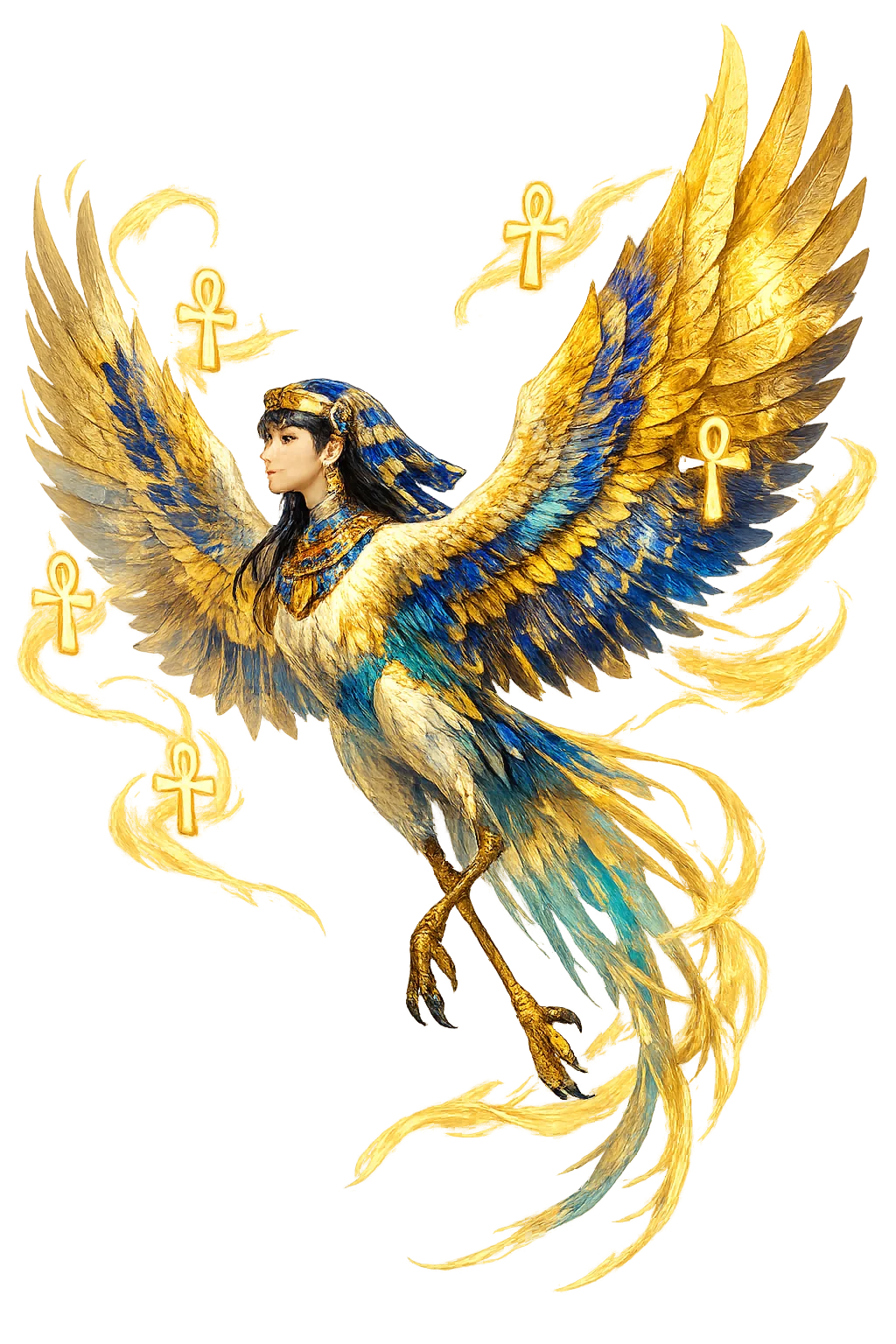
Bꜣ, spelled the way the sources wrote it
There is a version of this name the early internet had to settle for: ba. This is the file on how Bꜣ replaced it.
The bꜣ enters literature as a fully formed theological concept in the Pyramid Texts and remains central through the Coffin Texts and the Book of the Dead. Its mythology is not a single story but a set of possibilities: the ba may ascend, return, lament, or be transformed, depending on the rites performed for it. Egyptian anthropology is relational and composite. The most widely cited 'five components' are the ka (vital double, life-force sustained by offerings), the ba (mobile personality), the akh (transfigured effective spirit achieved after judgment), the ren (name, the marker of identity), and the sheut (shadow, the protective silhouette).
That is the figure this file is about — and the temple now standing at its restored name.
At a Glance
- Restored name: Bꜣ
- ASCII form: ba
- Meaning: "The soul, personality, or manifestation of a person. One of the five components of the Egyptian soul."
- Domain of influence: Soul, Personality, Manifestation
- Pantheon: Egyptian
- Classification: Tier 1
- Original script: 𓅡𓏤
- Series: The Restoration Files, No. 47 of 271
The Name Before the Marks
Bꜣ preserves its form without added diacritics: the restoration here is the exactness of the spelling itself, the form the tradition's own sources record. ba and Bꜣ may look interchangeable to a search box; they are not interchangeable to a philologist.
The Temple That Stands Now
The restored name is not a plaque; it is an address. The temple of Bꜣ lives at /sites/ba/, with its mythology in the lore halls, its peer-reviewed record in the Scholarly Edition, and its place in the pattern atlas on the patterns floor.
The restoration preserves more than the ASCII form can say — stress, length, or a letter the Latin keyboard lost — which places it in Tier-1: mechanically verifiable, information-rich.
Every flagship temple is hand-built to the same standard: the original script displayed with its provenance, the pronunciation reconstructed phoneme by phoneme, the sources named — because a restoration you cannot audit is just a spelling with confidence.
The Archetype at Work
A temple is also a reading of what this figure means — and meanings have addresses in the modern world. The pattern atlas maps Bꜣ to the industries its archetype genuinely resonates with, each match argued, weighted, and open to challenge:
- Funerary & Memorial Services — The soul’s journey; personality beyond the tomb.
- Aviation & Aerospace — The human-headed bird that flies between worlds; the soul's native motion is flight.
- Mental Health & Emotional Wellness — Personality itself; modern psychology found in the ba its precedent for layered personhood.
The mapping is conservative on purpose: only resonances that can be argued aloud. The rest of the atlas follows the same rule, industry by industry.
In the Sacred Texts
The Egyptian tradition is not a vibe; it is a library. The Sacred Texts collection holds The Book of the Dead — the primary sources the temple's scholarship is built on, free to read, cross-linked back to the names they mention. The temple is the argument; the texts are the evidence.
The File Continues
This is one of 271 Restoration Files — a second dispatch from every flagship temple in the fleet. The temple's first dispatch tells the founding story of the name; the blog index holds the whole archive.
Continue the series — previous file: Átropos (read it here) · next file: Baꜥal (read it here).
The Restoration Files are written from the same canonical record as the temples themselves: the lexicon, the lore catalog, the pattern atlas, and the cited scholarly sources. If a file ever disagrees with its temple, the temple is right — tell us, and the file will be corrected.