
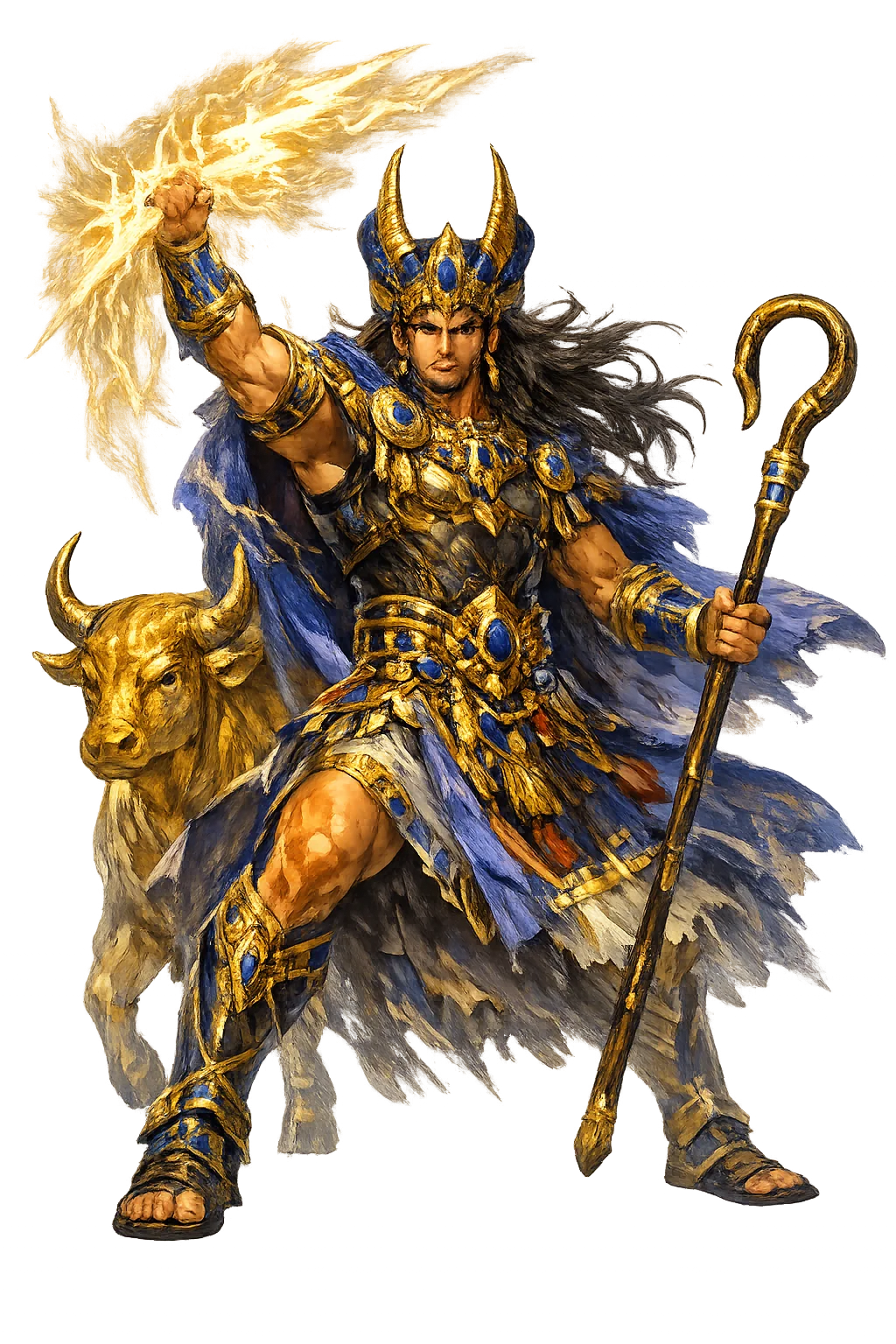
The hidden history behind Baꜥal
Behind the modern ASCII form baal hides a much longer story. Baꜥal reaches back through manuscripts, inscriptions, and oral tradition long before it ever touched a keyboard, and every mark in the restored spelling is a receipt from that journey. In what follows we trace the name from its Ugaritic attestations through its mythology, its cult, its symbols, and its afterlife in other cultures — and we show how the PuniCodex project turned that philological record into a Unicode domain that resolves today. The history was never lost. It was only waiting for the infrastructure to catch up.
At a Glance
- Restored name: Baꜥal
- ASCII form: baal
- Meaning: "Canaanite storm and fertility god; the title "Lord" (baʿlu) was also applied to local deities"
- Domain of influence: Storm God, Lord of the Heavens
- Pantheon: Canaanite
- Classification: Tier 2
- Original script: 𐎁𐎓𐎍 (Ugaritic)
- Live domain: baꜥal.com
Overview
Baꜥal (baal) — Rider of the Clouds · Lord of the Storm — is the storm and fertility god of the Canaanite pantheon, catalogued in this edition under the domain "Storm God, Lord of the Heavens." The name began as a title — baʿlu, "lord," a word applied to many local deities — and became at Ugarit the proper name of one god above all others.
Baꜥal is the storm made king. In a land where rain is life and drought is death, he is the deity who rides the clouds, shatters the sea-monster, and opens his palace windows so that the rains may fall. He is young, vigorous, and hungry for a throne — yet even his kingship depends on the older god Ēl. The Baꜥal Cycle is the great myth of his rise, death, and return.
PuniCodex restores the name as Baꜥal and serves its temple at baꜥal.com. The restoration preserves the voiced pharyngeal ʿayin — the signature consonant of the name — through the Egyptological Ain (ꜥ, U+A724), the only DNS-registrable stand-in for a sound the Latin alphabet never had; this single distinctive phoneme, carried without stress or length mark, places the name in Tier 2. The ASCII baal doubles the vowel and loses the throat entirely.
The Name
The name is attested in Ugaritic as 𐎁𐎓𐎍. Etymologically it means "Canaanite storm and fertility god; the title "Lord" (baʿlu) was also applied to local deities".
The reconstructed proto-form is baʿl- (proto-afro-asiatic, "lord, owner, husband"). From Common Semitic baʿlu, "lord"; the pharyngeal is written with Egyptian Ain (ꜥ) as the only registrable Unicode workaround
Cognate forms across related languages:
- בַּעַל (Baʿal) (Hebrew)
- 𐤁𐤏𐤋 (Bʿl) (Phoenician)
- بَعْل (Baʿl) (Arabic)
The ASCII form baal survives only because the early domain-name system could not carry diacritics; it is a technological compromise, not an ancient spelling. The Unicode restoration Baꜥal recovers the full diacritic detail of the scholarly transliteration directly in the address bar. The original preserves one prosodic feature — stress or vowel length — rather than both, which places the name in Tier 2.
The letter-by-letter transformation runs:
- b → B — Capital beta
- a → a — Same
- a → ꜥa — Egyptian Ain (ꜥ) used as the only DNS-registrable stand-in for Semitic ʿayin, followed by the vowel present in the Unicode restoration
- l → l — Same
Attested and derived spellings of the name:
- Baʿal — ideal form: Ugaritic/Phoenician ʿayin (ʿ) is the ideal consonant, but is rejected by the DNS root zone
- baꜥal — owned form: Lowercase owned form
- Baál — scholarly variant: Stress-only alternate transliteration (previous Phoenician entry)
The project holds the domain baꜥal.com (xn--baal-re8o.com) as the canonical home of this name.
Etymology & Roots
The recorded derivation reads: From Common Semitic baʿlu, "lord"; the pharyngeal is written with Egyptian Ain (ꜥ) as the only registrable Unicode workaround
The reconstructed proto-form is *baʿl- (proto-afro-asiatic), glossed as "lord, owner, husband".
The reconstruction is classed as attested.
Kindred forms recorded in the lexicon:
- בַּעַל (Baʿal) (Hebrew) — cognate
- 𐤁𐤏𐤋 (Bʿl) (Phoenician) — cognate
- بَعْل (Baʿl) (Arabic) — cognate
The Original Script
The name is preserved in Ugaritic as 𐎁𐎓𐎍 — Northwest Semitic cuneiform alphabet, attested Late Bronze Age, c. 1400–1200 BCE, in Ugarit (modern Ras Shamra, Syria). The script is written left-to-right.
The scholarly transliteration is Baꜥal (Ugaritic alphabetic cuneiform), giving the normalized reading /ˈbaʕlu/.
The rendering proceeds step by step:
- The name is written 𐎁𐎓𐎍 in the Ugaritic cuneiform alphabet.
- Ugaritic ʿayin is rendered with Egyptological Ain (ꜥ) for DNS registrability.
- Long vowels are reconstructed from Hebrew and Akkadian cognates and marked with macrons.
- The Unicode restoration Baꜥal is registrable in .com; the Ugaritic cuneiform form is not supported in the .com IDN table.
Ugaritic writes the name 𐎁𐎓𐎍 (b-ʿ-l), literally 'lord.' The middle sign is ʿayin, a voiced pharyngeal fricative. Because Semitic ʿayin is blocked at the DNS root, PUNICODEX renders it with the Egyptological Ain (ꜥ / U+A724). In many contexts the name is an appellative rather than a personal name; at Ugarit the storm god is often called Baꜥlu-Haddu.
Pronunciation
The reconstructed pronunciation of the name is /baʕ.al/ — Ugaritic/Phoenician Reconstruction.
Phoneme by phoneme:
- ba- — Plain voiced bilabial [b] plus open [a]; the word means 'lord, owner, husband' across Semitic languages.
- -ʕal — Voiced pharyngeal fricative [ʕ] plus [a] and [l]. The pharyngeal is the signature consonant; we render it with Egyptological Ain (ꜥ) for registrability.
For the modern speaker, the closest approximation is: 'BAH-ahl' — the middle consonant is a deep, throaty 'ʿ' (like Arabic ع), not a glottal stop or silent letter.
Kindred and historical forms of the name:
- Ugaritic — 𐎁𐎓𐎍 (bʿl), 'lord'; as divine name often paired with Hadad/Haddu, the storm/thunder god
- Hebrew — בַּעַל (Baʿal), 'lord, husband'; later a polemical name for Canaanite gods
- Akkadian — Adad/Hadad (dIM), the storm god with whom Baꜥal was equated
Baꜥal is technically a title ('Lord') that became a name. The ideal form includes Semitic ʿayin, which is blocked at the DNS root; the Egyptological Ain (ꜥ) is the registrable compromise. The name is Tier 2 because it preserves the ʿayin as a distinctive phoneme but carries no stress or length mark. In texts he is often 'Baꜥlu-Haddu' or simply the 'Rider on the Clouds.'
Mythology
The Ugaritic Baꜥal Cycle (KTU 1.1–1.6) is the central myth of Canaanite religion. It tells how Baꜥal wins kingship from the chaotic Sea, builds his palace, confronts Death, and returns to bring back the rains. The cycle is a seasonal drama of drought and renewal, but also a political statement about divine legitimacy.
Baꜥal and Yamm (The Baal Cycle)
Ēl grants kingship to Yamm, the Sea, who sends messengers demanding that Baꜥal be delivered as a slave. Baꜥal refuses. The craftsman god Kothar-wa-Ḫasīs forges two clubs, Yagrush ('Chaser') and Ayamur ('Driver'). With them Baꜥal strikes Yamm on the skull and scatters the chaotic waters, claiming the throne for himself (KTU 1.2 iv).
The Palace on Zaphon (The Baal Cycle)
Victorious, Baꜥal still has no palace. He sends ꜥAnat to petition Ēl, but it is Asherah who finally secures permission. Kothar-wa-Ḫasīs builds a cedar palace on Mount Zaphon. Baꜥal hesitates over a window — it will let his voice out, but it may also let Death in. He opens it, and his thunder resounds across the earth (KTU 1.3–1.4).
Descent into Mot (The Baal Cycle)
Death, personified as Mot, invites Baꜥal to the underworld. Baꜥal descends with his clouds, winds, and rains; the earth dries up. His sisters ꜥAnat and Aštart mourn him, and ꜥAnat destroys Mot, scattering his body like seed. Baꜥal returns, the rains resume, and fertility is restored (KTU 1.5–1.6).
Protector of Ugarit (Cult)
A ritual prayer from Ugarit (KTU 1.119) invokes Baꜥal to drive the enemy from the city gates and walls. Votive anchors from his temple show his importance to seafarers; having conquered Yamm, he protects those who sail the waters he once defeated.
Symbols & Iconography
Baꜥal's attributes are those of a storm king, stable from the Ugaritic tablets to the stelae:
- Bull — He wears his father Ēl's animal as a sign of fertility and storm power; seals and figurines show the smiting god standing upon a bull.
- Lightning club — Kothar-wa-Ḫasīs forges the magic clubs Yagruš ("Chaser") and Ayāmar ("Driver") that fell [[yam|Yām]] (KTU 1.2 iv); the raised weapon becomes his fixed pose.
- Thunder through the window — When the palace window opens on Mount Ṣaphon, his holy voice shakes the earth (KTU 1.4 vii): the aperture is the conduit of rain and sound.
- Cloud chariot — His title rkb ʿrpt, "Rider of the Clouds," names the storm cloud itself as his vehicle — an epithet the Bible later transfers to YHWH (Psalm 68:4).
- Smiting-god stance — The Baꜥal au foudre stela from his Ugarit temple (Louvre AO 15775) shows him striding forward, mace raised, a spear planted like a thunderbolt above stylized waves.
Archaeology & Evidence
Baꜥal has the richest material dossier of any Ugaritic god. His temple on the acropolis of Ugarit — excavated by Claude Schaeffer from 1929 onward, one of the city's two great sanctuaries beside that of Dagan — yielded stelae including the Baꜥal au foudre and dozens of votive stone anchors, the thank-offerings of sailors to the god who mastered the sea; the Baꜥal Cycle tablets (KTU 1.1–1.6) themselves come from the nearby library of the high priest.
Beyond Ugarit, the Karatepe bilingual (KAI 26, 8th century BCE) equates Phoenician Baꜥal with the Luwian storm god Tarhunza, and the Yehimilk inscription from Byblos (KAI 4, 10th century BCE) names Baꜥal-shamem, "Lord of the Heavens." In the first millennium the cult travels: the Temple of Bel dominated Palmyra until its destruction in 2015, and the tophet of Carthage preserves thousands of votive stelae dedicated "to the lord, to Baꜥal-Ḥammon."
Realm & Domain
Baꜥal is the storm made king. In a land where rain is life and drought is death, he is the deity who rides the clouds, shatters the sea-monster, and opens his palace windows so that the rains may fall. He is young, vigorous, and hungry for a throne — yet even his kingship depends on the older god Ēl. The Baꜥal Cycle is the great myth of his rise, death, and return.
Storm and Thunder
His voice is thunder, his weapon lightning; he gathers clouds, wind, and rain around his chariot.
Lord of Mount Zaphon
His cedar palace stands on the mountain of the north, the axis mundi from which he governs the cosmos.
Fertility of Field and Flock
When he lives, bread, wine, and oil abound; when he descends to Mot, the land withers.
Divine Warrior
He defeats Yamm, the primordial Sea, and shatters the seven-headed serpent Lotan.
Across Cultures
Baꜥal is inseparable from the older West Semitic storm god Hadad/Haddu; in texts and inscriptions the two names are often combined as Baꜥal-Haddu. In Mesopotamia he was equated with Adad (dIM), and in Egypt he influenced the Levantine storm god imported during the New Kingdom. The Greeks saw in him a Near Eastern Zeus, a sky-storm king, though they did not directly worship him. In the Hebrew Bible, Baꜥal became the archetype of apostasy, the 'false god' opposed by Elijah on Mount Carmel. Later Jewish and Christian tradition demonized the name, turning 'Baal' into a byword for idolatry and, in medieval occultism, for a class of demons.
Kindred figures in the PuniCodex cross-tradition index include [[enlil|Enlīl]], [[oya|Ọya]], [[perkunas|Perkūnas]], [[shango|Ṣàngó]], [[thor|Þórr]], and [[trengtreng|Trengtreng]], each linked through thunder / storm sovereignty.
Cultural Legacy
No Canaanite name was more reviled or more enduring than Baꜥal. The prophets of Israel spent generations attacking his cult, yet his imagery — the storm god who rides the clouds, defeats the sea, and sends rain — was quietly absorbed into the figure of Yahweh. In the New Testament, Beelzebub ('Lord of the Flies,' probably a distortion of Baꜥal-Zebul, 'Prince Baꜥal') becomes a name for Satan. In modern fantasy and occult literature, Baal persists as a demon-king. But beneath the polemic remains the old Levantine truth: a god of storm and fertility whose absence means drought and whose return means life.
The Scholarly Record
The account of Baꜥal given in this edition rests on the witnesses and reference works listed below. Lexica and etymological dictionaries secure the form and meaning of the name; the literary and religious texts supply the narrative evidence.
- KTU (Ugaritic texts).
- Corpus Inscriptionum Semiticarum, Académie des Inscriptions et Belles-Lettres, Paris, 1881. Full text
- Coogan, Stories from Ancient Canaan.
- Smith, The Ugaritic Baal Cycle.
- De Moor, The Seasonal Pattern in the Ugaritic Myth of Baʿlu.
- Wyatt, Religious Texts from Ugarit.
- KTU 1.1–1.6 (Ugaritic Baal Cycle).
- Karatepe bilingual inscription (Phoenician Baal and Azatiwada).
- Hebrew Bible, Psalm 29 (storm theophany over the waters).
- Hebrew Bible, 1 Kings 18 (Elijah and the prophets of Baal on Carmel).
A Meditation
Baꜥal is the god of the necessary storm. He does not create the world; he saves it from chaos, builds a house for his voice, and dies so that the cycle of rain may continue. His mythology is not about transcendence but about recurrence — the eternal return of the waters that make civilization possible.
In a warming world, Baꜥal's story takes on new weight. The storm is no longer merely symbolic; it is the weather that either nourishes or destroys. To remember Baꜥal is to remember that divine kingship, in the ancient imagination, was bound to the rains. The health of the cosmos and the legitimacy of the king rose and fell together. That is a theology we have not outgrown, however much we have renamed it.
The Unicode Restoration
Baꜥal is classified as Tier 2: the original preserves at least one philological feature that ASCII cannot encode. The ASCII fallback baal still resolves everywhere, but it is the restored form that carries the name's full information. Across the 4 characters of the name, the restoration adjusts 1: 1 further adjustment (ꜥa). That is the whole thesis of this temple: the marks are the message.
Name Variations
The lexicon records 3 additional forms of the name:
- Baʿal (ideal) — Ugaritic/Phoenician ʿayin (ʿ) is the ideal consonant, but is rejected by the DNS root zone
- baꜥal (owned) — Lowercase owned form
- Baál (alt) — Stress-only alternate transliteration (previous Phoenician entry)
The temple uses Baꜥal as the primary form: it is the spelling that best balances philological accuracy with the practical limits of DNS.
Character by Character
The journey from baal to Baꜥal, one character at a time:
- b → B — Capital beta
- a → a — Same
- a → ꜥa — Egyptian Ain (ꜥ) used as the only DNS-registrable stand-in for Semitic ʿayin, followed by the vowel present in the Unicode restoration
- l → l — Same
The Domain Name
The restored name is live as a working domain: baꜥal.com, which the DNS carries in punycode form as xn--baal-re8o.com — an ASCII-compatible encoding that lets a non-ASCII name travel the global network without breaking older infrastructure. The visitor sees Baꜥal; the machines see the encoding. That duality is the engineering compromise on which the entire restoration rests, and it is why a name written the way its own tradition wrote it in Ugaritic can now be typed into any browser on earth.
The Canaanite Pantheon
Baꜥal is one of 12 entries the PuniCodex lexicon catalogues under the Canaanite pantheon. The Pantheon page gathers the tradition's major figures in one place, and the Lexicon lets you filter all 895 restorations by tradition, tier, or script — the fastest way to see where this name sits among its kin.
Why This Restoration Matters
The story of Baꜥal did not end in antiquity; it changed medium. Names that survive for millennia do so because each generation finds a new carrier for them — clay, papyrus, print, and now DNS. The PuniCodex restoration simply makes the carrier honest: the spelling that resolves is the spelling the evidence supports. If this post showed anything, it is that baal and Baꜥal are not the same name with different styling. They are a summary and the text it summarizes. The web can now serve the text.
Explore Further
This post is one doorway into the temple. The home page carries the full character breakdown and the ambient canvas; the lore page tells the myths in long form; the Scholarly Edition preserves the sources, pronunciation data, and revision history; and the patron wall supports the restoration directly. For the wider map, browse the Lexicon, explore the Pantheon, or return to the PuniCodex blog.
Related Names
Sources
The full scholarly apparatus — every citation, revision, and review — lives in the Scholarly Edition. Key references for this post:
- Corpus Inscriptionum Semiticarum, Académie des Inscriptions et Belles-Lettres, Paris, 1881.
- Ugaritic Textual Corpus, Ras Shamra–Ugarit corpus (KTU / CUSAS), 1200 BCE.
- Dietrich, Loretz & Sanmartín (eds.), The Cuneiform Alphabetic Texts from Ugarit (KTU), 3rd enlarged ed., Ugarit-Verlag, 2013.
- Coogan & Smith, Stories from Ancient Canaan, 2nd ed., Westminster John Knox, 2012.
- Smith, The Ugaritic Baal Cycle, vol. 1, Brill, 1994.
- KTU (Ugaritic texts).
- Lexicon authorities for this entry: Ugaritic texts, CIS, KTU, Coogan, Smith, De Moor.