
Akṣobhya in 2026: why scholars still care
In 2026, names are treated as data points. Akṣobhya — the Immovable Buddha of the eastern quarter — is a reminder that they are also cultural artifacts. Scholars never stopped caring about the difference between akshobhya and Akṣobhya; the web simply made that care actionable — for search engines, AI training corpora, and anyone typing the name into a browser. What follows is the full scholarly picture — name, script, sound, vow, pure land, legacy — and then the engineering compromise that lets it live at a real address. The question is not whether the name is old. It is whether the digital world is old enough to hold it still.
At a Glance
- Restored name: Akṣobhya
- ASCII form: akshobhya
- Meaning: "Immovable"
- Domain of influence: Immovable, East
- Pantheon: Buddhist
- Classification: Tier 1
- Original script: अक्षोभ्य (Devanagari)
- Live domain: akṣobhya.com
Overview
Akṣobhya (akshobhya) — Immovable, East · Immovable — belongs to the Buddhist tradition, where it is catalogued under the domain "Immovable, East". The name means "Immovable".
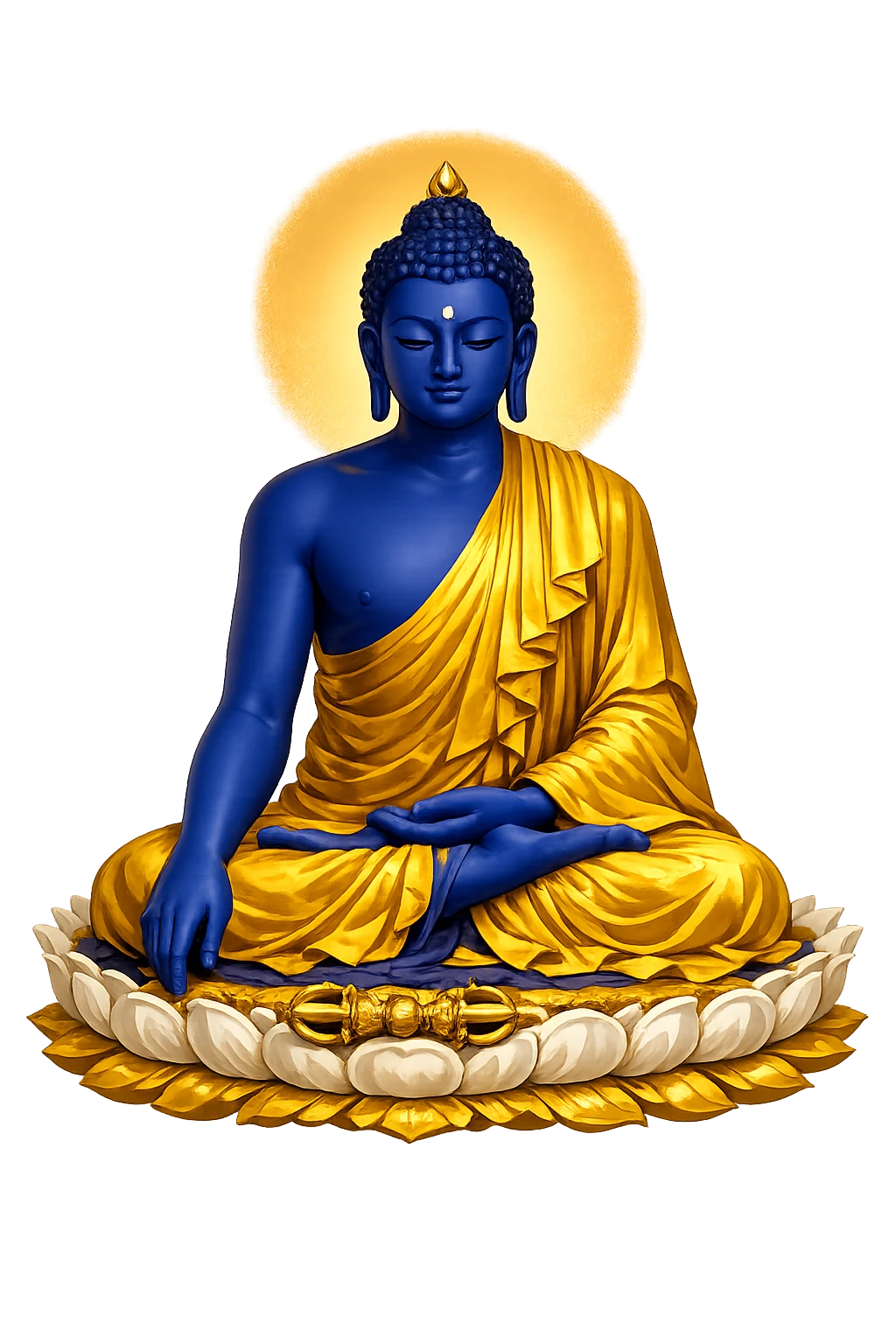
Akṣobhya is the Buddha who cannot be shaken — "The Unshakable · Mirror-Like Wisdom", as his temple's tagline compresses him: the eastern Tathāgata whose vow of patience carried him beyond anger altogether, lord of the pure land Abhirati.
PuniCodex restores the name as Akṣobhya and serves its temple at akṣobhya.com. The restoration preserves the retroflex ṣ of the Sanskrit conjunct kṣa — a distinctive feature ASCII loses — which places the name in Tier 1. The plain akshobhya survives as a convenience of the early domain-name system; the restoration, not the fallback, is the philologically complete form.
The Name
The name is attested in Sanskrit as अक्षोभ्य (IAST akṣobhya). It is a privative formation of three visible parts: the negative prefix a-, 'not'; the verbal root √kṣubh, 'to shake, stir'; and the adjectival suffix -ya — yielding a-kṣobh-ya, 'not to be shaken', the Unshakable. Its heart is the conjunct kṣa (क्ष), a ligature of k and the retroflex sibilant ṣ: Sanskrit writes the cluster as one fused character, and romanization writes it kṣ. The ASCII spelling akshobhya flattens the cluster to "ksh" — hence the h the restoration does not need, and the plain s that hides the retroflex tongue position.
The letter-by-letter transformation runs:
- a → A — Same, capitalized
- k → k — Same
- s → ṣ — Special character
- h → — — Dropped
- o → o — Same
- b → b — Same
- h → h — Same
- y → y — Same
- a → a — Same
The project holds the domain akṣobhya.com (xn--akobhya-473c.com) as the canonical home of this name.
The Original Script
The name is written in Devanagari as अक्षोभ्य — three syllables, अ-क्षो-भ्य (a-kṣo-bhya), in the abugida that has carried Sanskrit for a millennium and a half. Its middle character is the whole argument of the restoration: क्ष is not a sequence but a single conjunct letter, the fusion of क् (k) and ष (ṣ), the retroflex sibilant. The ASCII fallback akshobhya spells the fusion out as "ksh" and loses the retroflex; the restoration Akṣobhya keeps the ṣ the script itself insists on. The original is the form against which both are measured — and it takes sides.
Pronunciation
The reconstructed pronunciation of the name is /əkˈʂoː.bʱjə/ — Reconstructed Sanskrit.
For the modern speaker, the closest approximation is: uk-SHOH-byuh — three syllables, stress on the long ō.
Kindred and historical forms of the name:
- Devanagari — अक्षोभ्य
- IAST — Akṣobhya
- Tibetan — Mi bskyod pa, the tradition's own translation, 'the Unshakable One'
- Owned form — Akṣobhya
The retroflex ṣ [ʂ] is the sound English speakers most often miss: the sh of the cluster, made with the tongue curled back toward the palate, darkening the long ō that follows. Tibetan translates the name outright rather than borrowing the sound; the restoration preserves both.
Mythology
Akṣobhya's myths concern one thing the rest of us cannot manage: a mind anger cannot move — and what that stillness builds across an aeon.
The Vow of No Anger
The tradition remembers him first as a bodhisattva who made a singular resolve: never to feel anger or aversion toward any being, no matter the provocation. It is the vow that gives the name — a-kṣobh-ya, the one who cannot be shaken — and the texts treat the name as biography rather than label. He kept it across the long bodhisattva career, through every slight and test, until patience itself ripened into buddhahood. Where other buddhas are remembered for what they taught or built, Akṣobhya is remembered for what he refused: hatred, in every form, without remainder. The immovability is moral before it is cosmic.
The Eastern Pure Land
His buddha-field is Abhirati, 'the Joyful', in the eastern quarter — among the earliest pure lands in the literature. The Akṣobhyavyūha Sūtra preserves the early cult in detail: the vows that built the land, the conditions of rebirth there, and the character of a realm where anger has no purchase. Abhirati is reached through devotion and moral resolve — the aspirant practices the very unshakability the Buddha embodies. Scholars treat it as a witness to the first flowering of the pure-land idea, before Amitābha's western paradise came to dominate the devotional imagination of East Asia.
The Five Tathāgatas
The esoteric mandala arranges five buddhas as a complete map of awakened mind, and Akṣobhya takes the east. Vairocana sits at the center; Ratnasambhava the south; Amitābha the west; Amoghasiddhi the north. Akṣobhya, blue and unmoving, anchors the eastern point — the direction of dawn, and in the system's logic the place where practice begins. The five are not five gods but five ways the one awakening knows itself; Akṣobhya is the knowing that cannot be perturbed.
The Mirror-Like Wisdom
His gnosis is the ādarśa-jñāna, the mirror-like wisdom: a mind that reflects all things exactly as they are, without distortion, without commentary, and — the tradition underlines this — without anger. A mirror does not argue with what stands before it; it flatters nothing and flinches from nothing. Hatred, in the analysis of the five-wisdom system, is precisely a distortion: the mind adding its own turbulence to the object. The mirror is its antidote. The name and the wisdom say the same thing twice — what cannot be shaken sees clearly.
Symbols & Iconography
The iconography of Akṣobhya is a compressed statement about the name, and remarkably stable across two millennia:
- The blue body — deep lapis blue, the color of an unclouded, unstirred sky
- The vajra — the diamond scepter, the unbreakable thing, as the name is the unshakable one; he heads the vajra family of the mandala
- The earth-touching mudrā — the right hand touching the ground (bhūmisparśa), calling the earth to witness: resolve that cannot be moved
- The elephant throne — his seat borne by elephants, the steadiest mount the texts could give the Immovable
Among the five Tathāgatas he appears crowned and jeweled; in simpler images he sits in plain meditation, hand extended to the earth. Blue body, vajra, and downward hand identify him in any period and country.
Archaeology & Evidence
The earliest evidence is textual: the Akṣobhyavyūha Sūtra, the sūtra of his array, which preserves the early cult — the vows, the land of Abhirati, the path of devotion and resolve — and was translated into Chinese in the second century of the common era, a measure of the cult's antiquity. In art, the evidence is the mandala tradition: the five-buddha sets of the yoga tantras in paint and sculpture, the thangkas of Tibet and Nepal. The blue eastern Buddha with the earth-touching hand is among the most reproduced figures in Buddhist iconography.
Realm & Domain
Akṣobhya's domains are three faces of one stillness.
The Unshakable
His first domain is resolve itself: the vow kept past every provocation, patience that outlasts an aeon. Where this name walks, anger loses its argument — a practice the tradition offers to anyone.
The East
His quarter is the east: the direction of dawn, of beginnings, of first light. In the mandala's geography the day of practice starts with him — the mirror must be clean before anything else can be reflected.
The Mirror
His wisdom-domain is the mirror: the mind that shows things exactly as they are and adds nothing of its own. Every still surface of water in the tradition's poetry is a small portrait of him.
Across Cultures
The ideal Akṣobhya embodies — the sage no insult can move — is not the Buddhist tradition's alone. The Stoics of Greece and Rome built their ethics around the same figure: the wise person apathēs, free of turbulence, whom fortune cannot shake because the soul's good depends on nothing outside itself. The comparison is a resemblance of ideals, not a claim of contact: two traditions, working separately, concluded that the highest human state is immovability, and each named it by negation — a-kṣobhya, 'not-shaken', a-patheia, 'not-suffering'. Where they part is method: the Stoic trains judgment; the bodhisattva keeps a vow.
Cultural Legacy
Akṣobhya's legacy runs through the whole Buddhist world. In the Himalayas and Tibet the five Tathāgatas became the grammar of sacred art, and the blue eastern Buddha is its most painted member after Amitābha — his image set at the eastern quarter of stūpas, his mantra recited for the dead. And the name escaped the temple: Sanskrit lexicography records akṣobhya as a number so large it served as the tradition's way of saying 'beyond counting' — the immovable became the immeasurable. Vajrayāna practice still enters the mandala in the east, with him.
The Scholarly Record
The account given in this edition rests on the witnesses and reference works listed below. The Sanskrit lexica secure the form and etymology of the name and record its secondary life as a Buddhist numeral; the Akṣobhyavyūha Sūtra supplies the early cult, its vows, and its pure land; the yoga-tantra literature preserves the five-tathāgata system of the mirror-like wisdom. Lexicon authorities for this entry: Vajrayana texts, Buddhist texts.
A Meditation
Akṣobhya is the Buddha of the anger you do not take up. Every tradition has its image of the person nothing can provoke; most of us meet it as a rebuke. He asks the quieter question: what is still stirring you, and what would it cost to put it down? The mirror does not strain to be still. That is the whole meditation — not to defeat the shaking, but to be what cannot be shaken.
The Unicode Restoration
Akṣobhya is classified as Tier 1: the restoration preserves at least one distinctive feature the ASCII form loses. Here the feature is the retroflex ṣ of the conjunct kṣa — the sound Devanagari writes as one fused letter and ASCII spells "sh", losing the tongue position. Across the 9 characters of the name, the restoration adjusts 2: one retroflex sibilant recovered (s → ṣ) and one transliteration h removed — that h was only ever an artifact of spelling the cluster. The ASCII fallback still resolves everywhere, but the restored form carries the name's full information. The marks are the message.
Character by Character
The journey from akshobhya to Akṣobhya, one character at a time:
- a → A — Same, capitalized
- k → k — Same
- s → ṣ — Special character
- h → — — Dropped
- o → o — Same
- b → b — Same
- h → h — Same
- y → y — Same
- a → a — Same
The Domain Name
The restored name is live as a working domain: akṣobhya.com, which the DNS carries in punycode form as xn--akobhya-473c.com — an ASCII-compatible encoding that lets a non-ASCII name travel the global network without breaking older infrastructure. The visitor sees Akṣobhya; the machines see the encoding. That duality is the engineering compromise on which the restoration rests: a name written the way its own tradition wrote it, typed into any browser on earth.
The Buddhist Pantheon
Akṣobhya is one of 23 entries the PuniCodex lexicon catalogues under the Buddhist pantheon. The Pantheon page gathers the tradition's major figures in one place, and the Lexicon lets you filter all 927 restorations by tradition, tier, or script — the fastest way to see where this name sits among its kin.
Frequently Asked Questions
What does Akṣobhya mean? The traditional gloss is "Immovable" — from a-, 'not', and √kṣubh, 'to shake': the Unshakable.
Which tradition does Akṣobhya belong to? Akṣobhya is catalogued in the Buddhist pantheon of the PuniCodex lexicon.
Why is Akṣobhya classified as Tier 1? Because the restoration preserves a distinctive feature ASCII loses — the retroflex ṣ of the Sanskrit conjunct kṣa.
Is akṣobhya.com a working domain? Yes — akṣobhya.com resolves today and routes to this temple.
What is the punycode for akṣobhya.com? The DNS encoding is xn--akobhya-473c.com; browsers translate it automatically, so visitors only see the restored name.
Typing Akṣobhya
You do not need a special keyboard to use this restoration. The PuniCodex Type Tool converts the ASCII form akshobhya into Akṣobhya as you type, and the browser extension offers the same conversion inside any text field. Copy the restored form, paste it into the address bar, and the DNS does the rest.
Sister Temples
Other temples in the Buddhist pantheon include Mahāvairocana, Amitābha, and Ratnasambhava — each with its own restoration story, its own scholarly record, and its own place in the lexicon.
Why This Restoration Matters
In 2026 the stakes are practical. Search indexes, language models, and localization pipelines all inherit whatever spelling the web normalizes — which means every Unicode domain is also a training signal. Akṣobhya teaches the machinery that the retroflex ṣ exists, that it is used, and that it points to a real place. For a name held by a living tradition — recited, painted, meditated on today — getting the spelling right is not pedantry but respect rendered at the level of code points. This restoration makes sure the future sees the whole name.
Explore Further
This post is one doorway into the temple. The home page carries the full character breakdown and the ambient canvas; the lore page tells the myths in long form; the Scholarly Edition preserves the sources, pronunciation data, and revision history; and the patron wall supports the restoration directly. For the wider map, browse the Lexicon, explore the Pantheon, or return to the PuniCodex blog.
Related Names
Sources
The full scholarly apparatus — every citation, revision, and review — lives in the Scholarly Edition. Key references for this post:
- Monier-Williams Sanskrit-English Dictionary, Oxford, 1899.
- Vajrayāna / Tibetan Buddhist texts, trans. C. A. Musés and others, 700.
- Buddhist canonical and commentarial literature (Pāli, Sanskrit, Chinese, and Tibetan recensions).
- The Akṣobhyavyūha Sūtra; the five-tathāgata system of the yoga tantras.
- Lexicon authorities for this entry: Vajrayana texts, Buddhist texts.