The Authentic Orthography
Immovable, East · The Unshakable · Mirror-Like Wisdom
Unicode restoration and ASCII comparison
अक्षोभ्य
The name in its original Buddhist form. Akṣobhya (अक्षोभ्य) is attested in the source tradition — “N. of a Buddha of an author, an immense number, said by Buddhists to be 100 vivaras.”. Its emphatic consonants and palatal/retroflex sibilants carry the full phonetic and orthographic weight of the source tradition.
akshobhya
Reduced to plain akshobhya, the name loses everything that made it specific: emphatic consonants and palatal/retroflex sibilants. What remains is an ASCII string that machines can parse but that no longer speaks with its original voice.
Akṣobhya
The Unicode restoration recovers what ASCII flattened. Akṣobhya restores emphatic consonants and palatal/retroflex sibilants, returning the name to its original written dignity. The domain encodes to Punycode, but the browser displays the truth.
Akṣobhya.com → xn--akobhya-473c.com
The non-ASCII characters in Akṣobhya are encoded while the ASCII remains visible. To the DNS, it is Punycode. To humanity, it is Akṣobhya.
How Akṣobhya travels from ancient script to the modern URL
How Akṣobhya was spoken
The Eastern Pure Land, the Mirror-Like Wisdom, and the Vow Against Anger
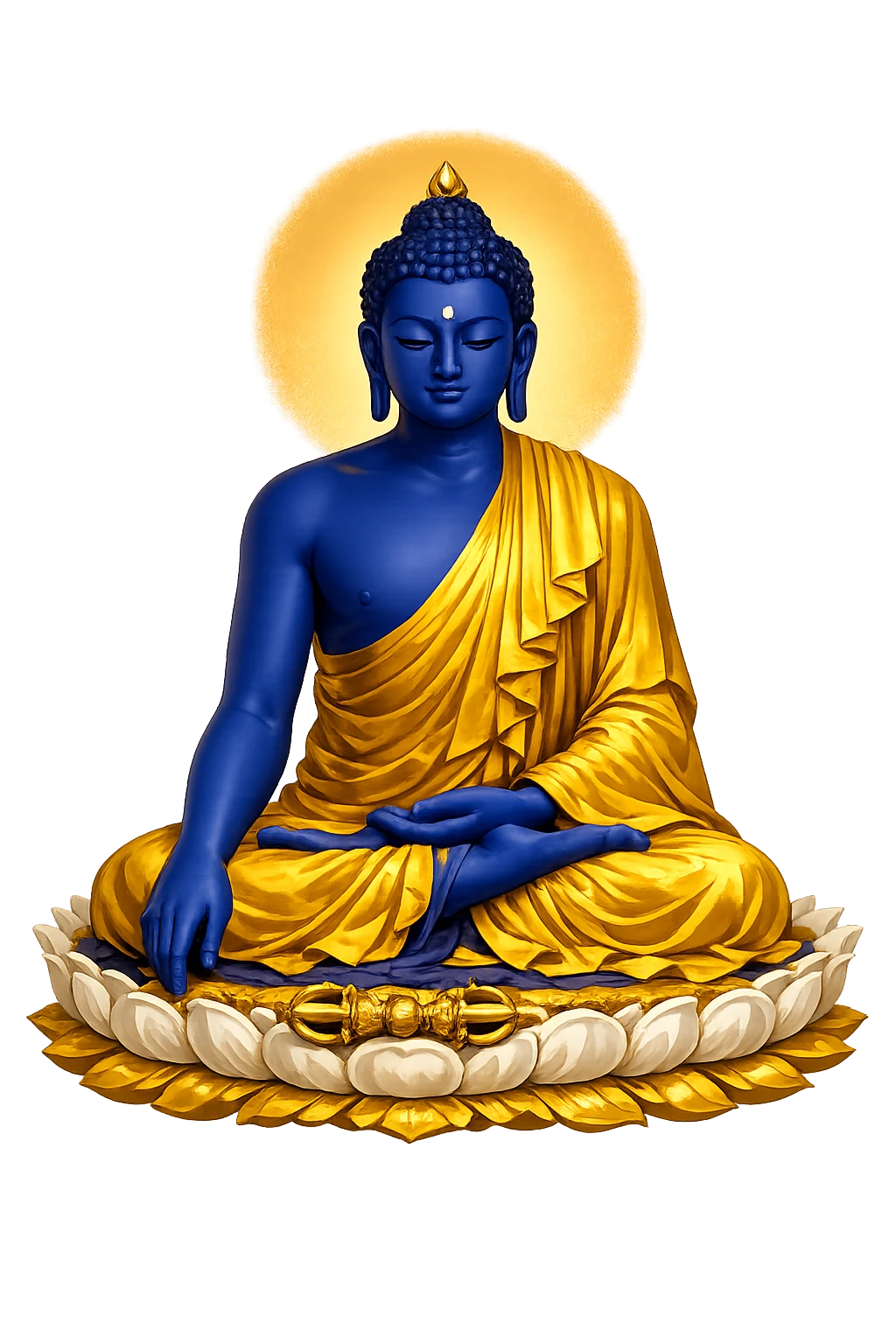
Akṣobhya is the Buddha who cannot be shaken: lord of Abhirati, the eastern Land of Delight, blue as the vajra family he heads, seated in the earth-touching gesture — the one of the five tathāgatas who turns the poison of hatred into the mirror-like wisdom that reflects everything and is disturbed by nothing.
The Land of Delight in the east — his Buddha-field, open to all who aspire to be reborn there.
Ādarśa-jñāna: awareness that shows all things exactly as they are, and holds none of them.
The earth-touching mudrā — the awakening gesture itself, his seal among the five.
Head of the vajra clan of the five tathāgatas: blue, eastern, indestructible as the thunderbolt.
Stories of Akṣobhya
Akṣobhya's mythology is the story of a single vow kept without a crack: the monk who resolved never to be angry, and became the Buddha of the unshakable land.
His sūtra — the Akṣobhya-tathāgatasya-vyūha, among the earliest pure-land scriptures translated into Chinese, carried over by Lokakṣema in the second century CE — tells how a monk of a past age stood before a Buddha and vowed that until his own awakening he would never give rise to anger or malice toward any being. From that vow came his name: Akṣobhya, the Unshakable. The text then shows the vow fulfilled: the monk is now the Buddha of Abhirati, and beings who aspire to his land are promised rebirth where anger finds no purchase.
Abhirati, "the Delightful," is the east's answer to Sukhāvatī: a Buddha-field without the evil rebirths, level and fragrant, beautiful beyond the worlds men know. The sūtra lavishes detail on its gentleness — no lower destinies, no sickness as we know it, and women, the text takes care to say, bear children there without pain. It is the pure land of moral steadiness: not escape from the world, but a world where steadiness is finally possible.
In the mandala of the five tathāgatas — Vairocana at the center, Akṣobhya east, Ratnasambhava south, Amitābha west, Amoghasiddhi north — each Buddha governs a poison and transmutes it. Akṣobhya's poison is hatred (dveṣa), and his transmutation is the ādarśa-jñāna, the mirror-like wisdom: the mind that reflects anger, insult, and loss exactly as they are, like a mirror showing a storm, and is not stormed. Blue, vajra-clan, elephant-borne, earth-touching: the whole iconography says one thing — unmoved.
In the Highest Yoga Tantras his rank rises further: the Guhyasamāja system places Akṣobhya at the mandala's center, and the primordial Buddha Vajrasattva is identified with him in the Nyingma tradition. His bodhisattva is Vajrapāṇi, the thunderbolt-bearer, and his wrathful faces guard the gates of every tantric mandala. The unshakable monk of the old sūtra became the still point around which the whole esoteric cosmos is arranged.
Akṣobhya is the patron of the unhurried strength: the hand that does not strike back, the mind that registers the insult and lets it pass through like weather through a window frame. He does not ask for indifference — a mirror is not indifferent; it shows everything. He asks for the one thing harder than anger: to see clearly and remain unmoved, and to let clarity, not reaction, do the answering.
Enter Extended Lore