PuniCodex

Extended Lore

अक्षोभ्य Akṣobhya

Etymology · Phonology · Orthography · Cultural Legacy · Primary Sources

Tier 1 Akṣobhya.com
Akṣobhya — Immovable, East
01

Quick Facts

Essential information about Akṣobhya, Immovable, East

Original Scriptअक्षोभ्य
Unicode RestorationAkṣobhya
Reconstructed Pronunciation/ɐk.ˈʂoː.bʱjɐ/
PantheonBuddhist
DomainImmovable, East
MeaningN. of a Buddha of an author, an immense number, said by Buddhists to be 100 vivaras.
ClassificationTier 1
Primary DomainAkṣobhya.com
Sacred SymbolsThe blue vajra, The elephant mount, The seed syllable HŪṀ
02

Etymology & Word Family

From original script to Unicode restoration

Original Script अक्षोभ्य Akṣobhya — "N. of a Buddha of an author, an immense number, said by Buddhists to be 100 vivaras."
Unicode Restoration Akṣobhya Restored stress, length, and script
Modern ASCII akshobhya Plain-ASCII fallback

Akṣobhya is a-privative plus kṣobhya, "to be shaken" — from √kṣubh, "to shake, agitate" (Monier-Williams): "the Unshakable, the Immovable." The name states his defining vow: never to give way to anger. The restoration keeps the kṣ conjunct with its retroflex ṣ exactly as the Sanskrit writes it; the ASCII "Akshobhya" transliterates the letter but loses its shape. Tier-1 by rule: the retroflex ṣ is a distinctive letter.

03

Unicode Character Breakdown

Character-by-character philological analysis

CharacterUnicodeNameBlockPhonetic Role
AU+0041Latin Capital Letter ABasic LatinSame, capitalized
kU+006BLatin Small Letter KBasic LatinSame
U+1E63Latin Small Letter S with Dot BelowUnknownSpecial character
N/ADropped characterBuddhist orthographyDropped
oU+006FLatin Small Letter OBasic LatinSame
bU+0062Latin Small Letter BBasic LatinSame
hU+0068Latin Small Letter HBasic LatinSame
yU+0079Latin Small Letter YBasic LatinSame
aU+0061Latin Small Letter ABasic LatinSame

The Tier 1 classification reflects how much of the original phonology this restoration preserves — stress and vowel length for Greek names, distinctive letters and diacritics for every other tradition.

04

Cultural Significance

From ancient cult to modern Unicode

Ancient Domain

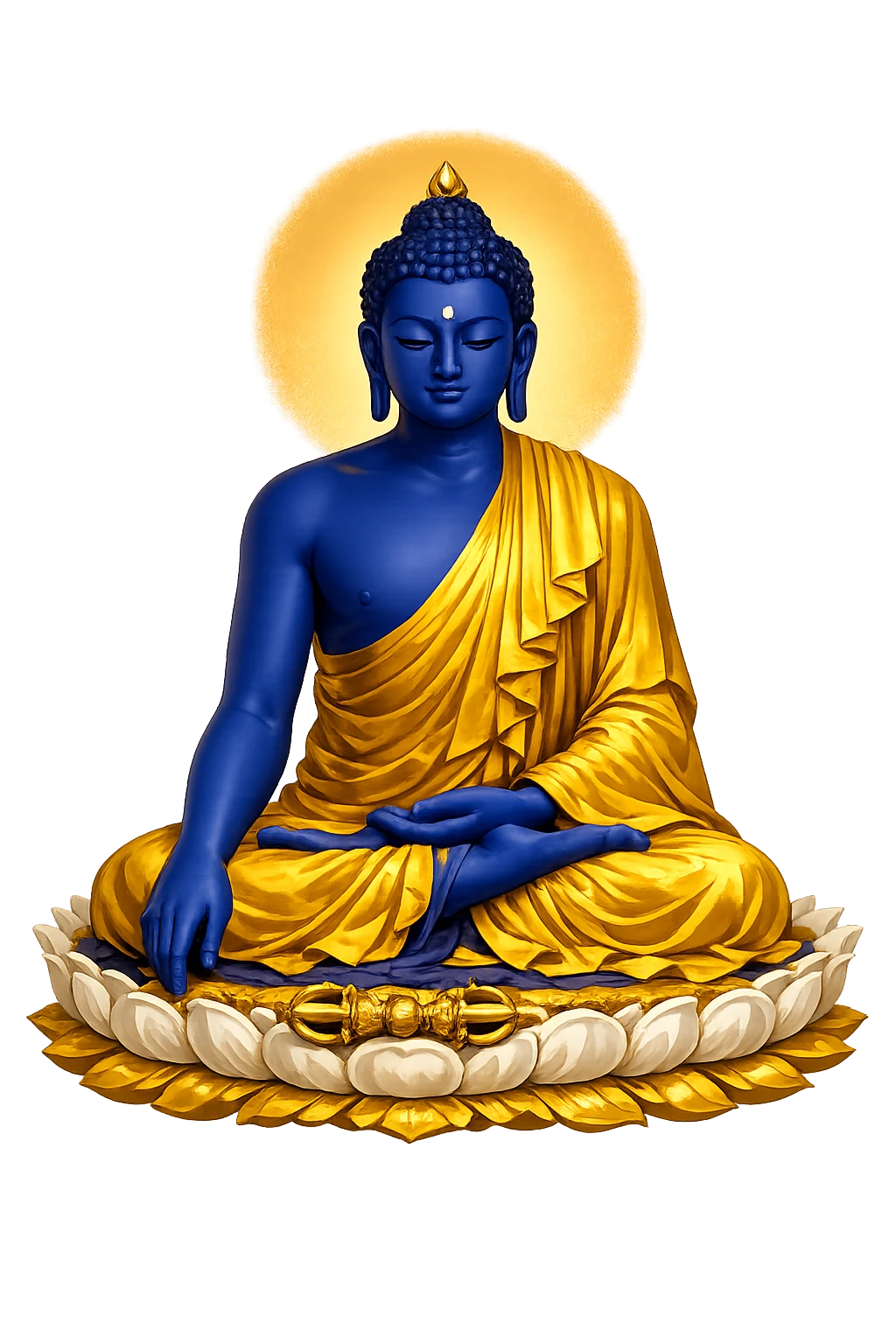
Akṣobhya is the Buddha who cannot be shaken: lord of Abhirati, the eastern Land of Delight, blue as the vajra family he heads, seated in the earth-touching gesture — the one of the five tathāgatas who turns the poison of hatred into the mirror-like wisdom that reflects everything and is disturbed by nothing.

Akṣobhya in Later Traditions

China received him early as Āchù and later rendered him "the Immovable" — a name he shares as a near-doublet with Acala, the blazing Fudō Myōō of Japan, whose wrathful immovability is the mirror image of his serene one. Tibet made Mi bskyod pa central to the highest tantras and to the rites of death and purification, and the five-Buddha system that enthrones him traveled from the Indian universities to every Himalayan valley. Scholars have noted the quiet irony: the least-known of the five in the West is, liturgically, among the most invoked — every vajra-family rite is his household.

Modern Legacy

Akṣobhya's legacy is the mirror itself: the image of mind as a reflecting surface that needs only to stay still became one of the deep metaphors of East Asian Buddhism, from Huayan to Zen. His earth-touching gesture — assigned to him among the five — is the most reproduced Buddha pose on earth, the seal of the historical awakening reassigned to the unshakable one. And his vow remains the tradition's standing definition of patience: not slowness, but a stillness no insult can reach.

Unicode Restoration as Cultural Act

Restoring Akṣobhya in a domain name is more than orthographic accuracy. It is a statement that the internet should recognize the full range of human writing — not only the ASCII keyboard.

05

Frequently Asked Questions

Common questions about Akṣobhya, Immovable, East, and Unicode restoration

01How do you pronounce Akṣobhya?

In reconstructed pronunciation, Akṣobhya is /ɐk.ˈʂoː.bʱjɐ/ — approximately uk-SHOH-bhyuh — the kṣ is a single conjunct sound (k + retroflex ṣ); the bh is aspirated..

02What does Akṣobhya mean?

Akṣobhya means N. of a Buddha of an author, an immense number, said by Buddhists to be 100 vivaras. in the buddhist tradition.

03What are the symbols of Akṣobhya?

Akṣobhya is associated with The blue vajra (Indestructibility: the thunderbolt that is also the diamond, his family and his nature), The elephant mount (The unshakable animal — the stillness that cannot be stampeded), The seed syllable HŪṀ (The sound of the unstruck stillness at the heart of the mandala).

04Why restore Akṣobhya in Unicode?

Plain ASCII akshobhya strips the stress, length, and script that make the name specific. Unicode restoration returns the name to its original written dignity.

05What is the most important myth about Akṣobhya?

His sūtra — the Akṣobhya-tathāgatasya-vyūha, among the earliest pure-land scriptures translated into Chinese, carried over by Lokakṣema in the second century CE — tells how a monk of a past age stood before a Buddha and vowed that until his own awakening he would never give rise to anger or malice toward any being. From that vow came his name: Akṣobhya, the Unshakable. The text then shows the vow fulfilled: the monk is now the Buddha of Abhirati, and beings who aspire to his land are promised rebirth where anger finds no purchase.

06

Scholarly Sources

The philological foundations of this restoration

Every claim on this page is grounded in established scholarship. The orthographic restorations follow disciplinary convention. The etymological chain follows the best available reference works. This is not invention — it is resurrection through scholarship.

Lexicography & Philology

  • Vajrayana texts
  • Buddhist texts

Primary Texts

  • The Larger Sukhāvatī-vyūha Sūtra; the Smaller Sukhāvatī-vyūha Sūtra; the Amitāyurdhyāna Sūtra; the Lotus Sūtra.

Archaeology & Art History

  • Material evidence — iconography, inscriptions, and temple archaeology — for Akṣobhya and related cults.
  • His oldest document is textual: Lokakṣema's second-century Chinese translation of his sūtra, among the first pure-land scriptures rendered into any language. In stone he belongs to the five-jina program that matured in the eighth and ninth centuries: the eastern niches of Borobudur carry his series in the earth-touching gesture, and the crowns of Nepalese paubhā and Tibetan sculpture place him on the east petal of the jina-mandala. East Javanese bronzes and stone Akṣobhyas — dark, right hand to the earth — are among the finest small Buddhist images in the world.

Religious Studies

  • Akṣobhya-tathāgatasya-vyūha Sūtra
  • Guhyasamāja Tantra
  • Conze
  • Edgerton, Buddhist Hybrid Sanskrit Dictionary
  • Monier-Williams
Return

The Surface Awaits

You have traced the name from its earliest attestation to its Unicode restoration. Now return to the myth. The story is where the name lives.

Back to Lore
Akṣobhya mascot