
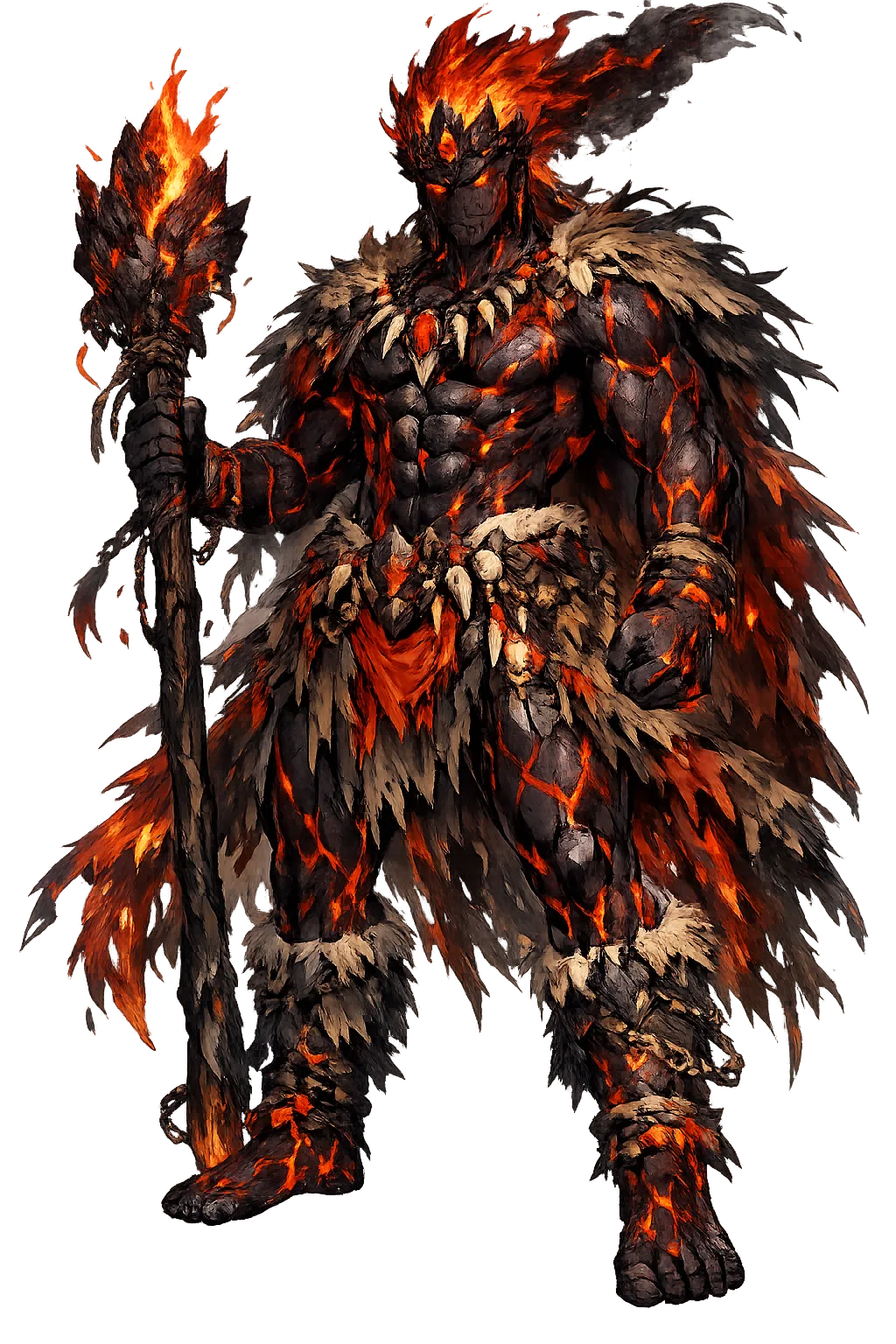
The many faces of Aganjú
No important name has only one face. Aganjú appears as a figure of myth, a scholarly reconstruction, a piece of material culture, a memory carried across languages, and — most recently — a Unicode domain. This post looks at each face in turn: the name and its roots, the Yoruba transcription original, the reconstructed pronunciation, the mythological record, the symbols and sanctuaries, the cross-cultural afterlife, and the engineering that lets the restored spelling resolve in a browser. Taken together, those faces explain why aganju was never going to be enough — and why the restored form is worth a domain of its own.
At a Glance
- Restored name: Aganjú
- ASCII form: aganju
- Meaning: "The uninhabited place"
- Domain of influence: Volcanoes, Wilderness
- Pantheon: Yoruba
- Classification: Tier 2
- Live domain: aganjú.com
Overview
Aganjú (aganju) — Volcanoes, Wilderness · The uninhabited place — belongs to the Yoruba tradition, where it is catalogued under the domain "Volcanoes, Wilderness". The name means "The uninhabited place".
Aganjú is the orixá of the uninhabited places: volcanic earth, desert scrub, and the molten core beneath the mountain. Unlike Ṣàngó, whose fire crackles in the sky, Aganjú's fire moves slowly through stone. He is the son of Odùduwà and Ọbatalá in many accounts, the giant whose strides once shook the earth and whose breath still steams from fissures in the ground.
In Afro-Atlantic ritual he appears as Aggayú Solá, the bearer of the world, a deity so tall that rivers reach only his ankles. To invoke him is to acknowledge that civilization rests on forces older and more patient than human law.
PuniCodex restores the name as Aganjú and serves its temple at aganjú.com. The original preserves one prosodic feature — stress or vowel length — rather than both, which places the name in Tier 2. The plain ASCII form aganju survives as a modern convenience imposed by the early domain-name system; the restoration, not the fallback, is the form the project defends as philologically complete.
The Name
No indigenous written attestation survives for this name; Aganjú is a scholarly transliteration of the reconstructed spoken form. Etymologically the name means "The uninhabited place".
The ASCII form aganju survives only because the early domain-name system could not carry diacritics; it is a technological compromise, not an ancient spelling. The Unicode restoration Aganjú recovers the stress accent of the original directly in the address bar. The original preserves one prosodic feature — stress or vowel length — rather than both, which places the name in Tier 2.
The letter-by-letter transformation runs:
- a → A — Same, capitalized
- g → g — Same
- a → a — Same
- n → n — Same
- j → j — Same
- u → ú — Stress on u
The project holds the domain aganjú.com (xn--aganj-cva.com) as the canonical home of this name.
The Original Script
No indigenous writing system is securely attested for Yoruba before the nineteenth century: the tradition was carried in speech, praise poetry, and the memorised verses of Ifá. Muslim Yoruba scholars maintained an Ajami literature in Arabic script, and the modern Latin orthography was developed by Church Missionary Society workers in the 1840s–1850s, codified in Samuel Ajayi Crowther's Yoruba grammar of 1852 and his Bible translation.
The form Aganjú is therefore a scholarly transliteration rather than an attested ancient spelling, and no mark in it is decorative. Its letters are plain Latin, but the acute accent on the final syllable records the high tone of the reconstructed /à.gà.ɲú/ — low, low, high — so that the fully toned orthographic spelling would be Àgànjú. Tone is phonemic in Yoruba, yet tone marks are routinely omitted in everyday print and cannot be carried in the DNS root zone; the restoration keeps the final high tone as the name's one registered mark. The tradition glosses the name as 'the uninhabited place', the wilderness beyond the town's edge.
Pronunciation
The reconstructed pronunciation of the name is /à.gà.ɲú/ — Yoruba Reconstruction.
Phoneme by phoneme:
- À- — Open central vowel [a] with low tone, written without dot below in the lexical form but historically linked to the agánbára ('force') root.
- -gà- — Voiced velar stop [g] followed by open [a] with low tone.
- -ɲú — Palatal nasal [ɲ] — like Spanish ñ — plus close back rounded vowel [u] with high tone.
For the modern speaker, the closest approximation is: ah-gah-NYOO — start low on 'ah', stay low on 'gah', then rise sharply to 'NYOO'.
Kindred and historical forms of the name:
- Yoruba — Aganjú, the orixá of volcanoes, desert, and terrible natural force.
- Brazilian Candomblé — Aganjú, syncretised with Saint Christopher and associated with the desert and fire.
- Cuban Santería — Aggayú Solá, the giant who carries the world and walks through lava.
Aganjú is Tier 2: the acute accent on ú preserves the high tone of the final syllable, but Yoruba tone marks are not registrable as length marks. The dot below is absent from the lexical form because the stem vowel is plain /a/, not open /ɔ/ or /ɛ/.
Mythology
Aganjú's myths are less numerous than those of Ọṣun or Ṣàngó, but they centre on a single theme: the earth as a living, burning body that carries human life without belonging to it.
Son of Odùduwà and Ọbatalá (Lineage)
In Yoruba cosmogony, Aganjú is born from the union of the royal ancestor Odùduwà and the white-cloth creator Ọbatalá. The story makes him kin to both earthly kingship and heavenly craftsmanship, but his own domain remains the wild land that refuses cultivation. He is the child who left the palace to live in the volcano.
Aggayú Solá Carries the World (Diaspora)
In Cuban Santería, Aggayú Solá is imagined as a giant so large that he wades through rivers and carries the earth itself. When he possesses a devotee in ceremony, the person's gait becomes heavy and swaying, as if the ground beneath them has gained consciousness. The myth turns geological force into a mythic person who walks among humans.
The Desert and the Town (Cult)
Aganjú receives offerings at the boundary between settlement and wilderness. His devotees leave him palm wine, smoked fish, and red palm oil at the edge of roads and quarries. The ritual geography acknowledges that human order exists only because older, hotter forces hold it up.
Symbols & Iconography
The iconography of Aganjú concentrates in a small set of recurring attributes, most fully developed in his diaspora cult, where the wilderness orisha was reimagined as the volcano made flesh:
- Volcanic stone — His seat and his bones; heavy stones and cooled lava ground his presence on altars. Yorubaland itself has no active volcanoes, and the lava imagery crystallised in the Cuban cult of Aggayú Solá.
- Palm frond fan — Used to cool and direct his immense heat during ritual possession.
- Red and brown beads — The colours of iron-rich earth, dried blood, and scorched clay, worn by his initiates.
- Giant's staff — The walking stick of the world-bearer, marking his stride across deserts.
Archaeology & Evidence
Direct archaeological attestation of Aganjú is sparse, and honest scholarship must say why: Yoruba orisha cults were transmitted orally and through perishable ritual objects rather than temple inscriptions, and no excavated object or site is epigraphically tied to him.
There is a further geographical caution. Yorubaland has no volcanic landscape, so the volcanic material now associated with him — lava stones on altars, scorched reds and browns — belongs to the diaspora's material culture, above all the Cuban cult of Aggayú Solá, where his wilderness domain was mapped onto volcanic and desert terrain. Boundary stones, iron implements, and red-beaded regalia in Afro-Cuban and Afro-Brazilian collections form the continuing material record of a cult whose African stratum survives mainly in verse and praise-names.
Realm & Domain
Aganjú is the orixá of the uninhabited places: volcanic earth, desert scrub, and the molten core beneath the mountain. Unlike Ṣàngó, whose fire crackles in the sky, Aganjú's fire moves slowly through stone. He is the son of Odùduwà and Ọbatalá in many accounts, the giant whose strides once shook the earth and whose breath still steams from fissures in the ground.
In Afro-Atlantic ritual he appears as Aggayú Solá, the bearer of the world, a deity so tall that rivers reach only his ankles. To invoke him is to acknowledge that civilization rests on forces older and more patient than human law.
Volcanic Earth
Magma, lava fields, and earthquakes are his body; he is the planet's slow, burning voice.
Desert Wilderness
The uninhabited plain where no farm can take root; the place beyond the town's edge.
World-Bearer
In the diaspora he becomes the giant who supports the earth on his shoulders.
Terrible Strength
Force without malice; the power that does not negotiate because it does not need to.
Across Cultures
In Brazilian Candomblé, Aganjú is syncretised with Saint Christopher, the giant who carries the Christ child across water. In Cuban Santería he becomes Aggayú Solá, often paired with the thunder-god Ṣàngó as complementary powers of sky-fire and earth-fire. The identification with Saint Christopher preserves the theme of colossal bearing strength, while the pairing with Ṣàngó maps the volcanic interior onto the stormy sky.
Within the Yoruba tradition, closely related names in the corpus include [[babaluaye|Ọbalúayé]], [[eshu|Ẹṣu]], [[obatala|Ọbatálá]], [[olodumare|Olódùmarè]], [[orunmila|Ọrúnmìlà]], and [[oshun|Ọṣun]].
Cultural Legacy
Aganjú remains one of the less domesticated orixás. He is not the god of the marketplace or the bedroom; he is the god of what lies beneath and beyond. In an age of ecological awareness, his mythology reads like a warning: the ground we build on is alive, slow, and capable of overwhelming any city. His colours — red, brown, and iron — appear in Candomblé and Santería altars, and his giant stride survives in the heavy, deliberate dance of his possessed devotees.
His feast falls on 25 July, the day of Saint Christopher, the giant of the ford with whom he is paired in both Cuba and Brazil. In Cuban houses his initiates keep to the margins of ceremony until called, a liturgical echo of his domain at the settlement's edge. Contemporary ecological readings of the orishas find in Aganjú a theology of the non-human: a god whose domain is precisely everything that does not exist for human use.
The Scholarly Record
The account of Aganjú given in this edition rests on the witnesses and reference works listed below; each contributes a distinct stratum of evidence, and the thinness of the older record for this orisha is itself part of the finding.
- Bascom, William, Ifa Divination: Communication Between Gods and Men in West Africa (Indiana University Press, 1969). — The primary published corpus of Ifá verses in English, the genre in which Aganjú's few mythic appearances are embedded.
- Idowu, E. Bolaji, Olódùmarè: God in Yoruba Belief (Longmans, 1962). — The standard synthetic theology of the orishas, situating Aganjú within the hierarchy of Olódùmarè's powers.
- Mason, John, Four New World Yoruba Rituals (Yoruba Theological Archministry, 1985). — Documents the New World liturgy in which Aganjú became Aggayú Solá.
- Verger, Pierre, Notes sur le Culte des Orisa et Vodun (IFAN, 1957). — Comparative record of orisha cults in West Africa and Bahia.
- Murphy, Joseph M., Santería: African Spirits in America (Beacon Press, 1988). — Ethnography of the Lukumí tradition, including Aggayú's pairing with Saint Christopher.
A Meditation
Aganjú teaches that stillness is not absence. The volcano sleeps for centuries; the desert seems empty; the earth beneath the pavement does not speak. And yet all of them hold forces that could reshape the world in a single day. Aganjú is the god of that withheld power.
To meditate on him is to remember that human institutions are thin crust on a molten sphere. He does not hate the city, but he does not need it. His gift is perspective: from the rim of a volcano or the centre of a desert, the anxieties of the town shrink to their proper size. He asks only that we do not mistake our maps for the territory.
The Unicode Restoration
Aganjú is classified as Tier 2: the original preserves at least one philological feature that ASCII cannot encode. The ASCII fallback aganju still resolves everywhere, but it is the restored form that carries the name's full information. Across the 6 characters of the name, the restoration adjusts 1: 1 mark of stress (ú). That is the whole thesis of this temple: the marks are the message.
Character by Character
The journey from aganju to Aganjú, one character at a time:
- a → A — Same, capitalized
- g → g — Same
- a → a — Same
- n → n — Same
- j → j — Same
- u → ú — Stress on u
The Domain Name
The restored name is live as a working domain: aganjú.com, which the DNS carries in punycode form as xn--aganj-cva.com — an ASCII-compatible encoding that lets a non-ASCII name travel the global network without breaking older infrastructure. The visitor sees Aganjú; the machines see the encoding. That duality is the engineering compromise on which the entire restoration rests, and it is why a name written the way its own tradition wrote it in Yoruba transcription can now be typed into any browser on earth.
The Yoruba Pantheon
Aganjú is one of 30 entries the PuniCodex lexicon catalogues under the Yoruba pantheon. The Pantheon page gathers the tradition's major figures in one place, and the Lexicon lets you filter all 895 restorations by tradition, tier, or script — the fastest way to see where this name sits among its kin.
Frequently Asked Questions
What does Aganjú mean? The traditional gloss is "The uninhabited place."
Which tradition does Aganjú belong to? Aganjú is catalogued in the Yoruba pantheon of the PuniCodex lexicon.
Why is Aganjú classified as Tier 2? Because the original preserves at least one philological feature that ASCII cannot encode — and the marks in the restored spelling preserve exactly that evidence.
Is Aganjú a working domain? Yes — aganjú.com resolves today and routes to this temple.
What is the punycode for aganjú.com? The DNS encoding is xn--aganj-cva.com; browsers perform the translation automatically, so visitors only ever see the restored name.
Typing Aganjú
You do not need a special keyboard to use this restoration. The PuniCodex Type Tool converts the ASCII form aganju into Aganjú as you type, and the browser extension offers the same conversion inside any text field. Copy the restored form, paste it into the address bar, and the DNS does the rest.
Sister Temples
Other temples in the Yoruba pantheon include Bunjil — each with its own restoration story, its own scholarly record, and its own place in the lexicon.
Why This Restoration Matters
Myth, script, sound, cult, legacy, domain: the faces of Aganjú add up to a single argument — that a name is a record, and records deserve fidelity. The PuniCodex restoration keeps that record in working order: the temple presents it, the Scholarly Edition footnotes it, the lexicon catalogs it, and the domain makes it addressable. aganju will always exist as a fallback. But fallback is not identity. Aganjú is the name; everything else is a convenience.
Explore Further
This post is one doorway into the temple. The home page carries the full character breakdown and the ambient canvas; the lore page tells the myths in long form; the Scholarly Edition preserves the sources, pronunciation data, and revision history; and the patron wall supports the restoration directly. For the wider map, browse the Lexicon, explore the Pantheon, or return to the PuniCodex blog.
Related Names
Sources
The full scholarly apparatus — every citation, revision, and review — lives in the Scholarly Edition. Key references for this post:
- Bascom, Ifa Divination.
- Idowu, Olódùmarè: God in Yoruba Belief.
- Mason, Four New World Yoruba Rituals.
- Crowther, Samuel Ajayi, A Grammar and Vocabulary of the Yoruba Language (Seeleys, 1852).
- Lexicon authorities for this entry: Bascom, Idowu.