Unicode restoration and ASCII comparison
Aganjú
The name survives only in scholarly transliteration. Aganjú is the standard Yoruba romanisation, documented in academic sources — “The uninhabited place”. Its acute stress marks preserve distinctions lost in plain ASCII.
No indigenous writing system is securely attested for individual yoruba names. The form shown is a modern scholarly transliteration.
aganju
Reduced to plain aganju, the name loses everything that made it specific: acute stress marks. What remains is an ASCII string that machines can parse but that no longer speaks with its original voice.
Aganjú
The Unicode restoration recovers what ASCII flattened. Aganjú restores acute stress marks, returning the name to its original written dignity. The domain encodes to Punycode, but the browser displays the truth.
Aganjú.com → xn--aganj-cva.com
The non-ASCII characters in Aganjú are encoded while the ASCII remains visible. To the DNS, it is Punycode. To humanity, it is Aganjú.
How Aganjú is preserved in writing
No indigenous writing system is securely attested for individual yoruba names. The form shown is a modern scholarly transliteration.
Contribute scholarly provenance →How Aganjú was spoken
Wilderness, Desert, and Terrestrial Fire
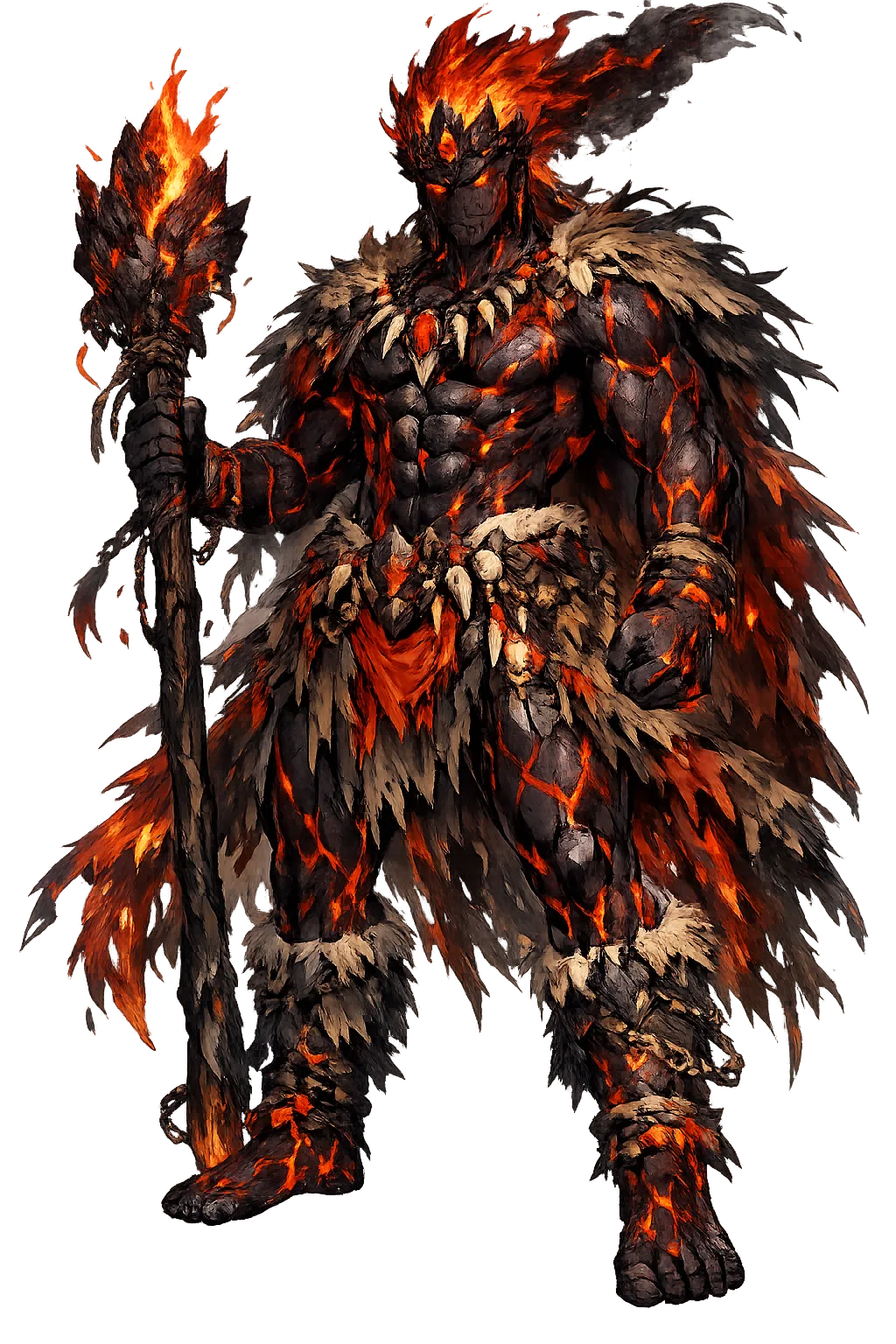
Aganjú is the orixá of the uninhabited places: volcanic earth, desert scrub, and the molten core beneath the mountain. Unlike Ṣàngó, whose fire crackles in the sky, Aganjú's fire moves slowly through stone. He is the son of Odùduwà and Ọbatalá in many accounts, the giant whose strides once shook the earth and whose breath still steams from fissures in the ground.
In Afro-Atlantic ritual he appears as Aggayú Solá, the bearer of the world, a deity so tall that rivers reach only his ankles. To invoke him is to acknowledge that civilization rests on forces older and more patient than human law.
Magma, lava fields, and earthquakes are his body; he is the planet's slow, burning voice.
The uninhabited plain where no farm can take root; the place beyond the town's edge.
In the diaspora he becomes the giant who supports the earth on his shoulders.
Force without malice; the power that does not negotiate because it does not need to.
Stories of Aganjú
Aganjú's myths are less numerous than those of Ọṣun or Ṣàngó, but they centre on a single theme: the earth as a living, burning body that carries human life without belonging to it.
In Yoruba cosmogony, Aganjú is born from the union of the royal ancestor Odùduwà and the white-cloth creator Ọbatalá. The story makes him kin to both earthly kingship and heavenly craftsmanship, but his own domain remains the wild land that refuses cultivation. He is the child who left the palace to live in the volcano.
In Cuban Santería, Aggayú Solá is imagined as a giant so large that he wades through rivers and carries the earth itself. When he possesses a devotee in ceremony, the person's gait becomes heavy and swaying, as if the ground beneath them has gained consciousness. The myth turns geological force into a mythic person who walks among humans.
Aganjú receives offerings at the boundary between settlement and wilderness. His devotees leave him palm wine, smoked fish, and red palm oil at the edge of roads and quarries. The ritual geography acknowledges that human order exists only because older, hotter forces hold it up.
Aganjú teaches that stillness is not absence. The volcano sleeps for centuries; the desert seems empty; the earth beneath the pavement does not speak. And yet all of them hold forces that could reshape the world in a single day. Aganjú is the god of that withheld power.
Enter Extended Lore