PuniCodex

Extended Lore

Aganjú

Etymology · Phonology · Orthography · Cultural Legacy · Primary Sources

Tier 2 Aganjú.com
Aganjú — Volcanoes, Wilderness
01

Quick Facts

Essential information about Aganjú, Volcanoes, Wilderness

Scholarly TransliterationAganjú
Unicode RestorationAganjú
Reconstructed Pronunciation/à.gà.ɲú/
PantheonYoruba
DomainVolcanoes, Wilderness
MeaningThe uninhabited place
ClassificationTier 2
Primary DomainAganjú.com
Sacred SymbolsVolcanic stone, Palm frond fan, Red and brown beads, Giant's staff
02

Etymology & Word Family

From original script to Unicode restoration

Scholarly Transliteration Aganjú Aganjú — "The uninhabited place"
Unicode Restoration Aganjú Restored stress, length, and script
Modern ASCII aganju Plain-ASCII fallback

Aganjú is Tier 2: the acute accent on ú preserves the high tone of the final syllable, but Yoruba tone marks are not registrable as length marks. The dot below is absent from the lexical form because the stem vowel is plain /a/, not open /ɔ/ or /ɛ/.

03

Unicode Character Breakdown

Character-by-character philological analysis

CharacterUnicodeNameBlockPhonetic Role
AU+0041Latin Capital Letter ABasic LatinSame, capitalized
gU+0067Latin Small Letter GBasic LatinSame
aU+0061Latin Small Letter ABasic LatinSame
nU+006ELatin Small Letter NBasic LatinSame
jU+006ALatin Small Letter JBasic LatinSame
úU+00FALatin Small Letter U with AcuteLatin-1 SupplementStress on u

The Tier 2 classification reflects which ancient features stress, length, or script are preserved in this restoration.

04

Cultural Significance

From ancient cult to modern Unicode

Ancient Domain

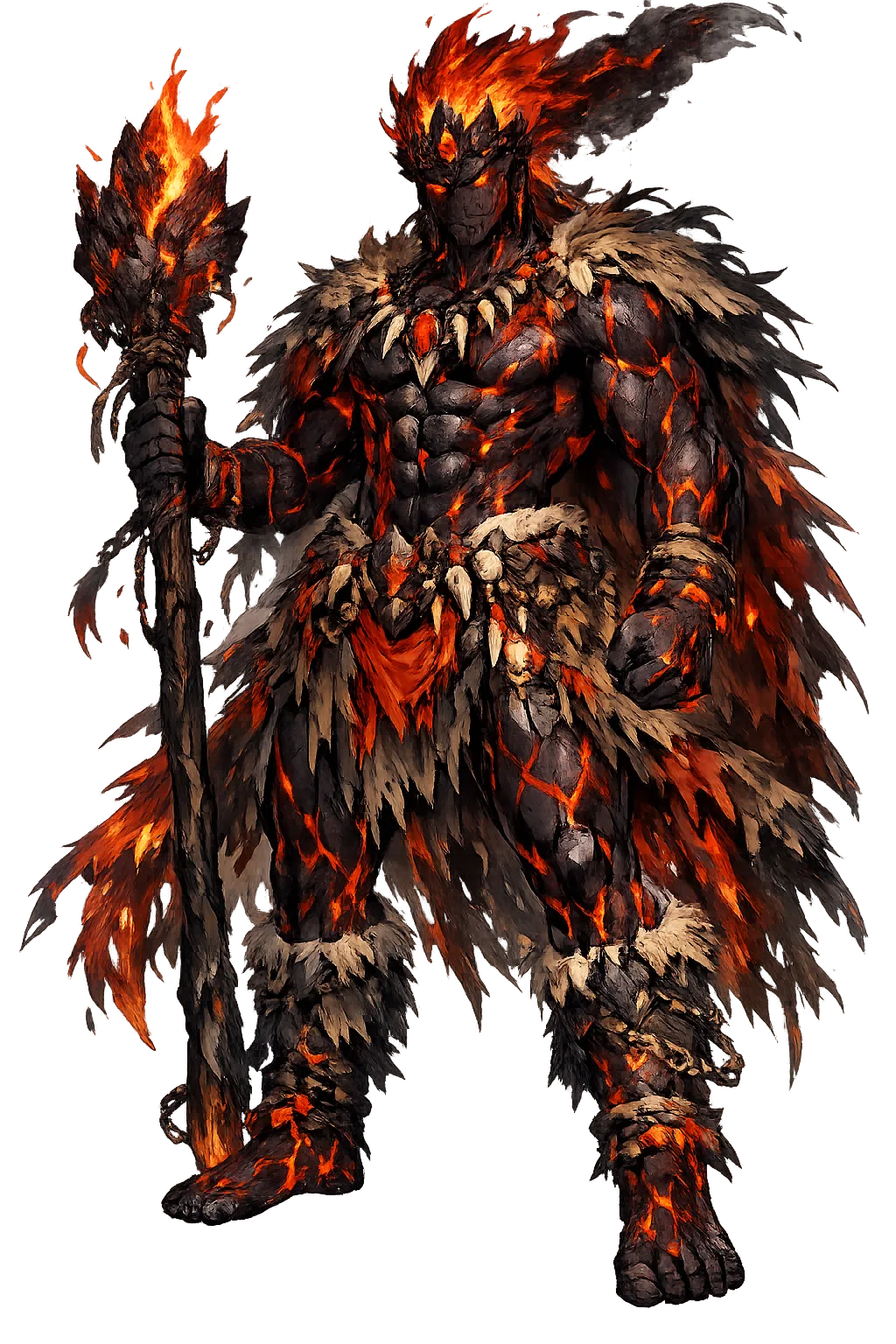
Aganjú is the orixá of the uninhabited places: volcanic earth, desert scrub, and the molten core beneath the mountain. Unlike Ṣàngó, whose fire crackles in the sky, Aganjú's fire moves slowly through stone. He is the son of Odùduwà and Ọbatalá in many accounts, the giant whose strides once shook the earth and whose breath still steams from fissures in the ground.

In Afro-Atlantic ritual he appears as Aggayú Solá, the bearer of the world, a deity so tall that rivers reach only his ankles. To invoke him is to acknowledge that civilization rests on forces older and more patient than human law.

Aganjú in Later Traditions

In Brazilian Candomblé, Aganjú is syncretised with Saint Christopher, the giant who carries the Christ child across water. In Cuban Santería he becomes Aggayú Solá, often paired with the thunder-god Ṣàngó as complementary powers of sky-fire and earth-fire. The identification with Saint Christopher preserves the theme of colossal bearing strength, while the pairing with Ṣàngó maps the volcanic interior onto the stormy sky.

Modern Legacy

Aganjú remains one of the less domesticated orixás. He is not the god of the marketplace or the bedroom; he is the god of what lies beneath and beyond. In an age of ecological awareness, his mythology reads like a warning: the ground we build on is alive, slow, and capable of overwhelming any city. His colors — red, brown, and iron — appear in Candomblé and Santería altars, and his giant stride survives in the heavy, deliberate dance of his possessed devotees.

Unicode Restoration as Cultural Act

Restoring Aganjú in a domain name is more than orthographic accuracy. It is a statement that the internet should recognize the full range of human writing — not only the ASCII keyboard.

05

Frequently Asked Questions

Common questions about Aganjú, Volcanoes, Wilderness, and Unicode restoration

01How do you pronounce Aganjú?

In reconstructed pronunciation, Aganjú is /à.gà.ɲú/ — approximately ah-gah-NYOO — start low on 'ah', stay low on 'gah', then rise sharply to 'NYOO'..

02What does Aganjú mean?

Aganjú means The uninhabited place in the yoruba tradition.

03What are the symbols of Aganjú?

Aganjú is associated with Volcanic stone (His seat and his bones; cooled lava is placed on altars to ground his presence.), Palm frond fan (Used to cool and direct his immense heat during ritual possession.), Red and brown beads (The colors of iron-rich earth, dried blood, and scorched clay.), Giant's staff (The walking stick of the world-bearer, marking his stride across deserts.).

04Why restore Aganjú in Unicode?

Plain ASCII aganju strips the stress, length, and script that make the name specific. Unicode restoration returns the name to its original written dignity.

05What is the most important myth about Aganjú?

In Yoruba cosmogony, Aganjú is born from the union of the royal ancestor Odùduwà and the white-cloth creator Ọbatalá. The story makes him kin to both earthly kingship and heavenly craftsmanship, but his own domain remains the wild land that refuses cultivation. He is the child who left the palace to live in the volcano.

06

Scholarly Sources

The philological foundations of this restoration

Every claim on this page is grounded in established scholarship. The orthographic restorations follow disciplinary convention. The etymological chain follows the best available reference works. This is not invention — it is resurrection through scholarship.

Lexicography & Philology

  • Bascom
  • Idowu

Primary Texts

  • The Ifá divination corpus; ọ̀rọ̀ àṣà and oríkì traditions; Abraham’s Dictionary of Modern Yoruba.

Archaeology & Art History

  • Material evidence — iconography, inscriptions, and temple archaeology — for Aganjú and related cults.
  • Direct archaeological attestation of Aganjú is sparse because Yoruba orixá cults were transmitted orally and through ritual objects rather than temple inscriptions. Volcanic stone implements, iron slag, and boundary markers associated with wilderness orishas appear in Yoruba archaeological contexts, while diaspora altars preserve his colours and implements (palm fronds, stones, red beads) as material continuity of his cult.

Religious Studies

  • Bascom, Ifa Divination
  • Idowu, Olódùmarè: God in Yoruba Belief
  • Mason, Four New World Yoruba Rituals
  • Verger, Notes sur le Culte des Orisa et Vodun
  • Murphy, Santería: African Spirits in America
Return

The Surface Awaits

You have traced the name from its earliest attestation to its Unicode restoration. Now return to the myth. The story is where the name lives.

Back to Lore
Aganjú mascot