
How Simargl got its accent back
The ASCII form simargl is missing something. Simargl restores the marks the source language used to distinguish this name from a thousand others — and those marks change how the name is read, pronounced, and understood. Simargl is one of the most intriguing figures in the Slavic pantheon because he is not originally Slavic at all. His name points eastward, to Iran and the ancient Near East, where the Simurgh — a fabulous winged creature — appears in Persian mythology. How did a Persian bird-beast become a Slavic deity? The answer lies in centuries of cultural contact along the steppe routes, the great highways that carried gods, goods, and stories across Eurasia. This post explains, with the full scholarly record behind it, what Simargl preserves: the Iranian connection, the reconstructed sound, the myths the name carries, and the classification logic that places him in the Slavic pantheon.
The story of Simargl is a story of cultural translation. It shows how a name and an image can travel thousands of miles, crossing language families and religious systems, and yet retain enough of their identity to be recognized. The Slavic Simargl is not the Persian Simurgh, but he is unmistakably related. He is a borrowed and transformed ancestor, a reminder that the ancient world was far more connected than we often assume.
For the contemporary visitor, Simargl offers a glimpse into the cosmopolitan religious world of early Rus'. The Slavs were not isolated pagans in a dark forest; they were participants in networks of trade and cultural exchange that stretched from the Baltic to the Black Sea and beyond. Simargl is the proof.
At a Glance
- Restored name: Simargl
- ASCII form: simargl
- Meaning: "From Simurgh (Iranian)"
- Domain of influence: Winged Guardian, Plant Life
- Pantheon: Slavic
- Classification: Tier 2
Overview
Simargl belongs to the Slavic tradition, where he is catalogued under the domains of winged guardian and plant life. His name appears in the Primary Chronicle among the gods worshipped by the pagan princes of Kievan Rus', but his origins lie much farther east. The Slavic Simargl is a borrowed and transformed version of the Iranian Simurgh, a massive bird or bird-dog creature that appears in Persian epic and myth. This borrowing is a reminder that Slavic religion was never isolated; it participated in the vast networks of exchange that linked Europe and Asia.
In the Slavic context, Simargl became a guardian figure associated with the world tree and the seeds of plant life. He is sometimes described as chained to the world tree, preventing him from devouring the world or from breaking the branch that holds the seeds of all growing things. This image combines the Iranian guardian-bird with Slavic cosmological concerns about the balance of nature and the preservation of life.
The PuniCodex restoration presents Simargl in its standard scholarly form. The ASCII form simargl is a DNS fallback; the restored form preserves the name as a proper noun and a borrowed divine name. Because the name does not require diacritics or special characters in its standard English rendering, it is classified as Tier 2. As a flagship entry, it represents the project's interest in names that cross cultural boundaries.
Simargl also raises fascinating questions about the religious world of Kievan Rus'. The pantheon described in the Primary Chronicle includes figures of Slavic, Iranian, Baltic, and possibly Finno-Ugric origin. This diversity reflects the cosmopolitan nature of the trade routes that passed through Rus' and the many peoples who contributed to its culture. Simargl is one of the clearest witnesses to this diversity.
Etymology and Meaning
The etymology of Simargl is one of the clearest cases of borrowing in Slavic religion. The name derives from Middle Persian sēnmurw or sīmurgh, which itself comes from an older Iranian form meaning "eagle bird" or "thirty birds" depending on the analysis. The Persian Simurgh is a fabulous creature with the body of a bird and sometimes the head of a dog, associated with healing, wisdom, and the protection of the divine tree.
The Slavic form Simargl shows the kind of phonetic adaptation that happens when a name travels from one language family to another. The Persian -urgh or -urw becomes Slavic -argl or -arigl, and the initial s- is preserved. Similar adaptations are known from other Iranian loans in Slavic, including words related to religion, warfare, and administration. The borrowing likely occurred during the first millennium CE, when Iranian-speaking peoples such as the Sarmatians, Scythians, and Alans were in contact with Slavic tribes on the Pontic steppe.
The meaning "From Simurgh (Iranian)" is therefore both etymological and cultural. Simargl is not merely a Slavic name that happens to sound Iranian; he is the Slavic descendant of an Iranian mythological figure. This makes him a precious witness to the religious syncretism of the Eurasian steppe, where Persian, Scythian, Slavic, and later Turkic ideas mingled and transformed one another.
The pronunciation of Simargl is approximately "SEE-mar-gl," with stress on the first syllable and a light final -gl. The name does not require diacritics in its standard English form, though some scholars may use transliteration marks when discussing the Iranian original. The restoration preserves the Slavicized form that appears in medieval sources and modern scholarship.
The Iranian Simurgh itself has a rich mythology. In the Persian epic Shahnameh, the Simurgh lives on Mount Alborz and raises the hero Zal. It is a creature of immense wisdom and power, capable of healing and prophecy. These associations with wisdom and guardianship may have influenced how the Slavs understood Simargl, though the Slavic figure is more narrowly focused on the protection of plant life.
Mythology and Domain
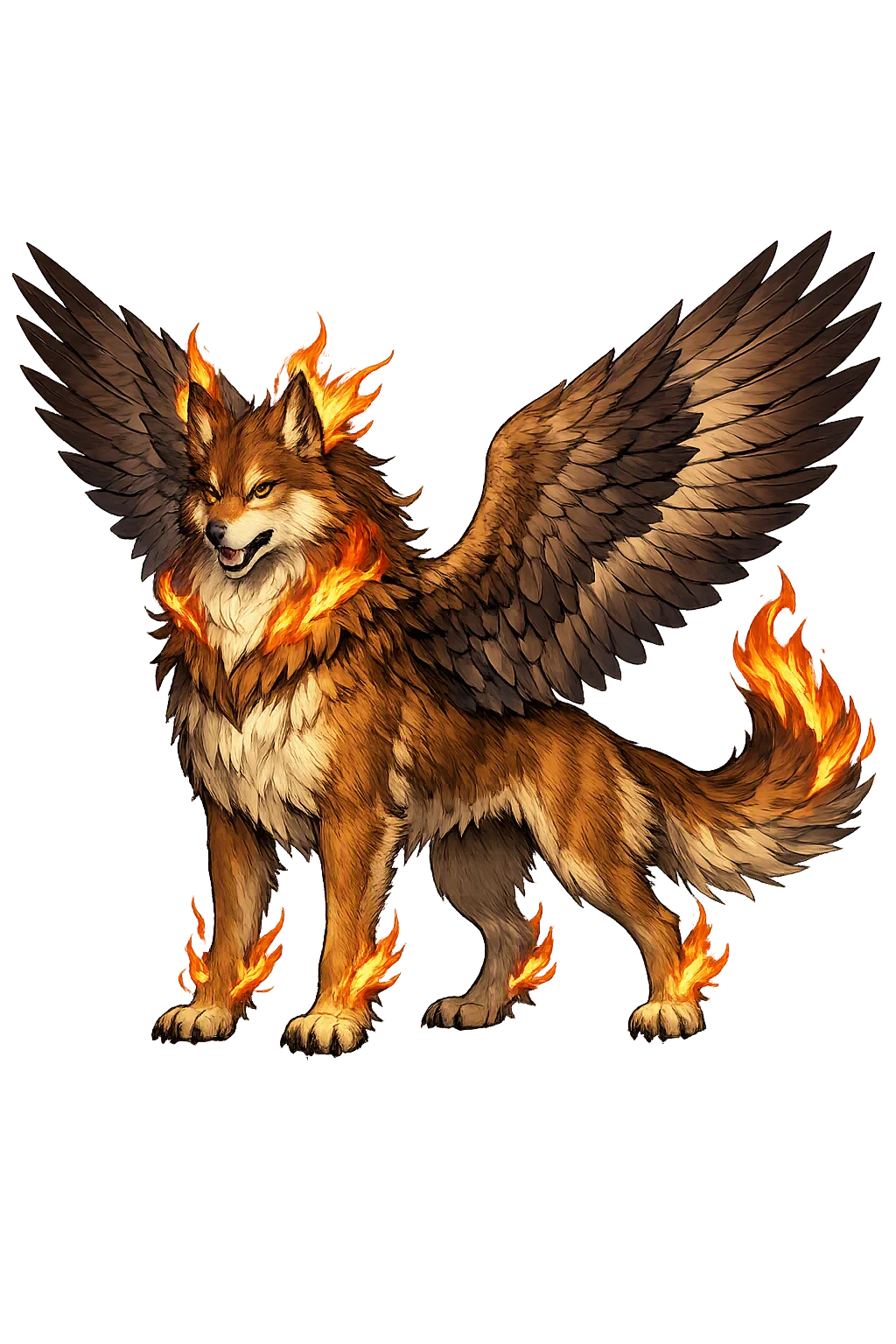
Simargl's mythology in the Slavic tradition centers on his role as a winged guardian and protector of plant life. He is often imagined as a fantastic creature, part bird and part dog or lion, chained to the world tree or guarding its branches. This imagery combines the Iranian Simurgh — a bird of immense size and power — with Slavic ideas about the cosmic tree that supports the world.
The domain of the winged guardian is central. Simargl watches over the boundary between the human world and the forces that could destroy it. His wings give him the power to travel between worlds, and his guardian role means that he must remain vigilant. The chain that binds him is a symbol of this responsibility: he is powerful enough to threaten the world, but he is restrained so that he can protect it instead.
The domain of plant life follows from his connection to the world tree. In some traditions, Simargl guards the branch that holds the seeds of all plants. If he were to break that branch, vegetation would perish and the world would wither. This makes him a deity of extraordinary importance for agriculture and the survival of life. Every spring, every harvest, every green leaf depends in some sense on his vigilance.
The Iranian background adds further depth. The Persian Simurgh lives in a tree whose branches hold the seeds of all healing plants. When the Simurgh shakes herself, the seeds fall and scatter across the earth, bringing medicine and fertility. This imagery may underlie the Slavic idea of Simargl as a guardian of plant life. The borrowed figure has been adapted to Slavic cosmology, but it still carries traces of its eastern origin.
The world tree is a central image in many Eurasian mythologies, including the Slavic. It stands at the center of the world, its roots reaching into the underworld and its branches touching the sky. A guardian of the world tree is thus a guardian of the entire cosmic order. Simargl's role at the tree places him among the most cosmologically significant figures of the Slavic pantheon, even if his cultic documentation is sparse.
Cultural Legacy
Simargl's cultural legacy is a fascinating mixture of scholarly reconstruction, fantasy art, and pagan revival. Because his Iranian origins are well understood, he has become a symbol of the cosmopolitan nature of Slavic religion. He reminds us that the Slavs were not isolated forest-dwellers but participants in a wider Eurasian world where ideas traveled along with trade goods and languages.
In academic scholarship, Simargl is often discussed alongside other Iranian borrowings in Slavic culture, including the god Svarog, whose name may also have Iranian connections. These discussions highlight the importance of the steppe frontier in shaping early Slavic civilization. The gods of the Rus' were not purely Slavic; they were a blend of inherited Indo-European, local Slavic, and borrowed Iranian elements.
In contemporary Slavic Native Faith and related movements, Simargl is honored as a guardian of nature and a protector of plant life. Rituals in his honor may involve trees, seeds, and offerings of grain or fruit. Some practitioners also draw on Iranian imagery, invoking him as a winged being who carries prayers between earth and sky. The figure appeals to those who see Slavic religion as connected to a broader Eurasian spirituality.
Simargl has also inspired artists and writers, particularly those interested in the visual possibilities of a winged guardian. He appears in fantasy illustrations, games, and comics as a creature of awe-inspiring size and power. These depictions vary widely in accuracy, but they keep the name and the basic image in circulation.
The image of Simargl as a winged dog or bird-lion is particularly striking. It combines the familiar and the fantastic in a way that appeals to the imagination. Artists have depicted him with feathered wings, sharp talons, and a watchful gaze, chained to a great tree or hovering protectively over a seed-filled branch. These modern visualizations may go beyond the historical evidence, but they capture something essential about the figure's symbolic role.
Unicode Restoration and Conclusion
The PuniCodex restoration of Simargl returns the name to its scholarly spelling. The ASCII form simargl is a technical fallback that strips the name of its status as a proper noun and obscures its Iranian-Slavic heritage. The restored form, with its capital S, marks Simargl as a figure of myth and religion, a borrowed name that became a Slavic deity.
The restoration is especially appropriate for a figure whose story is about cultural transmission. Simargl traveled from Persian myth to Slavic worship along the same routes that carried silk, spices, and alphabet systems. His name is a reminder that the ancient world was more connected than we sometimes imagine. The Unicode domain allows that story to be told under the correct name, preserving the marks that distinguish Simargl from ordinary words.
The restoration also honors the principle that borrowed names are still real names. Some might dismiss Simargl as a foreign import unworthy of a Slavic pantheon. But the history of religion is full of borrowed deities who became thoroughly naturalized in their new homes. Isis in Rome, Ganesha in Southeast Asia, and the Japanese Benzaiten all testify to the power of cultural borrowing. Simargl belongs in this company.
The restoration of Simargl also celebrates the phenomenon of mythological migration. In an age of debates about cultural purity and authenticity, Simargl stands as evidence that religions have always borrowed, adapted, and transformed. The Persian Simurgh did not lose its identity by becoming Slavic; it gained a new life. The restored name honors both the Iranian source and the Slavic adaptation, refusing to reduce the figure to either one.
In the end, Simargl got his accent back not because of a single diacritic — the standard form needs none — but because the restoration gives the name back its proper shape and status. He is the winged guardian, the protector of plant life, the Iranian visitor who became a Slavic god. The restoration ensures that this remarkable name continues to fly.
Simargl and the World Tree
The image of Simargl chained to the world tree is one of the most evocative in Slavic mythology. It combines the Iranian guardian-bird with a cosmological symbol shared by many Eurasian peoples: the great tree that stands at the center of the world, connecting sky, earth, and underworld. In this image, Simargl is not merely a protector of plants but a guardian of the entire cosmic order. His vigilance ensures that the tree remains intact and that the world continues to flourish.
The world tree appears in many forms across the Indo-European world. The Norse Yggdrasil, the Baltic world tree, and various Iranian and Indian cosmic trees all share the basic idea of a central axis that supports the cosmos. For the Slavs, the world tree was probably imagined as an oak or a linden, the sacred trees of the region. Its roots reached into the realm of the dead, its trunk supported the world of humans, and its branches touched the sky.
Simargl's position at the tree gives him a liminal role. He stands at the center of the world, where all realms meet. This makes him a mediator between worlds, capable of traveling from the depths to the heights on his wings. It also makes him dangerous. A guardian who can move between worlds is a being of immense power, and the chain that binds him is a recognition of that power. He is restrained not because he is evil but because his freedom would threaten the balance he protects.
The branch of seeds that Simargl guards is a particularly rich symbol. Seeds contain the potential for all future plant life. They are the memory of past harvests and the promise of future ones. By guarding the branch of seeds, Simargl guards the continuity of life itself. This connects him to agriculture, medicine, and the cyclical renewal of nature. Every planted field is, in a sense, an invocation of Simargl's vigilance.
The chain that binds Simargl also deserves attention. In many mythologies, chains are used to restrain dangerous or chaotic forces: the Norse wolf Fenrir, the Greek Titans, and various demons across cultures. But Simargl is not a chaotic force to be defeated; he is a necessary guardian to be kept in place. The chain is thus a symbol of responsibility rather than punishment. It marks the boundary between protective power and destructive freedom.
Modern interpretations of Simargl often emphasize ecological themes. As a guardian of plant life and the world tree, he can be seen as a patron of biodiversity and environmental balance. In an age of deforestation and climate change, the image of a winged being protecting the source of all vegetation takes on urgent meaning. Simargl becomes not only an ancient deity but a symbol of the need to protect the natural world.
The Unicode restoration of Simargl supports these interpretations by giving the name a stable digital home. Under the restored spelling, scholars, artists, and environmental thinkers can gather to discuss Simargl's mythology and its modern resonances. The domain becomes a new branch on the world tree, a place where the guardian's name can be honored and his story told.
In the end, Simargl's connection to the world tree elevates him from a borrowed exotic figure to a central cosmic guardian. He reminds us that the preservation of life depends on vigilance, balance, and respect for the structures that sustain the world. The restoration ensures that this profound symbol continues to be spelled and understood correctly.
The restoration of Simargl ultimately celebrates the long history of cultural exchange. From Persian epic to Slavic chronicle to modern domain, the name has traveled far, adapting to each new context without losing its core identity. Simargl reminds us that mythology has always been a conversation across languages and peoples, and that the most interesting figures often have the most complex passports.
Related Names
- Baba Jagá — Forest Witch, Death
- Černobog — Darkness, Chaos, Evil
- Dažbog — Sun, Wealth, Giving
- Domovój — Household Spirit
- Kikimóra — House Spirit, Swamp Hag
Sources
- N. I. Tolstoi et al., Slavic Antiquities: Ethnolinguistic Dictionary (1995–2012).
- Vyacheslav Ivanov & Vladimir Toporov, comparative Slavic mythology studies.
- L. Niderle, The Slavic Antiquities (1902–1924).