The Living Myth
Victory, Dragon-Slaying, Heroism · Victory-guardian (from sigr, victory, + vǫrðr, guardian)
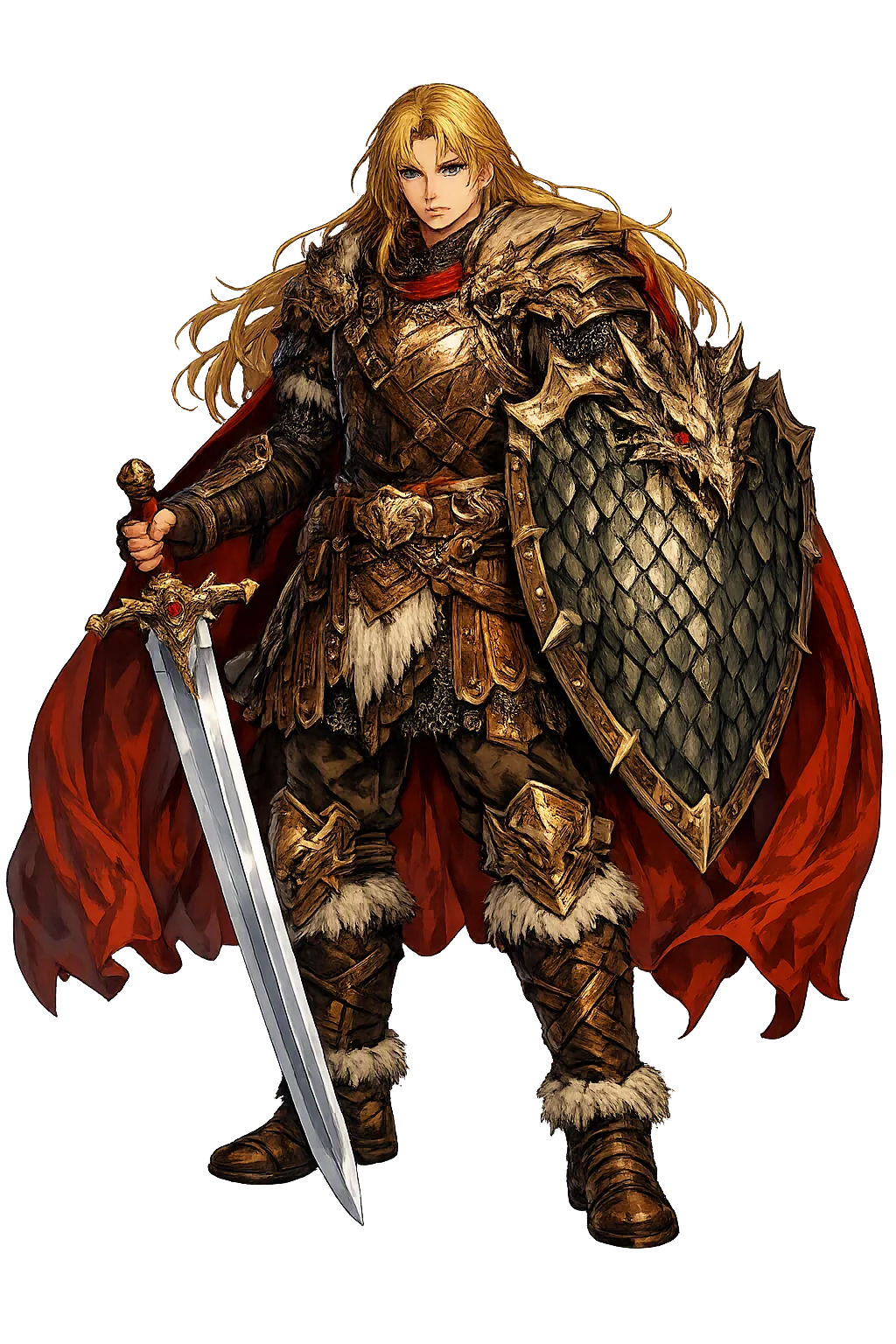
Stories of Sigurðr
Sigurðr is the dragonslayer of the Vǫlsunga cycle, the Norse original of the German Siegfried and the last great hero of the legendary North. Son of Sigmundr and Hjǫrdís, fostered by the smith Reginn, he reforged his father's sword, killed the dragon Fáfnir, and woke the valkyrie Brynhildr from her enchanted sleep — then lost her, and his life, to a draught of forgetfulness and the plotting of his sworn brothers. His story survives in the Poetic Edda, the Prose Edda, and Vǫlsunga saga, and through the Middle High German Nibelungenlied it became the backbone of Wagner's Ring. Where the gods of the Edda face a doom they know is coming, Sigurðr faces one he has forgotten — and that is the more human tragedy.
At the wedding feast of his sister Signý, a one-eyed stranger — Óðinn — thrust a sword to the hilt into the tree Barnstokkr that grew through the hall of Vǫlsungr, and only Sigmundr of all the company could draw it. Years later Sigmundr fell in battle, the sword shattering beneath him against the same god's spear, and his widow Hjǫrdís carried the shards away for her unborn son. That son, Sigurðr, was fostered by Reginn, a smith of the dwarf-kin, who urged him against the dragon Fáfnir and forged blade after blade that broke under the boy's testing — until Sigurðr demanded the shards of his father's sword be worked into the new steel. Reginn reforged them into Gramr, and the boy clove the smith's anvil to the stock and sheared a tuft of wool drifting on the current as though it were standing stone (Vǫlsunga saga 13–15; Reginsmál).
The blade binds the hero to Óðinn from birth: the god who gave the sword also broke it, and the steel that passes from father to son is the visible thread of a destiny the boy never chose. In the North, inheritance is not property but appointment.
Fáfnir was Reginn's brother, who had killed their father Hreiðmarr for the hoard paid as weregild for the slain Ótr, and crawled away to Gnitaheiðr, where greed long brooding over gold twisted him into a dragon. Guided by a one-eyed old man who would not give his name, Sigurðr dug a trench across the worm's path to the water and lay in it; when Fáfnir crawled overhead he thrust Gramr upward into the heart. The dying dragon warned him that the gold would be his death, and the hero answered with the northern creed: every man must die, and wealth must serve until that day (Fáfnismál; Vǫlsunga saga 18–20). Roasting the heart for Reginn, Sigurðr burned his finger, set it in his mouth, and the heart-blood opened the speech of birds to him: the nuthatches in the branches warned that the smith meant to kill him. He took Reginn's head, loaded the cursed gold onto Grani, and rode away the richest and most doomed man in the North.
The birds that save him here will not be there at the end. The episode's point is exact: the monster's death transfers the monster's curse, and every new owner of the gold only inherits it.
Before the dragon, on Hindarfjall, Sigurðr found the vafrlogi — a wall of flame no horse would cross — and within it a hall where a warrior slept in full armor, as if dead. The sleep-thorn in her corslet marked her as a valkyrie; he drew Gramr and cut the armor from her, and she woke as Brynhildr and taught him the runes and the lore of the worlds: the healing runes, the ale-runes, the speech of victory and the speech of weddings, and the caution that shapes the whole cycle — never to swear falsely (Sigrdrífumál; Vǫlsunga saga 21–22). They plighted their troth and parted, and she prophesied what he would forget.
The flame-wall is the cycle's question about fate: it parts for the destined rider and for no one else, and the man it admits is not thereby saved from what comes after.
At the court of Gjúki's sons the queen Grímhildr brewed Sigurðr the ale of forgetfulness, and Brynhildr passed from his mind as if she had never been. He married Guðrún, swore oaths with her brothers Gunnarr and Hǫgni, and when Gunnarr wooed Brynhildr and could not cross the flames, Sigurðr exchanged shapes with him and rode the fire in his friend's likeness — wooing his own forgotten beloved for another man, with a drawn sword laid between them in the bridal bed (Vǫlsunga saga 28; Guðrúnarkviða I). The deception could not hold: from a ring and a quarrel at the washing-stones Brynhildr learned what had been done, and wounded in her pride she demanded the death of the man who had ridden the flames and then married another.
The betrayal is the cycle's quiet engine: no one in it acts from malice until the ale is brewed — the draught of forgetfulness is the one weapon the curse of gold did not need to supply.
The brothers, bound to Sigurðr by oath, could not strike him; they incited the younger Guthormr, who had sworn nothing, and he stabbed Sigurðr as he slept. Some lays — Sigurðarkviða en skamma and Guðrún's own laments — have him slain out of doors, in the forest; Brot af Sigurðarkviðu, preserved only in a fragment around the Codex Regius lacuna, gives the death in bed and the last words. Dying, Sigurðr spoke gently to Guðrún, named the true traitors, and flung Gramr after the killers; the sword caught Guthormr in the doorway and took him too. Brynhildr laughed once at the bier, told the truth at last, and went onto the pyre to lie beside him (Sigurðarkviða en skamma; Vǫlsunga saga 31–32).
The sources disagree on the place but not on the meaning: the hoard's curse reached the man who thought himself above it, through the only door he had left open — the trust of those he called his own.
The domain of Sigurðr
In the norse tradition, Sigurðr governed victory, dragon-slaying, heroism. The name encodes a sphere of power that shaped ritual, narrative, and social order.
His is the northern form of the greatest heroic story the Germanic world ever told: the foster-son of a smith who reforged his father's shattered sword, the slayer of the dragon Fáfnir, the wooer of the valkyrie behind the flame, and the oath-brother destroyed by the very loyalty that made him great. What the Iliad is to Greece, the Vǫlsunga cycle is to the North.
The sword Óðinn thrust into the tree Barnstokkr and only Sigmundr could draw; shattered in his last battle, reforged by Reginn for the son who would avenge him.
The brother turned dragon by greed, slain by a hero lying in a trench; from his heart-blood Sigurðr learned the speech of birds.
Through the vafrlogi on Hindarfjall rode Grani's rider to wake Brynhildr, the valkyrie Óðinn had sunk in sleep — the oath sworn there could not survive the world of men.
Andvari's gold, paid as weregild for Ótr and cursed at its surrender; every hand it passed through — Hreiðmarr, Fáfnir, Sigurðr, the Gjúkings — it brought to ruin.
From the original script to the living URL
ᛋᛁᚴᚢᚱᚦᛦ
The name in its original Norse form. Sigurðr (ᛋᛁᚴᚢᚱᚦᛦ) is attested in the source tradition — “Victory-guardian (from sigr, victory, + vǫrðr, guardian)”. Its original diacritics and script distinctions carry the full phonetic and orthographic weight of the source tradition.
sigurd
Reduced to plain sigurd, the name loses everything that made it specific: original diacritics and script distinctions. What remains is an ASCII string that machines can parse but that no longer speaks with its original voice.
Sigurðr
The Unicode restoration recovers what ASCII flattened. Sigurðr restores original diacritics and script distinctions, returning the name to its original written dignity. The domain encodes to Punycode, but the browser displays the truth.
Sigurðr.com → xn--sigurr-twa.com
The non-ASCII characters in Sigurðr are encoded while the ASCII remains visible. To the DNS, it is Punycode. To humanity, it is Sigurðr.
Owned, ideal, and ASCII forms of Sigurðr
Sigurðr
Restores ᛋᛁᚴᚢᚱᚦᛦ. The live temple domain — sigurðr.com.
sigurd
Flattens ᛋᛁᚴᚢᚱᚦᛦ. The plain ASCII fallback — what DNS and legacy systems see.
How Sigurðr was spoken
How Sigurðr travels from ancient script to the modern URL
The lore you have read is the living myth. Extended Lore opens the scholarly vault beneath it: the cult and its material remains, a history of the image, the name after antiquity, a meditation on what the name still means, and the full scholarly apparatus — etymology, orthography, sources.
Enter Extended Lore