
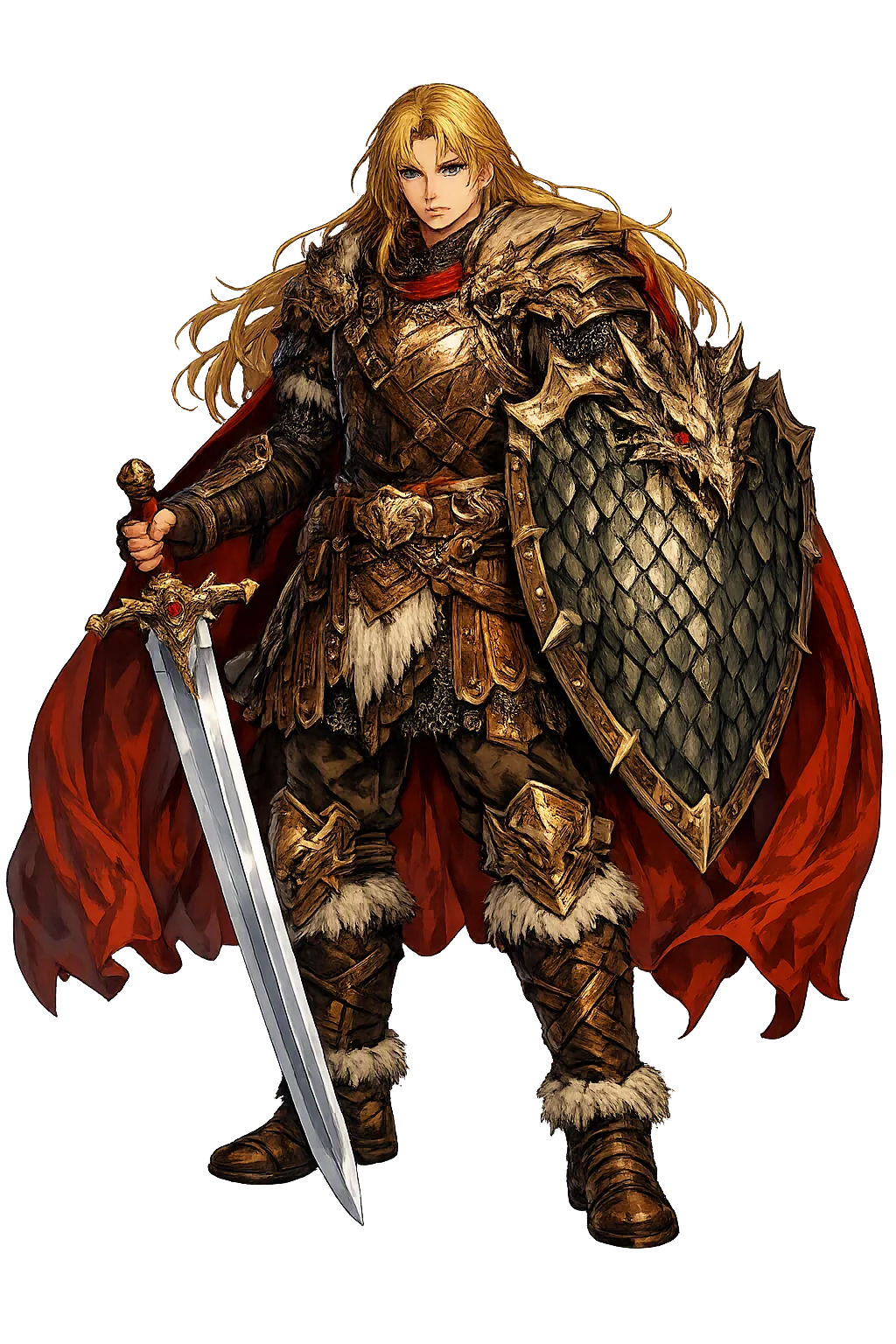
Sigurðr in 2026: why scholars still care
In 2026, names are treated as data points. Sigurðr is a reminder that they are also cultural artifacts — and that the difference matters for search engines, AI training corpora, and anyone who types the name of a Norse figure into a browser. Scholars never stopped caring about the difference between sigurd and Sigurðr; the web simply made that care actionable. What follows is the full scholarly picture — name, script, sound, myth, cult, and legacy — followed by the engineering compromise that lets a restored spelling live at a real address. The question is not whether the name is old. It is whether the digital world is old enough to hold it.
At a Glance
- Restored name: Sigurðr
- ASCII form: sigurd
- Meaning: "Victory-guardian (from sigr, victory, + vǫrðr, guardian)"
- Domain of influence: Victory, Dragon-Slaying, Heroism
- Pantheon: Norse
- Classification: Tier 1
- Live domain: sigurðr.com
Overview
Sigurðr (sigurd) — Victory, Dragon-Slaying, Heroism · Victory-guardian (from sigr, victory, + vǫrðr, guardian) — belongs to the Norse tradition, where it is catalogued under the domain "Victory, Dragon-Slaying, Heroism". The name means "Victory-guardian (from sigr, victory, + vǫrðr, guardian)".
In the norse tradition, Sigurðr governed victory, dragon-slaying, heroism. The name encodes a sphere of power that shaped ritual, narrative, and social order.
His is the northern form of the greatest heroic story the Germanic world ever told: the foster-son of a smith who reforged his father's shattered sword, the slayer of the dragon Fáfnir, the wooer of the valkyrie behind the flame, and the oath-brother destroyed by the very loyalty that made him great. What the Iliad is to Greece, the Vǫlsunga cycle is to the North.
PuniCodex restores the name as Sigurðr and serves its temple at sigurðr.com. The restoration preserves at least one distinctive feature — a diacritic or a distinctive letter — that the ASCII form loses, and exactly one historically valid Unicode restoration exists, which places the name in Tier 1. The plain ASCII form sigurd survives as a modern convenience imposed by the early domain-name system; the restoration, not the fallback, is the form the project defends as philologically complete.
The Name
No indigenous written attestation survives for this name; Sigurðr is a scholarly transliteration of the reconstructed spoken form. Etymologically the name means "Victory-guardian (from sigr, victory, + vǫrðr, guardian)".
The ASCII form sigurd survives only because the early domain-name system could not carry diacritics; it is a technological compromise, not an ancient spelling. The Unicode restoration Sigurðr recovers the full diacritic detail of the scholarly transliteration directly in the address bar. The restoration preserves at least one distinctive feature — a diacritic or a distinctive letter — that the ASCII form loses, and exactly one historically valid Unicode restoration exists, which places the name in Tier 1.
The letter-by-letter transformation runs:
- s → S — Same, capitalized
- i → i — Same
- g → g — Same
- u → u — Same
- r → r — Same
- d → ðr — Eth ð (voiced dental fricative) + nominative -r of Sigurðr
The project holds the domain sigurðr.com (xn--sigurr-twa.com) as the canonical home of this name.
The Original Script
The original script for this norse name has not yet been added to PUNICODEX. The form shown is a scholarly transliteration.
The form Sigurðr is therefore a scholarly transliteration rather than an attested ancient spelling; it encodes the reconstructed sound of the name for modern use, and no mark in it is decorative.
The medieval Norse wrote Sigurðr in the Latin alphabet the Icelanders adapted for their vernacular, and it is in that script — Codex Regius, the Vǫlsunga saga manuscripts — that the name is preserved. The hero's own age wrote in the Younger Futhark, the sixteen-rune alphabet carved on the memorial stones that depict his deeds; reduced to sixteen signs, it did not even distinguish ð from þ or d from t, so the full sound of the name was never recoverable from runes alone. The restored form Sigurðr keeps both features the Latin-script manuscripts attest: the eth ð, the voiced dental fricative, and the nominative ending -r. As a registrable domain the Unicode form carries the eth that the ASCII sigurd flattens to d — the punycode encodes exactly what the saga scribes wrote.
Pronunciation
The reconstructed pronunciation of the name is /ˈsiɣ.urðr̩/ — Old Norse Reconstruction.
Phoneme by phoneme:
- S — Voiceless alveolar sibilant [s], as in English 'sea'
- i — Short close front [i]; the first syllable carries the stress
- g — Medial voiced velar fricative [ɣ]; between vowels Old Norse g softened to a glide, closer to the Spanish g of 'lago' than a hard stop
- -urðr — Short [u], alveolar trill [r], the voiced dental fricative [ð] — the soft 'th' of 'father' — and the final nominative ending -r, syllabic after the eth
For the modern speaker, the closest approximation is: 'SIG-urthr' — stress the first syllable, soften the middle g almost to a glide, sound the ð as the soft 'th' of 'father', and let the final -r hang as a light voiced syllable; it is the Old Norse nominative ending, not a separate vowel.
Kindred and historical forms of the name:
- Old Norse — Sigurðr, the form of the Vǫlsunga cycle and the Eddic lays
- Modern Icelandic — Sigurður, the living form with the epenthetic -u- before the final -r
- German — Siegfried, the continental cognate of the Nibelungenlied and Wagner's Ring
- Anglicized — Sigurd, the conventional English rendering, dropping the eth and the nominative -r
Sigurðr is Tier 1: the eth ð is a distinctive letter the ASCII form loses, and the final -r preserves the Old Norse nominative ending that English drops entirely. Cleasby-Vigfusson (s.v. Sigurðr) and Zoëga (s.v. Sigurðr) record the form as the name of the Vǫlsung hero; the name compounds sigr, 'victory', with -vǫrðr, 'guardian', yielding 'victory-guardian', and answers to the continental German Siegfried.
Mythology
Sigurðr is the dragonslayer of the Vǫlsunga cycle, the Norse original of the German Siegfried and the last great hero of the legendary North. Son of Sigmundr and Hjǫrdís, fostered by the smith Reginn, he reforged his father's sword, killed the dragon Fáfnir, and woke the valkyrie Brynhildr from her enchanted sleep — then lost her, and his life, to a draught of forgetfulness and the plotting of his sworn brothers. His story survives in the Poetic Edda, the Prose Edda, and Vǫlsunga saga, and through the Middle High German Nibelungenlied it became the backbone of Wagner's Ring. Where the gods of the Edda face a doom they know is coming, Sigurðr faces one he has forgotten — and that is the more human tragedy.
The Reforging of Gramr (Vǫlsunga saga)
At the wedding feast of his sister Signý, a one-eyed stranger — Óðinn himself — thrust a sword to the hilt into the tree Barnstokkr that grew through the hall of Vǫlsungr, and only Sigmundr of all the company could draw it. Years later Sigmundr fell in battle, the sword shattering beneath him against the same god's spear, and his widow Hjǫrdís carried the shards away for her unborn son. That son, Sigurðr, was fostered by Reginn, a smith of the dwarf-kin, who urged him against the dragon Fáfnir and forged blade after blade that broke under the boy's testing.
Only the shards of his father's sword held. Reginn reforged them into Gramr, and Sigurðr clove the smith's anvil to the stock and sheared a tuft of wool drifting downstream as though it were stone. The episode binds the hero to Óðinn from birth: the god who gave the sword also broke it, and the blade that passes from father to son is the visible thread of a destiny the boy never chose.
The Slaying of Fáfnir (Fáfnismál)
Fáfnir was Reginn's brother, who killed their father Hreiðmarr for the hoard paid as weregild for the slain Ótr and crawled away to Gnitaheiðr, where greed long brooding over gold twisted him into a dragon. Guided by a one-eyed old man, Sigurðr dug a trench across the dragon's path to the water and lay in it; when Fáfnir crawled overhead, he thrust Gramr upward into the heart. The dying dragon questioned his slayer and warned him that the gold would be his death — a warning Sigurðr answered with the hero's creed that every man must die, and wealth must serve until that day.
Roasting the dragon's heart for Reginn, Sigurðr burned his finger and set it in his mouth, and the heart-blood opened the speech of birds to him: the nuthatches in the branches warned that Reginn meant to kill him. He cut off the smith's head, loaded the cursed hoard onto Grani, and rode away the richest and most doomed man in the North. The birds that save him here will not be there at the end.
The Ale of Forgetfulness (Guðrúnarkviða)
Sigurðr rode through the vafrlogi, the flame-wall on Hindarfjall, and woke Brynhildr, the valkyrie Óðinn had pricked with the sleep-thorn; they plighted their troth and parted. At the court of Gjúki's sons, the queen Grímhildr brewed him the ale of forgetfulness, and Brynhildr passed from his mind as if she had never been. He married Guðrún, swore oaths with her brothers Gunnarr and Hǫgni, and when Gunnarr sought Brynhildr's hand and could not cross the flames, Sigurðr exchanged shapes with him and rode the fire in his likeness — wooing his own forgotten beloved for another man, with a drawn sword laid between them in the bed.
The deception could not hold. Brynhildr learned from a ring and a quarrel at the river what had been done, and wounded in her pride she demanded Sigurðr's death. The brothers, bound to him by oath, incited the unsworn Guthormr, who stabbed Sigurðr as he slept; some lays — Sigurðarkviða en skamma and Guðrún's own laments — have him slain instead out of doors, in the forest. The texts disagree on the place but not on the meaning: the hoard's curse had reached the man who thought himself above it, through the only weapon that could touch him, the trust of those he called his own.
Symbols & Iconography
The iconography associated with Sigurðr concentrates in a small set of recurring attributes, each a compressed statement about the name:
- Gramr — The reforged sword of Sigmundr, drawn from Barnstokkr and mended by Reginn; with it Sigurðr slew Fáfnir
- Grani — The grey horse of Sleipnir's line who bore Sigurðr through the flame-wall and carried the dragon's gold from Gnitaheiðr
- Andvaranautr and the hoard — The dwarf Andvari's ring and gold, taken as ransom and cursed at the taking — the engine of every death in the cycle
- The dragon's heart-blood — Roasting Fáfnir's heart, Sigurðr tasted the blood and understood the birds — knowledge bought from the monster he killed
- The vafrlogi flame-wall — The ring of fire around the sleeping Brynhildr, crossable only by the destined rider; crossed twice, once for love and once in betrayal
Archaeology & Evidence
The Sigurðr cycle is the most widely depicted heroic legend of the Viking Age. The Ramsund carving (Sö 101) in Södermanland, Sweden, shows the whole Gnitaheiðr episode in one frame — Sigurðr piercing the serpent from below, the heart roasting over the fire, the thumb in his mouth, the listening birds, the headless Reginn, and Grani laden with the gold — and the nearby Gök stone (Sö 327) quotes the same scene within a runic serpent band. The Drävle runestone (U 1163) in Uppland adds a further Swedish depiction, while across the North Sea the Manx cross-slabs, above all the Kirk Andreas cross, show Sigurðr roasting Fáfnir's heart, proof the legend travelled with Norse settlers. In Norway the carved portal of Hylestad stave church (c. 1200) narrates the cycle panel by panel, from the forging of Gramr to Reginn's death. The textual tradition is Icelandic and later: the heroic lays of the Poetic Edda survive chiefly in the Codex Regius (GKS 2365 4to, c. 1270), whose famous eight-leaf lacuna has cost us the fullest form of the Sigurðr lays — Brot af Sigurðarkviðu preserves only a fragment — while Vǫlsunga saga itself (c. 1270) survives in paper copies of the lost vellum NKS 1824 b 4to.
Realm & Domain
In the norse tradition, Sigurðr governed victory, dragon-slaying, heroism. The name encodes a sphere of power that shaped ritual, narrative, and social order.
His is the northern form of the greatest heroic story the Germanic world ever told: the foster-son of a smith who reforged his father's shattered sword, the slayer of the dragon Fáfnir, the wooer of the valkyrie behind the flame, and the oath-brother destroyed by the very loyalty that made him great. What the Iliad is to Greece, the Vǫlsunga cycle is to the North.
Gramr
The sword Óðinn thrust into the tree Barnstokkr and only Sigmundr could draw; shattered in his last battle, reforged by Reginn for the son who would avenge him.
Fáfnir at Gnitaheiðr
The brother turned dragon by greed, slain by a hero lying in a trench; from his heart-blood Sigurðr learned the speech of birds.
The Flame-Wall
Through the vafrlogi on Hindarfjall rode Grani's rider to wake Brynhildr, the valkyrie Óðinn had sunk in sleep — the oath sworn there could not survive the world of men.
The Cursed Hoard
Andvari's gold, paid as weregild for Ótr and cursed at its surrender; every hand it passed through — Hreiðmarr, Fáfnir, Sigurðr, the Gjúkings — it brought to ruin.
Across Cultures
Sigurðr is the northern twin of a pan-Germanic hero. The continental tradition — preserved in the Middle High German Nibelungenlied (c. 1200), the Lied vom Hürnen Seyfrid, and the Old Norse Þiðreks saga, which repatriates German material — tells of the same dragon-fight, hoard, and betrayal under the name Siegfried, with the details reworked: the valkyrie becomes a Burgundian queen, the flame-wall drops away, and the murder moves to a forest spring. Scholars have long read the cycle's skeleton against history, seeing in Gunnarr and the fall of the Gjúkings the shadow of the Burgundian kingdom destroyed by the Huns in 437 — legend crystallized around remembered catastrophe. The dragon-slaying itself belongs to a still older inheritance: the Indo-European formula of the hero who kills the serpent, traced by Calvert Watkins through Indra and Vṛtra, Herakles and the Lernaean hydra, and Beowulf's fatal last fight. In later folklore the story lived on in the Faroese Sjúrðar kvæði ballads, still sung and danced in the islands centuries after the saga manuscripts were copied.
Within the Norse tradition, closely related names in the corpus include Álfheimr, Bifrǫst, Búri, Eggþér, Fáfnir, and Helheimr.
Cultural Legacy
No Norse figure has had a longer second life. William Morris retold the cycle in his epic The Story of Sigurd the Volsung and the Fall of the Niblungs (1876), which he called the great story of the North that should be to all his race what the tale of Troy was to the Greeks. Richard Wagner made it the armature of Der Ring des Nibelungen — Siegfried and Götterdämmerung follow the Norse sources where the Nibelungenlied had softened them, restoring the valkyrie Brünnhilde to the centre. Arthur Rackham's illustrations fixed the cycle's visual grammar for a century, and J. R. R. Tolkien, who read the Eddas closely, composed his own The Legend of Sigurd and Gudrún in Eddic metre. The dragonslayer persists in opera houses, novels, games, and film wherever a hero wins gold and is destroyed by it. In modern heathenry Sigurðr is honoured less as an object of cult than as the model of the heroic ethic — courage held fast inside a fate already written — and the runestones that depict him are among the tradition's most cited monuments. Restoring Sigurðr in Unicode keeps the eth and the nominative -r that the German Siegfried and the anglicized Sigurd alike have lost.
The Scholarly Record
The account of Sigurðr given in this edition rests on the witnesses and reference works listed below. Lexica and etymological dictionaries secure the form and meaning of the name; the literary and religious texts supply the narrative evidence.
- Vǫlsunga saga — The Story of the Volsungs, trans. William Morris & Eiríkr Magnússon (Project Gutenberg). Full text
- The Poetic Edda, trans. Henry Adams Bellows — Reginsmól, Fáfnismól, Sigrdrífumál, Brot af Sigurðarkviðu, Sigurðarkviða en skamma, Guðrúnarkviða (Sacred Texts). Full text
- The Prose Edda of Snorri Sturluson, trans. Arthur Gilchrist Brodeur — Skáldskaparmál's retelling of the Vǫlsung cycle (Sacred Texts). Full text
- Sigurd (encyclopedia entry). Full text
- Völsunga saga (encyclopedia entry). Full text
- Nibelungenlied (encyclopedia entry). Full text
- Der Ring des Nibelungen (encyclopedia entry). Full text
- Fáfnir (encyclopedia entry). Full text
A Meditation
Names are not merely labels; they are compressed worlds. Sigurðr carries within it a norse understanding of victory under guard: sigr, the thing won, held by a vǫrðr, a watcher — as if the North already knew that every victory needs defending, and that the guard can fail. The hero who bore the name guarded the hoard, the oath, and the bride, and lost all three to a single draught of ale; the name outlived the man by eight centuries and counting. Unicode restoration returns that world to readable form: the eth that softens the ending, the final -r that marks him as the subject of his own sentence.
The Unicode Restoration
Sigurðr is classified as Tier 1: the restoration preserves at least one distinctive feature — a diacritic or a distinctive letter — that the ASCII form loses. The ASCII fallback sigurd still resolves everywhere, but it is the restored form that carries the name's full information. Across the 6 characters of the name, the restoration adjusts 1: 1 further adjustment (ðr). That is the whole thesis of this temple: the marks are the message.
The Domain Name
The restored name is live as a working domain: sigurðr.com, which the DNS carries in punycode form as xn--sigurr-twa.com — an ASCII-compatible encoding that lets a non-ASCII name travel the global network without breaking older infrastructure. The visitor sees Sigurðr; the machines see the encoding. That duality is the engineering compromise on which the entire restoration rests, and it is why a name written the way its own tradition wrote it in Runes can now be typed into any browser on earth.
Why This Restoration Matters
In 2026 the stakes are practical. Search indexes, language models, and localization pipelines all inherit whatever spelling the web normalizes — which means every Unicode domain is also a training signal. Sigurðr teaches the machinery that the restored form exists, that it is used, and that it points to a real place. That is why a project built on philology ends up caring about DNS: the infrastructure decides which names the future sees. This restoration makes sure the future sees the whole name.
Explore Further
This post is one doorway into the temple. The home page carries the full character breakdown and the ambient canvas; the lore page tells the myths in long form; the Scholarly Edition preserves the sources, pronunciation data, and revision history; and the patron wall supports the restoration directly. For the wider map, browse the Lexicon, explore the Pantheon, or return to the PuniCodex blog.
Related Names
Sources
The full scholarly apparatus — every citation, revision, and review — lives in the Scholarly Edition. Key references for this post:
- Vǫlsunga saga — The Story of the Volsungs, trans. William Morris & Eiríkr Magnússon (Project Gutenberg).
- The Poetic Edda, trans. Henry Adams Bellows — Reginsmól, Fáfnismól, Sigrdrífumál, Brot af Sigurðarkviðu, Sigurðarkviða en skamma, Guðrúnarkviða (Sacred Texts).
- The Prose Edda of Snorri Sturluson, trans. Arthur Gilchrist Brodeur — Skáldskaparmál's retelling of the Vǫlsung cycle (Sacred Texts).
- Sigurd (encyclopedia entry).
- Völsunga saga (encyclopedia entry).
- Nibelungenlied (encyclopedia entry).
- Poetic Edda, Reginsmál–Sigrdrífumál; the great lacuna of the Codex Regius.
- Poetic Edda, Brot af Sigurðarkviðu; Sigurðarkviða en skamma (the betrayal and the death).
- Poetic Edda, Guðrúnarkviða (the lament).
- Prose Edda, Skáldskaparmál (the cycle as gold-lore; Fáfnisbani).
- Lexicon authorities for this entry: Poetic Edda, Prose Edda, Cleasby-Vigfusson.