
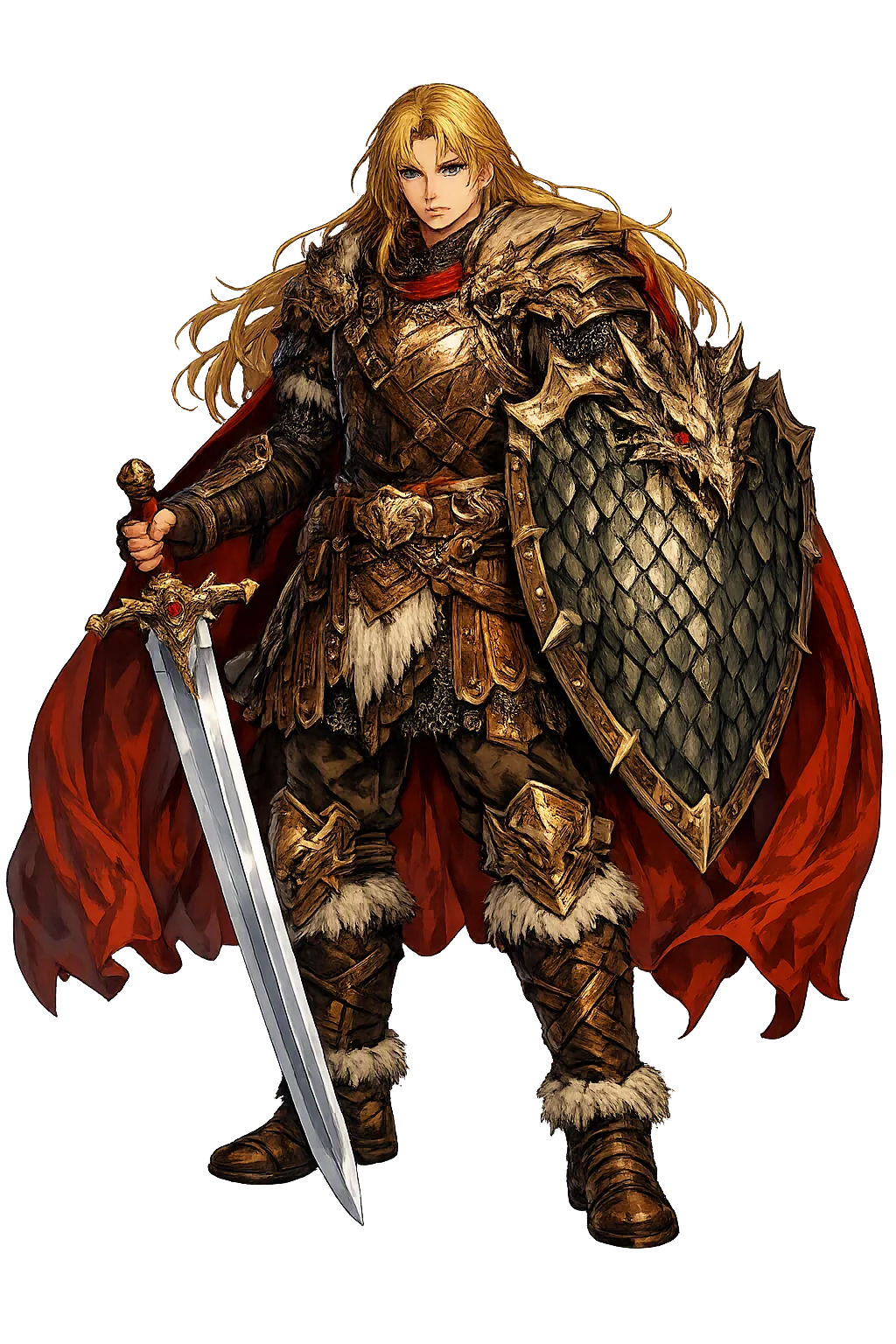
The provenance file on Sigurðr
Catalogue entry — Sigurðr. Every claim below carries its chain of custody.
Provenance
1. The attestation. ᛋᛁᚴᚢᚱᚦᛦ, from the tradition's own record. On record: Vǫlsunga saga — The Story of the Volsungs, trans. William Morris & Eiríkr Magnússon (Project Gutenberg), The Poetic Edda, trans. Henry Adams Bellows — Reginsmól, Fáfnismól, Sigrdrífumál, Brot af Sigurðarkviðu, Sigurðarkviða en skamma, Guðrúnarkviða (Sacred Texts), The Prose Edda of Snorri Sturluson, trans. Arthur Gilchrist Brodeur — Skáldskaparmál's retelling of the Vǫlsung cycle (Sacred Texts), Sigurd (encyclopedia entry).
2. The narrative record. The Reforging of Gramr — At the wedding feast of his sister Signý, a one-eyed stranger — Óðinn — thrust a sword to the hilt into the tree Barnstokkr that grew through the hall of Vǫlsungr, and only Sigmundr of all the company could draw it. Years later Sigmundr fell in battle, the sword shattering beneath him against the same god's spear, and his widow Hjǫrdís carried the shards away for her unborn son. The Slaying of Fáfnir — Fáfnir was Reginn's brother, who had killed their father Hreiðmarr for the hoard paid as weregild for the slain Ótr, and crawled away to Gnitaheiðr, where greed long brooding over gold twisted him into a dragon. Guided by a one-eyed old man who would not give his name, Sigurðr dug a trench across the worm's path to the water and lay in it; when Fáfnir crawled overhead he thrust Gramr upward into the heart.
3. The physical record. The Sigurðr cycle is the most widely depicted heroic legend of the Viking Age. The Ramsund carving (Sö 101) in Södermanland, Sweden, shows the whole Gnitaheiðr episode in one frame — Sigurðr piercing the serpent from below, the heart roasting over the fire, the thumb in his mouth, the listening birds, the headless Reginn, and Grani laden with the gold — and the nearby Gök stone (Sö 327) quotes the same scene within a runic serpent band. The Drävle runestone (U 1163) in Uppland adds a further Swedish depiction, while across the North Sea the Manx cross-slabs, above all the Kirk Andreas cross, show Sigurðr roasting Fáfnir's heart, proof the legend travelled with Norse settlers. In Norway the carved portal of Hylestad stave church (c. 1200) narrates the cycle panel by panel, from the forging of Gramr to Reginn's death. The textual tradition is Icelandic and later: the heroic lays of the Poetic Edda survive chiefly in the Codex Regius (GKS 2365 4to, c. 1270), whose famous eight-leaf lacuna has cost us the fullest form of the Sigurðr lays — Brot af Sigurðarkviðu preserves only a fragment — while Vǫlsunga saga itself (c. 1270) survives in paper copies of the lost vellum NKS 1824 b 4to.
4. The current holding. The temple at /sigurd/, classified Tier 1. What survives here cannot be shown in ASCII: a feature of the original that the fallback alphabet flattens. That is the Tier-1 test, and this name passes it without argument.
5. The documented resonances. Writing, Publishing & Media, Gaming, Fantasy & Entertainment IP, Music, Arts & Performance — seats argued and weighted in the pattern atlas, read through the myths in this temple's Resonance File.
6. The primary sources. Poetic Edda, Prose Edda — the library this file answers to, open at the Sacred Texts collection.
7. The continuing record. No Norse figure has had a longer second life. William Morris retold the cycle in his epic The Story of Sigurd the Volsung and the Fall of the Niblungs (1876), which he called the great story of the North that should be to all his race what the tale of Troy was to the Greeks.
At a Glance
- Restored name: Sigurðr
- ASCII form: sigurd
- Meaning: "Victory-guardian (from sigr, victory, + vǫrðr, guardian)"
- Domain of influence: Victory, Dragon-Slaying, Heroism
- Pantheon: Norse
- Classification: Tier 1
- Original script: ᛋᛁᚴᚢᚱᚦᛦ
- Series: The Restoration Files, No. 445 of 546
The File Continues
Read the founding dispatch for the name's full story, the Resonance File for the archetype at work — or the whole archive in one sitting.
Continue the series — previous file: Sif (read it here) · next file: Sigyn (read it here).
The Restoration Files are written from the same canonical record as the temples themselves: the lexicon, the lore catalog, the pattern atlas, and the cited scholarly sources. If a file ever disagrees with its temple, the temple is right — tell us, and the file will be corrected.