
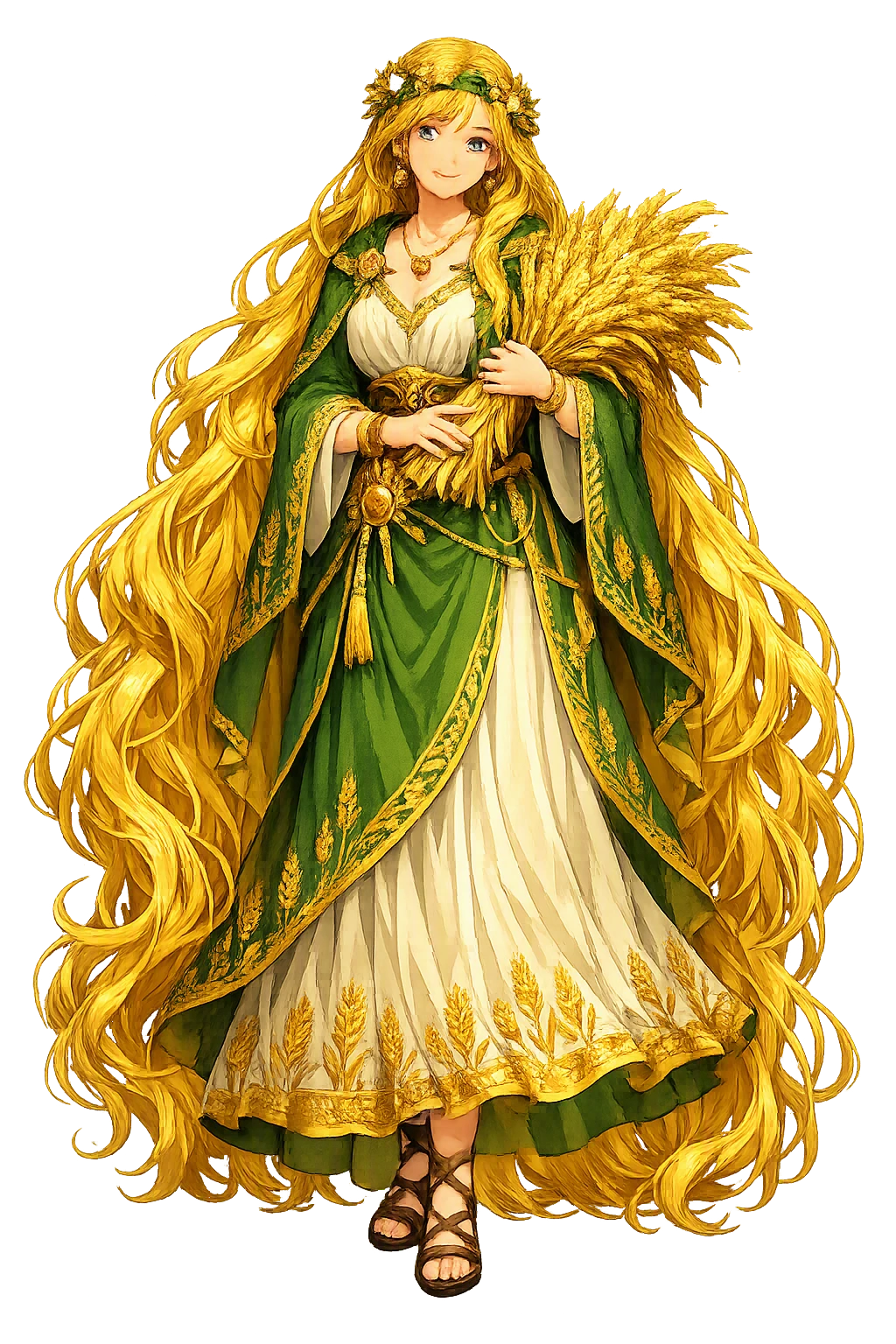
The name Sif and the world it opens
A name is a door. Sif opens onto an entire world: the domain of earth, harvest, a Norse tradition, and centuries of storytelling, worship, and scholarship. This post walks through that world room by room — the name and its roots, the original script, the sound of it, the myths, the symbols, the sites, the afterlife across cultures — and ends at the newest room of all: a Unicode domain that makes the whole structure addressable. sif gets you to the same building, but only the restored form tells you why it was built.
At a Glance
- Restored name: Sif
- ASCII form: sif
- Meaning: "Relation by marriage"
- Domain of influence: Earth, Harvest
- Pantheon: Norse
- Classification: Tier 2
- Original script: ᛋᛁᚠ (Younger Futhark)
Overview
Sif (sif) — Earth, Harvest · Relation by marriage — is the golden-haired wife of Þórr, mother of Ullr, and the still centre of the busiest forge-story in the Edda: when Loki sheared off her hair in mischief, the redress Þórr exacted sent Loki to the dwarfs, and the smithying that followed produced not only her new hair of living gold but Gungnir, Skíðblaðnir, Draupnir, Gullinbursti, and Mjölnir — the gods' entire great arsenal, all descended from one act of domestic malice.
Her name is the Old Norse common noun sif (plural sifjar), 'affinity, relation by marriage' — cognate with Old English sibb and Old High German sippa, and so the ancestor of English sib, sibling, and gossip. The theonym is kinship itself, made personal. In the Poetic Edda she appears twice: pouring Loki mead in a crystal cup and asking to be counted blameless (Lokasenna 53), and as the target of a taunt flung at Þórr across the water (Hárbarðsljóð 48) — the corpus's whole record of her voice.
PuniCodex restores the name as Sif — identical to the ASCII input, because normalized Old Norse writes no diacritic in this name. The mechanical rule therefore places the name in Tier 2: nothing distinctive is lost in transit, a statement about orthography and never about the goddess. The temple is domain-less: the plain-ASCII sif.com is registered to a third party outside the collection and is watched for release.
The Name
The name is attested in Old Norse as Sif — the goddess's name and, beside it, the common noun sif (plural sifjar), 'affinity, kinship, relation by marriage'. The etymology is among the clearest in the onomasticon: the theonym is the abstract noun of marriage-bond made personal, from the Germanic root behind Old English sibb 'kinship, peace', Old High German sippa, and Gothic sibja — the same root that gives modern English sib, sibling, and, through god-sibb 'baptismal sponsor', gossip. Cleasby–Vigfusson gloss the goddess's name with the noun it is, and neither de Vries nor the handbooks record any serious rival derivation.
The ASCII form is not a fallback here but the form itself: normalized Old Norse writes three plain Latin letters and a capital. The Unicode restoration Sif therefore preserves nothing the ASCII alphabet loses, and the mechanical rule classifies the name Tier 2 — an orthographic fact, not a judgment on the goddess.
The letter-by-letter transformation runs:
- s → S — Same, capitalized
- i → i — Same
- f → f — Same
The project holds no domain for this name. The plain-ASCII sif.com is registered to a third party outside the collection and is watched for release; this temple claims nothing it does not hold.
The Original Script
The name is preserved in medieval Icelandic manuscripts in the Latin alphabet as Sif — Old Norse (North Germanic), attested 13th c. CE in the Codex Regius of the Poetic Edda (Lokasenna, Hárbarðsljóð) and the codices of Snorri's Edda, recording material centuries older — beside the common noun sif (plural sifjar), 'affinity, relation by marriage'. Before the Latin bookhand, Old Norse names were carved in the Younger Futhark; no runic attestation of this theonym survives, so the manuscript form is the primary witness. The runic rendering is ᛋᛁᚠ (s-i-f).
The scholarly rendering proceeds step by step:
- ᛋ (sól) writes /s/.
- ᛁ (ís) writes both /i/ and /e/; here /i/.
- ᚠ (fé) writes both /f/ and /v/; the manuscripts' f stood for the voiced fricative heard in modern Icelandic Sif.
- The spelling sif is a normalized phonetic reconstruction; Younger Futhark does not distinguish voiced/voiceless fricatives or separate short and long vowels.
- The Unicode restoration Sif is therefore identical to the ASCII form — the restoration is a matter of canonical reference, not rescued orthography. The name's etymology is the common noun itself, registered in the lexica and never seriously disputed.
Pronunciation
The reconstructed pronunciation of the name is /ˈsiv/ — Old Norse Reconstruction.
Phoneme by phoneme:
- S- — Voiceless alveolar sibilant [s], as in English 'see'; Old Norse initial s is plain and unaspirated
- -i- — Short close front [i], held brief — Old Norse short i, not the long í
- -f — Written f but sounded [v]: Old Norse f after a vowel was the voiced fricative, exactly as in modern Icelandic, where the name is still pronounced 'seev'
For the modern speaker, the closest approximation is: 'SEEV' — one syllable, the vowel short and bright, the final f voiced; never an English 'siff'.
Kindred and historical forms of the name:
- Old Norse — Sif, wife of Þórr; beside the common noun sif (plural sifjar), 'affinity, relation by marriage'
- Younger Futhark — ᛋᛁᚠ (s-i-f), the Viking-Age runic rendering
- Modern Icelandic — Sif, a living given name, pronounced with the voiced final fricative to this day
- English cognates — sib, sibling, and gossip (from Old English god-sibb): the same inherited root of kinship, worn down into ordinary words
Sif is Tier 2 because the restoration preserves nothing the ASCII form loses: no diacritic, no distinctive letter, no vowel length. English and Old Norse write the name identically.
Mythology
Sif's mythology is short in line-count and enormous in consequence: one act of malice against her sets the forges of the dwarfs to work, and the gods' six greatest treasures come out of the fire. Snorri tells the hair-myth whole; the Poetic Edda gives her two smaller scenes; Gylfaginning names her son.
The Shearing of the Golden Hair (Skáldskaparmál)
Loki Laufeyjarson, Snorri begins, did this for mischief: he cut off all Sif's hair. When Þórr learned it, he seized Loki and would have broken every bone in him, had Loki not sworn to go to the svartálfar and have them make Sif a head of hair from gold that would grow like other hair. Loki went to the dwarfs called the sons of Ívaldi; they made the hair, and it grew to her head the moment it was set there, as if it were her own. The episode runs to a handful of sentences, and Sif does not speak in it — the shearing, the oath, and the making all happen around her.
The Wager That Forged Mjölnir (Skáldskaparmál)
The sons of Ívaldi made more than the hair: in the same commission came Gungnir, the spear that never misses, for Óðinn, and Skíðblaðnir, the best of ships, for Freyr. Then Loki wagered his head with the dwarf Brokkr that Brokkr's brother Sindri could not match those three. Sindri laid gold, a boar's hide, and iron in the fire in turn while Loki, in fly-shape, stung the bellows-worker — and out came Draupnir the dripping ring, Gullinbursti the golden-bristled boar, and Mjölnir, its handle short only because the fly stung Brokkr's eyelid at the last draw. The Æsir judged Mjölnir the best of all, and Loki saved his head on the quibble that his neck was not in the wager. Count the consequence of one shorn head of hair: the spear, the ship, the ring, the boar, and the hammer all exist because Sif lost hers.
The Crystal Cup (Lokasenna 53–54)
In Ægir's hall, as Loki's slander works down the company, Sif alone rises and pours him mead in a crystal cup: hail to thee, Loki — take the cup, and say that she alone among the Æsir's kin is without blame. It is the flyting's one courteous stanza, and Loki's answer is its coldest: he grants she would be blameless indeed, were it not that he knows one who drew the mighty Þórr's wife from home — 'and that was I.' The poem offers the accusation and no verdict; Sif speaks no second stanza.
The Taunt on the Shore (Hárbarðsljóð 48)
Óðinn in ferryman's disguise keeps Þórr waiting on the wrong side of the sound, and among the gibes flung across the water is one aimed at the home Þórr cannot reach: 'Sif has a lover at home; him you will want to meet.' The poem gives the charge no support and no sequel — one dart in a long volley, leaning on the same rumour Lokasenna spent a stanza on. The scholarly verdict is uniform: the eddic poets twice insinuate and never narrate, and the taunts are evidence about the sport of needling Þórr, not about the goddess.
Ullr, Sif's Son (Gylfaginning 32)
In Snorri's catalogue of the Æsir: 'Ullr is the name of a son of Sif and a stepson of Þórr. He is such a good archer and so fast on skis that no one can compete with him.' Stepson — the word is the whole of it. Sif had a child before the thunder-god, by a father no source names, and the speculation that has filled the gap is speculation, not attestation. Snorri's kennings keep the household straight: Þórr is 'husband of Sif, stepfather of Ullr, father of Móði and Magni and Þrúðr' — Magni by the giantess Járnsaxa, Þrúðr counted as Sif's daughter in the reference tradition.
Symbols & Iconography
Sif's iconography is narrative rather than cultic — the corpus gives her no temple regalia, but fixed around her few scenes a small set of objects no retelling can omit:
- The golden hair — her defining attribute: shorn by Loki, remade in living gold by the sons of Ívaldi, and read since Grimm as the ripe corn of the harvest field
- The crystal cup of mead — her single speech in Lokasenna: hospitality offered to the one guest no one else would serve
- Mjölnir — the hammer that exists because her hair was cut: the wager's greatest prize, and the Æsir's surest defence
- Gungnir and Skíðblaðnir — Óðinn's spear and Freyr's ship, made in the same commission that remade her hair: her restoration underwriting the gods' whole arsenal
- Þrúðheimr — the 'world of strength', Þórr's realm, where her household stands among its fields
Archaeology & Evidence
Sif is a wholly textual goddess: no runestone invokes her, no votive deposit names her, and no image can be securely identified with her — a silence she shares with most of the ásynjur, who appear in verse and prose but rarely, if ever, in dedications. Her attestation hangs on the manuscript witnesses of the two Eddas: the Codex Regius of the Poetic Edda for Lokasenna and Hárbarðsljóð, and the codices of Snorri's Edda for the Skáldskaparmál hair-myth and the Gylfaginning genealogy that names Ullr her son.
No certain place-name contains her name, and no Viking-Age carving of the theonym has ever been read. The material afterlife of her myth is real but indirect: the treasures her shearing produced — Mjölnir above all — are among the most depicted objects of the Viking Age, worn as amulets in thousands of graves, so that the consequence of her one great scene is archaeologically everywhere while she herself is nowhere.
Realm & Domain
Sif is catalogued under Earth, Harvest — a heading that is half attestation and half interpretation, and this edition keeps the two apart. The sources themselves give her no office: no hall named hers, no cult, no domain assigned in any stanza. What the tradition attests is the household at the centre of Þórr's world; what modern readers, following Grimm, have added is the harvest.
Earth
Grimm read the golden hair as the ripe corn of the field — shorn in harvest, regrown in gold — and the reading made Sif the Germanic earth-and-grain goddess beside the corn-mothers of folklore. The sources never call her so; but the pairing with Þórr, the farmer's weather-god, has kept the interpretation alive in the handbooks.
Harvest
The harvest belongs to the same interpretive line: the shearing and the golden regrowth read as the agricultural year in miniature. Simek and Turville-Petre record the reading while warning that the myth explains itself well enough as the aetiology of the gods' treasures.
Kinship by Marriage
The one domain the name itself attests. Sif is the Old Norse noun for affinity — the bond created by marriage — and the corpus honours it: she presides over the Edda's most blended household, stepmother and mother in one, and her one speech is an act of hospitality.
The Thunder-God's House
Snorri's kennings define her by the household: Þórr is 'husband of Sif', and from that house come Ullr the archer, and Þrúðr of the strength-name. Her sphere in the tradition is not a force of nature but a relation — the bond that holds the strongest of the gods to a home.
Across Cultures
Sif has attracted exactly one great comparative reading, and it begins with her hair. Jacob Grimm took the shearing and the golden regrowth as a nature myth: the hair is the ripe corn, the shearing the harvest, and the dwarfs' gold the field growing back golden — a reading that made her the Germanic harvest-goddess beside Demeter and the corn-mothers of folklore, and that matches her marriage to Þórr, the farmer's weather-god.
Twentieth-century scholarship cooled on the certainty without abandoning the observation. Simek and Turville-Petre note that the sources never call her an earth or harvest goddess, that her name means only 'kinship by marriage', and that the corn-gold reading is interpretation laid over a myth that explains itself well enough as the aetiology of the gods' treasures. Within the corpus her closest kin are the figures of her own household and its story: Loki, whose mischief she both suffers and, in Ægir's hall, alone tries to answer with courtesy; and Ullr, the son whose father the tradition declined to name. The clean statement remains the lexicon's: her attested sphere is the household and its bonds; the harvest is what modern readers, following Grimm, have grown in her golden hair.
Cultural Legacy
Sif's afterlife runs on two tracks, one scholarly and one popular. In the scholarly line she is the type-case of the Edda's reticence about goddesses: a figure with no cult record and one great myth, whose golden hair made her, from Grimm onward, the default Germanic corn-goddess of the comparative handbooks, and whose name — plain sif, 'affinity' — became the standing example of a theonym that is simply an abstract noun.
In the popular line her golden hair carried her into every Victorian retelling of the gods, and modern popular culture has borrowed her outright — most visibly as the Marvel comics and film character — usually trading the wife of the sources for a swordswoman. Modern Heathen and Ásatrú communities keep the older reading, hailing her at harvest rites as the golden-haired one, patroness of grain, marriage, and household bonds; in Iceland the name Sif remains a living given name. And her quietest legacy is lexical: the root of her name lives on in English, unbeknownst to its speakers, in sib, sibling, and gossip — kinship worn down into ordinary speech, which is exactly what her name always meant.
The Scholarly Record
The account of Sif given in this edition rests on the witnesses and reference works listed below. Skáldskaparmál supplies the hair-myth and the making of the treasures; Gylfaginning the genealogy of Ullr; Lokasenna and Hárbarðsljóð her two eddic scenes; Cleasby–Vigfusson, Zoëga, and de Vries the name's transparent etymology; Grimm the harvest interpretation, with Simek, Orchard, Lindow, and Turville-Petre arbitrating attestation against interpretation.
- Snorri Sturluson, Edda, Skáldskaparmál (the shearing of Sif's hair; the sons of Ívaldi; Loki's wager with Brokkr; the making of the golden hair, Gungnir, Skíðblaðnir, Draupnir, Gullinbursti, and Mjölnir; kennings for Þórr as 'husband of Sif'), trans. Anthony Faulkes (London: Viking Society for Northern Research, 1998).
- Snorri Sturluson, Edda, Gylfaginning 32 (Ullr son of Sif, stepson of Þórr), ed. and trans. Anthony Faulkes (London: Everyman, 1987).
- The Poetic Edda, trans. Carolyne Larrington, 2nd ed. (Oxford: Oxford University Press, 2014): Lokasenna 53–54 (the crystal cup; Loki's accusation); Hárbarðsljóð 48 (the taunt from the far shore); Grímnismál 4 (Þrúðheimr).
- Cleasby, Richard, and Guðbrandur Vigfússon, An Icelandic-English Dictionary, 2nd ed. (Oxford: Clarendon Press, 1957), s.v. sif, sifjar.
- Zoëga, Geir T., A Concise Dictionary of Old Icelandic (Oxford: Clarendon Press, 1910), s.v. sif.
- de Vries, Jan, Altnordisches etymologisches Wörterbuch, 2nd ed. (Leiden: Brill, 1962), s.v. sif (the kinship etymology: Old Norse sif, Old English sibb, Old High German sippa).
- Grimm, Jacob, Deutsche Mythologie, 4th ed., trans. James Steven Stallybrass, Teutonic Mythology (London: George Bell, 1882–88) — the golden hair read as the corn of the harvest field.
- Simek, Rudolf, Dictionary of Northern Mythology, trans. Angela Hall (Cambridge: D. S. Brewer, 1993), s.v. Sif, Ullr, Þrúðr.
- Orchard, Andy, Dictionary of Norse Myth and Legend (London: Cassell, 1997), s.v. Sif.
- Lindow, John, Norse Mythology: A Guide to the Gods, Heroes, Rituals, and Beliefs (Oxford: Oxford University Press, 2001), s.v. Sif.
- Turville-Petre, E. O. G., Myth and Religion of the North: The Religion of Ancient Scandinavia (London: Weidenfeld and Nicolson, 1964), s.v. Sif.
- Gordon, E. V., An Introduction to Old Norse, 2nd ed. rev. A. R. Taylor (Oxford: Clarendon Press, 1957).
A Meditation
Sif is the Edda's study in how much weight a silent figure can bear. She speaks one stanza in the whole corpus — a cup of mead, a courteous wish to be counted blameless — and is answered with the flyting's crudest accusation. She is sheared, restored, taunted about, and never once given an adventure of her own; and yet the tradition built the gods' entire armoury on her injury. Gungnir, Skíðblaðnir, Draupnir, Gullinbursti, Mjölnir: take away Loki's shears and the Æsir face Ragnarǫk unarmed. The myths do not say this. They simply arrange that the greatest weapons in the North descend from a wrong done to the woman whose name means kinship.
Perhaps that is the point the name was always making. Sif is not the goddess of a thing — not thunder, not wisdom, not the sea — but of a relation: the bond that makes a household out of separate lives. The corpus honours her in its own idiom by making her household the most blended in Ásgarðr — a stepson of unknown father, sons by a giantess, a daughter of strength — and by routing every treasure of the gods through her golden head. Grimm read the hair as corn; the Edda read it as kinship. Both readings agree on the essential: what she is, grows back.
The Unicode Restoration
Sif is classified as Tier 2: the restoration needs no distinctive letters or diacritics its ASCII form would lose. The ASCII fallback sif still resolves everywhere, but it is the restored form that carries the name's full information. That is the whole thesis of this temple: the marks are the message.
Why This Restoration Matters
A door only matters if people walk through it. The temple is open, and everything behind it — the myths, the scholarship, the canvas, the patrons — hangs on the restored spelling. The PuniCodex project bets that the web will make room for names as they were actually written, and Sif is one of its standing proofs. Visit, share, cite, type it yourself: each use is a small rehearsal for a web where no name has to hide its marks to be found.
Explore Further
This post is one doorway into the temple. The home page carries the full character breakdown and the ambient canvas; the lore page tells the myths in long form; the Scholarly Edition preserves the sources, pronunciation data, and revision history; and the patron wall supports the restoration directly. For the wider map, browse the Lexicon, explore the Pantheon, or return to the PuniCodex blog.
Related Names
Sources
The full scholarly apparatus — every citation, revision, and review — lives in the Scholarly Edition. Key references for this post:
- Snorri Sturluson, Edda, Skáldskaparmál (the shearing of Sif's hair and the making of the treasures), trans. Anthony Faulkes (London: Viking Society for Northern Research, 1998).
- Cleasby, Richard, and Guðbrandur Vigfússon, An Icelandic-English Dictionary, 2nd ed. (Oxford: Clarendon Press, 1957), s.v. sif; de Vries, Jan, Altnordisches etymologisches Wörterbuch, 2nd ed. (Leiden: Brill, 1962), s.v. sif.
- Lokasenna 53–54 and Hárbarðsljóð 48 (Poetic Edda), trans. Carolyne Larrington, The Poetic Edda, 2nd ed. (Oxford: Oxford University Press, 2014).
- de Vries, Jan, Altnordisches etymologisches Wörterbuch, 2nd ed. (Leiden: Brill, 1962), s.v. sif.
- Lexicon authorities for this entry: Poetic Edda, Cleasby-Vigfusson.