
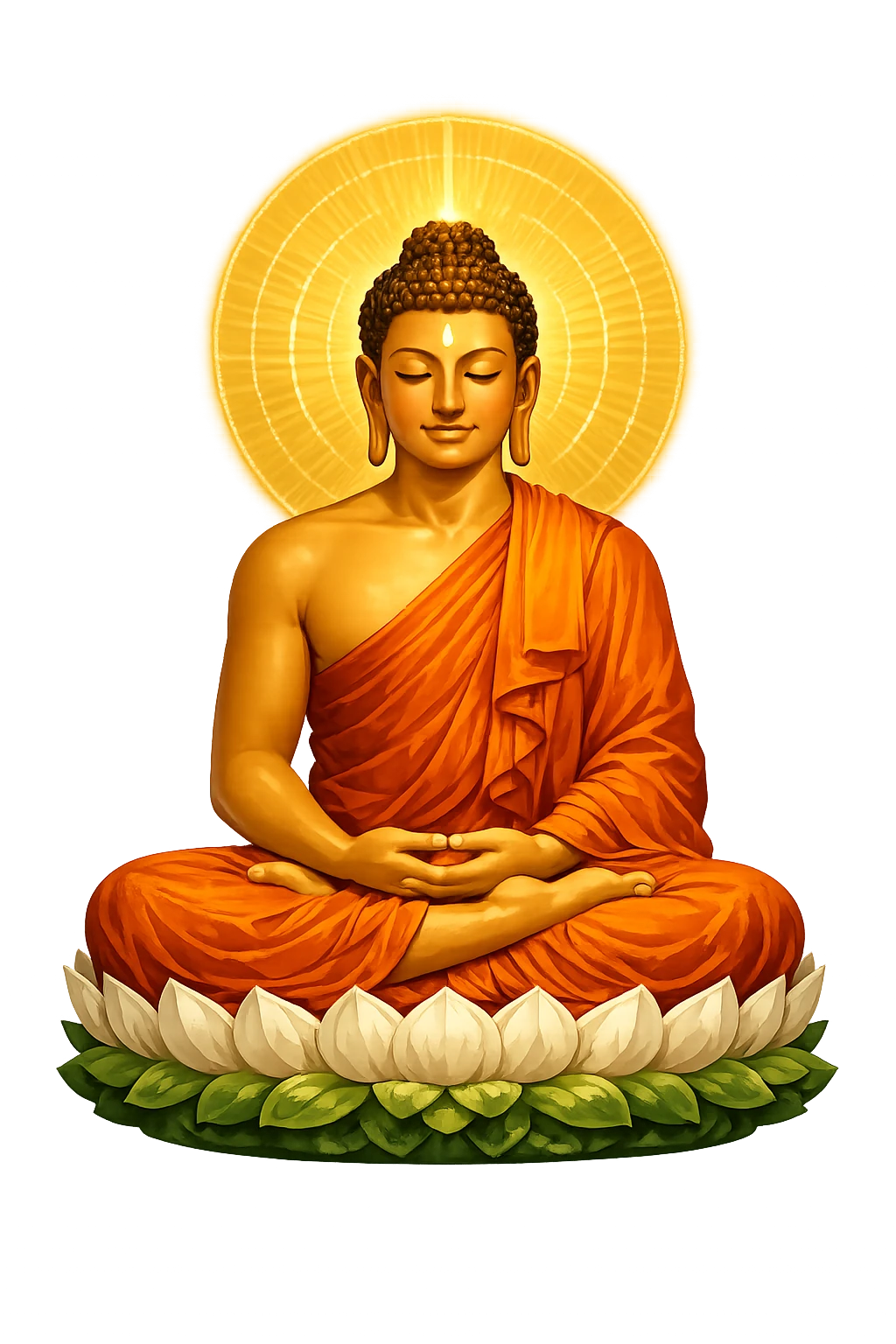
Stress-testing Śākyamuni: do the industry seats hold?
Audit: Śākyamuni, seat by seat. The atlas makes claims; the myths decide which ones stand. This is the record of what held.
At a Glance
- Temple: Śākyamuni
- Pantheon: Buddhist
- Domain of influence: Enlightenment, Teaching, Historical Buddha
- Pattern seats: 3
- Sectors touched: Society & Spirit · Health & Wellbeing
- Strongest seat: Education, Research & Knowledge
- Series: The Resonance Files, No. 435 of 546
The Test
Seat 1: Education, Research & Knowledge
Claim: The teacher of the path; forty-five years of turning the wheel. Exhibit: The Birth at Lumbinī — Queen Māyā, traveling to her father's house, gave birth standing in the grove at Lumbinī, holding the branch of a sāla tree; the child took seven steps and declared this his last birth.
Verdict: stands. Strip both to their function and the functions match.
Seat 2: Faith & Spiritual Organizations
Claim: The founder; the tradition begins under his tree. Exhibit: The Four Sights and the Going Forth — Sheltered in three palaces, the young Śākyan saw what his father had fenced out: an old man, a sick man, a corpse, and a wandering ascetic — the four sights the later tradition makes the hinge of his life.
Verdict: holds under load. The correspondence is functional, not decorative.
Seat 3: Yoga, Meditation & Holistic Wellness
Claim: The source of meditation; the mindfulness economy traces every breath to his seat under the tree. Exhibit: The Awakening and the First Turning — Six years of austerities on the Nairañjanā brought him to the edge of death and the discovery of the middle way; seated under the Bodhi tree at Uruvelā he withstood Māra's assault, touched the earth as his witness, and by dawn saw the four noble truths and the chain of dependent arising.
Verdict: survives scrutiny. The myth and the trade do the same work.
The Control Group
Against the seats that survived, one control: the temple's own summary of its figure — The life of Śākyamuni is the best-attested sacred biography of the ancient world — told in the Pāli Nikāyas, versified by Aśvaghoṣa, expanded in the Nidānakathā and the Lalitavistara, and anchored in the ground by Aśoka's own inscriptions. The seats do not drift far from it. That is the audit's cleanest result.
The Method, Stated Plainly
Skeptical? Good — the system is built for you. Every seat in this file carries its why-line and its weight, the full derivation is public at the methodology page, and the challenge process is part of the design. Falsifiable is not a posture here; it is the mechanism.
For the Ones Who Work There
For a sponsor in education, research & knowledge, the fit here is not adjacency — it is inheritance. Your trade already tells this story every working day; the temple simply holds the original. The patron tier and the advertising terms carry the mechanics; the myths above carry the reason.
The File Continues
This is one of 546 Resonance Files — the third dispatch from every flagship temple, where the myths meet the markets. The temple's founding dispatch tells the name's story; its Restoration File tells the spelling's; the blog index holds the whole archive.
Continue the series — previous: Śakti (read it) · next: Šamaš (read it).
The Resonance Files are argued from the same canonical record as the pattern atlas itself: the lexicon, the lore catalog, and the cited sources. Every seat can be challenged at the methodology page — and the challenge is the point.