
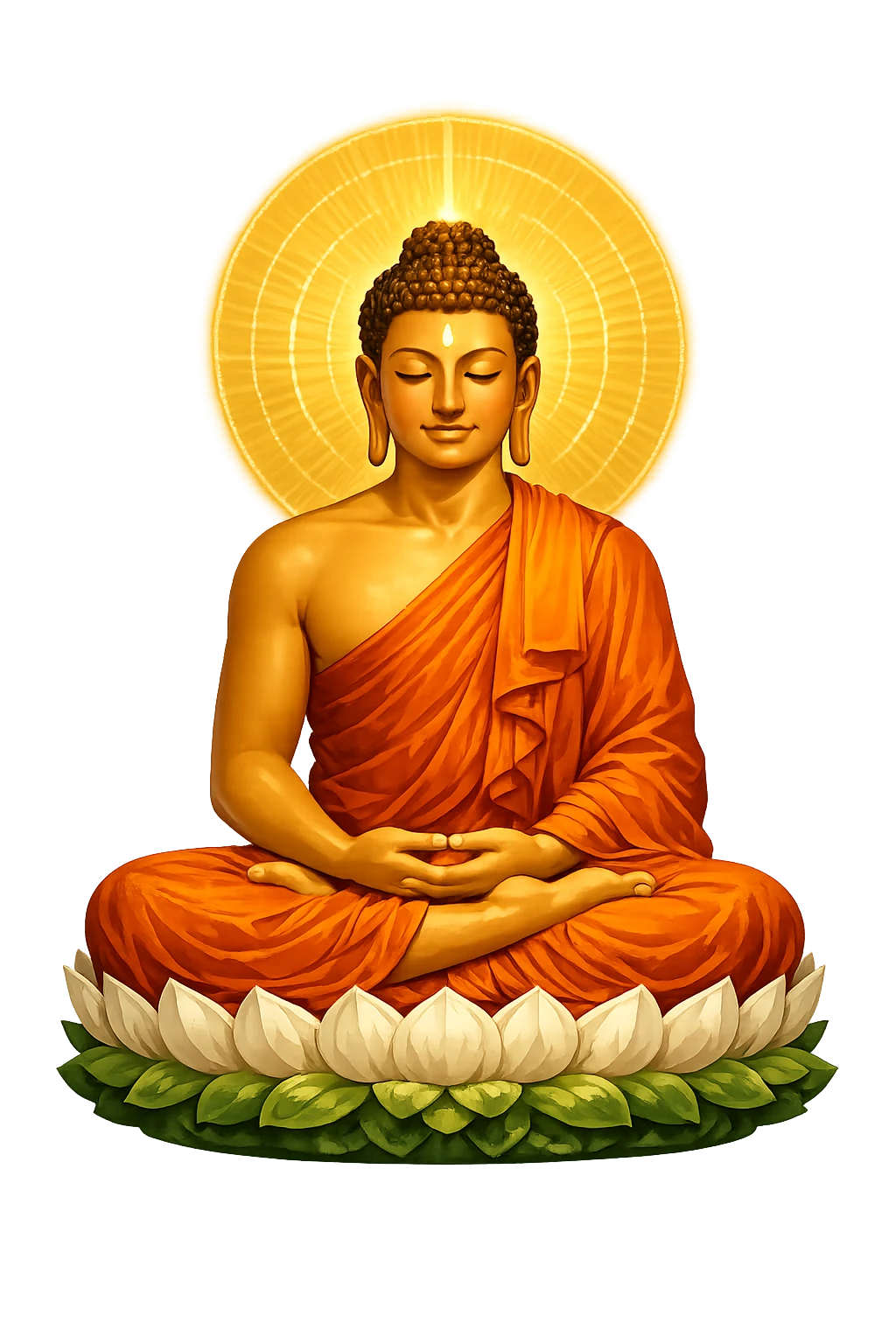
From Devanagari to Unicode: the journey of Śākyamuni
Of all the names a tradition can give its founder, this one is a clan's signature. Śākyamuni — shakyamuni in the ASCII spelling the early internet settled for — names the historical Buddha not by a miracle or a throne but by his people: the sage who came out of the Śākya clan and never stopped belonging to them. Sanskrit kept the name whole for two and a half millennia; Devanagari wrote it with every mark in place; and the domain-name system, for most of its life, could carry neither. This post follows the name from the script that wrote it first to the Unicode restoration that lets it live, complete, at a real address — and shows why each mark is evidence, not decoration.
At a Glance
- Restored name: Śākyamuni
- ASCII form: shakyamuni
- Meaning: "sage of the Śākya clan"
- Domain of influence: Enlightenment, Teaching, Historical Buddha
- Pantheon: Buddhist
- Classification: Tier 1
- Original script: शाक्यमुनि (Devanagari)
- Live domain: śākyamuni.com
Overview
Śākyamuni (shakyamuni) — Enlightenment, Teaching, Historical Buddha · sage of the Śākya clan — belongs to the Buddhist tradition, where it stands as the standard Sanskrit title of the historical Buddha, Siddhārtha Gautama.
In one sentence: the world calls him the Buddha; the name calls him by the oldest title his followers gave — the clan-sage whose awakening became a teaching.
PuniCodex restores the name as Śākyamuni and serves its temple at śākyamuni.com. The restoration preserves two distinctive features the ASCII form loses — the palatal sibilant Ś and the long vowel ā — which places the name in Tier 1. The plain ASCII shakyamuni survives as a fallback; the restoration is the form the tradition wrote.
The Name
The name is a compound of two transparent Sanskrit words. Śākya — शाक्य — means "of the Śākya clan," the people of Kapilavastu where Siddhārtha Gautama was born. Muni — मुनि — means "sage": the silent seer who has mastered speech and self. Joined, Śākyamuni is exactly what it says — the sage of the Śākya clan. The epithet became the standard Sanskrit title of the historical Buddha: a title, not a personal name, though the texts also call him the Bhagavān or the Tathāgata. But "Śākyamuni" is the form that traveled — into every canon and onto temple walls across Asia.
The letter-by-letter transformation runs:
- s → Ś — Ś: voiceless palatal sibilant /ɕ/
- h → (dropped) — Part of ś digraph
- a → ā — Macron: long /aː/
- k → k — Same
- y → y — Same
- a → a — Same
- m → m — Same
- u → u — Same
- n → n — Same
- i → i — Same
The Original Script
The name is written in Devanagari as शाक्यमुनि — the form against which both the ASCII fallback and the restoration are measured. Devanagari records what the Roman alphabet flattens. Its first consonant श is the palatal sibilant, distinct from the dental स and the retroflex ष, and the transliteration Ś keeps that three-way distinction visible. The long ā of शाक्य is marked in the script itself, and the macron of the restoration preserves exactly that length. Where shakyamuni says neither how the first sound is made nor how long the first vowel is held, शाक्यमुनि and Śākyamuni both say it plainly.
Pronunciation
The reconstructed pronunciation of the name is /ˈɕaː.kjə.mu.ni/ — Reconstructed Sanskrit.
For the modern speaker, the closest approximation is: SHAH-kyuh-moo-ni — four even syllables, the first held long, the initial sound a soft palatal hush rather than English "sh."
Kindred and historical forms of the name:
- Devanagari — शाक्यमुनि
- Pāli — Sakyamuni
- IAST scholarly transliteration — Śākyamuni
- Owned form — Śākyamuni
The Pāli canon simplifies the palatal to a plain s — Sakyamuni — because Pāli lost Sanskrit's three-way sibilant distinction. The scholarly IAST transliteration restores it, and the owned form follows the scholars: the first syllable of शाक्यमुनि is written, not guessed.
Mythology
Śākyamuni's story is the founding narrative of Buddhism — a biography the tradition treats as the first teaching.
The Birth at Lumbinī
He was born Siddhārtha Gautama, son of the Śākya clan of Kapilavastu, in the grove of Lumbinī on the road to his mother's home. The texts surround the birth with signs: Queen Māyā's dream of a white elephant, the child received standing beneath flowering trees, and the seven steps the newborn took, declaring this his final birth. A sage read the marks and prophesied the two paths open to such a child — a universal monarch if he stayed in the world, a fully awakened Buddha if he left it. His father, preferring a king, built walls of pleasure around the prophecy's first horn.
The Four Sights and the Renunciation
At twenty-nine, a royal excursion showed Siddhārtha what the palace had hidden: an old man bent with age, a sick man wasted by disease, a corpse carried to the pyre — and then a wandering ascetic, calm in the middle of it all. The first three sights disclosed the human condition; the fourth disclosed that someone had already walked out to face it. That night he made the great departure, riding his horse Kanthaka out of the sleeping city, and cut off his hair at the river's edge — trading the prince for the seeker.
The Awakening
Six years of austerity nearly killed him, until a meal of milk-rice revealed the middle way between indulgence and mortification. He seated himself beneath the Bodhi tree at Bodh Gayā, resolved not to rise until he saw clearly. Māra — the tempter, the lord of desire and death — assaulted him with armies, storms, and finally his own daughters, challenging his right to the seat. Siddhārtha reached down and touched the earth, calling it as his witness — and the earth answered. By dawn, at thirty-five, the prince of the Śākyas was the Buddha.
The Turning of the Wheel
His first sermon, at the deer park of Sārnāth near Vārāṇasī, set the wheel of the teaching turning: the four noble truths, delivered to the five ascetics who had once been his companions in austerity. Forty-five years of teaching followed — roads walked on foot, monasteries founded, kings and outcasts instructed alike. At Kuśinagara, aged eighty, he lay down between two sāl trees and entered parinirvāṇa, leaving the teaching itself as the community's refuge.
Symbols & Iconography
The iconography of Śākyamuni concentrates in a few recurring attributes, each tied to a moment of the life:
- The Bodhi tree — the fig tree beneath which the awakening happened; a descendant grows at Bodh Gayā.
- The begging bowl — the sign of the renunciant: the milk-rice that ended the austerities, and years of alms.
- The earth-touching mudrā — the right hand reaching to the ground, calling the earth to witness against Māra.
- The wheel — the dharma-wheel set turning at Sārnāth, flanked in early art by two deer.
Early Buddhist art avoided his figure altogether — the Buddha appears as a tree, an empty seat, a footprint, a wheel. When the human image came, the earth-touching posture became his signature: the sage of the Śākyas, seated, one hand on the earth that answered him.
Archaeology & Evidence
The geography of the life survives as a pilgrimage chain that can still be walked. At Lumbinī, an inscribed pillar of the emperor Aśoka identifies the spot as the Buddha's birthplace — the earliest epigraphic witness to the tradition. Bodh Gayā preserves the seat of the awakening, marked by the Mahābodhi temple. Sārnāth holds the deer park of the first sermon and its own Aśokan column. And Kuśinagara keeps the shrine of the parinirvāṇa. Four sites, four events, one itinerary: birth, awakening, teaching, and passing.
Realm & Domain
The temple's tagline reads: "Sage of the Śākyas · The Awakened One." The domain of influence — Enlightenment, Teaching, Historical Buddha — names three aspects of one figure.
The Sage
The muni of the compound, honored first. Before he was a teacher he was a practitioner — the man who left a palace, mastered his teachers' meditations, and pushed past austerity to the middle way.
The Teacher
Forty-five years walking the Gangetic plain: sermons for kings and outcasts, an order of monks and nuns founded, a body of discourses vast enough to fill three baskets of scripture. The wheel turned at Sārnāth never stopped.
The Awakened One
Buddha is a title, not a name — "the Awakened One," the one who woke from the sleep of ignorance. The epithet Śākyamuni keeps the man inside the title: not a god descended, but a Śākya clansman who woke up, and taught that waking is available to anyone.
Across Cultures
The title traveled with the teaching, and every tradition shaped it to its own ear. Pāli, the language of the earliest surviving canon, simplifies it to Sakyamuni, the palatal flattened to a plain s. In Japan he is Shakamuni. In China the name was transcribed as 釋迦牟尼 (Shìjiāmóuní), characters chosen for sound and kept ever since. Tibetan, Korean, Vietnamese, and Thai traditions carry their own renderings. The forms differ in sound and script; the reference does not — everywhere, the same sage of the same clan.
Cultural Legacy
Few titles have structured as much human culture. The name Śākyamuni stands at the head of every Buddhist canon and over the altars of half of Asia; the biography it labels — departure, awakening, teaching — supplied the narrative frame for two and a half millennia of art, from Gandhāran reliefs to Japanese screen painting. In the modern world the story crossed into secular ground: mindfulness and the psychology of meditation. And the name's grammar still does quiet work — a reminder that the founder of a universal teaching was remembered, first, as the son of one small clan.
The Scholarly Record
The account of Śākyamuni given in this edition rests on the witnesses and reference works listed below. The Sanskrit lexicon secures the form and etymology of the compound; the canonical and commentarial literature — Pāli, Sanskrit, Chinese, and Tibetan recensions — supplies the narrative evidence. Aśvaghoṣa's Buddhacarita, the earliest complete poetic biography, and the Mahāparinibbāna Sutta of the Dīgha Nikāya anchor the tradition's testimony; the Aśokan inscriptions anchor its ground.
A Meditation
A clan name is an odd thing to give a world religion's founder — and exactly right. Śākyamuni refuses to let the teacher float free of the man: before the Buddha was the Awakened One, he was a son of the Śākyas, born in one grove, under one tree, on one road. The title says the universal grew out of the particular — that enlightenment was achieved by a person, in a place, with a family name. The sage did not erase where he came from; he carried it into the awakening.
The Unicode Restoration
Śākyamuni is classified as Tier 1: the restoration preserves at least one distinctive philological feature the ASCII form cannot encode — here, two. The Ś records the palatal sibilant, the first of Sanskrit's three s-sounds, which the digraph "sh" only gestures at; the ā records the long first vowel, a distinction Devanagari marks in the script itself. Strip both, and shakyamuni still points at the right sage — but it no longer says how the name is pronounced. The restoration keeps the evidence on the surface of the name: the marks are the message.
Character by Character
The journey from shakyamuni to Śākyamuni, one character at a time:
- s → Ś — Ś: voiceless palatal sibilant /ɕ/
- h → (dropped) — Part of ś digraph
- a → ā — Macron: long /aː/
- k → k — Same
- y → y — Same
- a → a — Same
- m → m — Same
- u → u — Same
- n → n — Same
- i → i — Same
The Domain Name
The restored name is live as a working domain: śākyamuni.com, which the DNS carries in punycode form as xn--kyamuni-r3a32f.com — the ASCII-compatible encoding that lets a non-ASCII name travel the global network without breaking older infrastructure. The visitor sees Śākyamuni; the machines see the encoding. Browsers perform the translation automatically, so the name its own tradition wrote can be typed into any address bar and resolve to this temple.
The Buddhist Pantheon
Śākyamuni is one of 23 entries the PuniCodex lexicon catalogues under the Buddhist pantheon. The Pantheon page gathers the tradition's major figures in one place, and the Lexicon lets you filter all 927 restorations by tradition, tier, or script.
Frequently Asked Questions
What does Śākyamuni mean? "Sage of the Śākya clan" — śākya, "of the Śākya clan," plus muni, "sage": the standard Sanskrit title of the historical Buddha.
Which tradition does Śākyamuni belong to? He is catalogued in the Buddhist pantheon of the PuniCodex lexicon — the tradition whose founding figure he is.
Why is Śākyamuni classified as Tier 1? Because the restoration preserves features the ASCII form loses — the palatal sibilant Ś and the long vowel ā.
Is śākyamuni.com a working domain? Yes — śākyamuni.com resolves today and routes to this temple.
What is the punycode for śākyamuni.com? The DNS encoding is xn--kyamuni-r3a32f.com; browsers perform the translation automatically, so visitors only ever see the restored name.
Typing Śākyamuni
You do not need a special keyboard to use this restoration. The PuniCodex Type Tool converts the ASCII form shakyamuni into Śākyamuni as you type, and the browser extension offers the same conversion in any text field. Copy, paste into the address bar, and the DNS does the rest.
Sister Temples
Other temples in the Buddhist pantheon include Amitābha, Tārā, and Maitreya — each with its own restoration story and scholarly record.
Why This Restoration Matters
This is the name of the founder of a living tradition, and the internet's default spelling silently drops two of its sounds. That matters beyond typography: search indexes and language models inherit whatever spelling the web normalizes, so every Unicode domain is a training signal. Śākyamuni teaches the machinery that the restored form exists, is used, and points to a real place. A name carried carefully for twenty-five centuries deserves an address that carries it just as carefully.
Explore Further
This post is one doorway into the temple. The home page carries the full character breakdown; the lore page tells the life in long form; the Scholarly Edition preserves the sources and revision history; the patron wall supports the restoration directly. For the wider map, browse the Lexicon, explore the Pantheon, or return to the PuniCodex blog.
Related Names
Sources
The full scholarly apparatus — every citation, revision, and review — lives in the Scholarly Edition. Key references for this post:
- Monier-Williams Sanskrit-English Dictionary, Oxford, 1899.
- Buddhist canonical and commentarial literature (Pāli, Sanskrit, Chinese, and Tibetan recensions).
- Aśvaghoṣa, Buddhacarita; Dīgha Nikāya 16 (Mahāparinibbāna Sutta).
- Lexicon authorities for this entry: MW, Buddhist texts.