
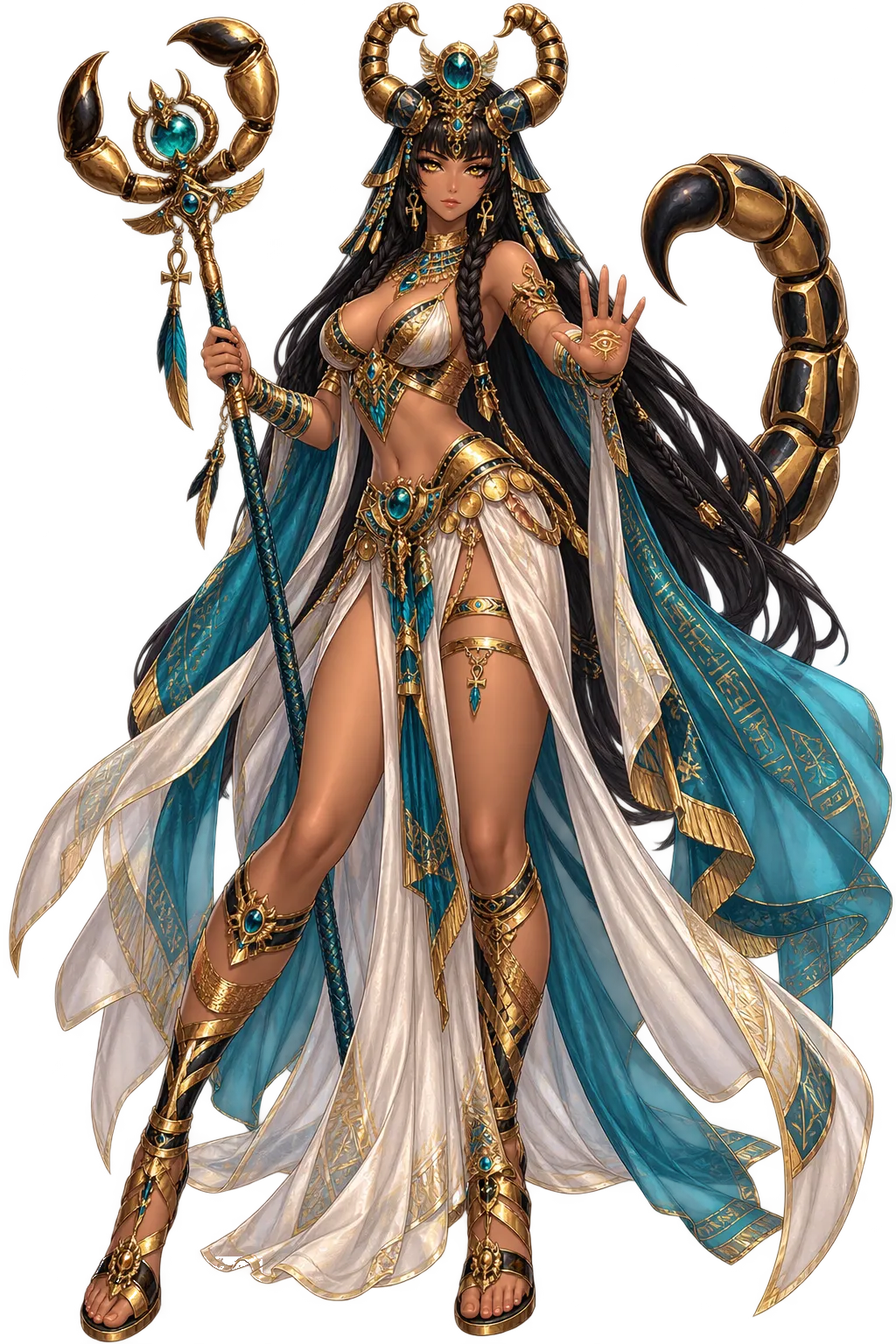
Srqt in 2026: why scholars still care
In 2026, names are treated as data points. Srqt is a reminder that they are also cultural artifacts — and that the difference matters for search engines, AI training corpora, and anyone who types the name of a Egyptian figure into a browser. Scholars never stopped caring about the difference between serket and Srqt; the web simply made that care actionable. What follows is the full scholarly picture — name, script, sound, myth, cult, and legacy — followed by the engineering compromise that lets a restored spelling live at a real address. The question is not whether the name is old. It is whether the digital world is old enough to hold it.
At a Glance
- Restored name: Srqt
- ASCII form: serket
- Meaning: "She who causes the throat to breathe"
- Domain of influence: Scorpions, Healing, Poison
- Pantheon: Egyptian
- Restoration: ASCII-equivalent form
- Original script: 𓊃𓂋𓈎𓏏𓁐 (Hieroglyphs)
Overview
Srqt (serket) — Scorpions, Poison, Protection of the Vulnerable · She who causes the throat to breathe — belongs to the Egyptian tradition, where it is catalogued under the domain "Scorpions, Healing, Poison". The name means "She who causes the throat to breathe".
Srqt — Serket — is the scorpion’s sting turned to medicine: the goddess of venom and its cure. She guards the vulnerable — children, the poisoned, the dead in their most helpless passage — and her scorpion crawls at the feet of kings and coffins alike, holding the poison at bay by its mere presence.
PuniCodex restores the name as Srqt and serves its temple at its temple. The restoration aSCII-equivalent form — a description computed from the displayed form itself. The plain ASCII form serket survives as a modern convenience imposed by the early domain-name system; the restoration, not the fallback, is the form the project defends as philologically complete.
The Name
The name is attested in Hieroglyphs as 𓊃𓂋𓈎𓏏𓁐. Etymologically it means "She who causes the throat to breathe".
The ASCII form serket survives only because the early domain-name system could not carry diacritics; it is a technological compromise, not an ancient spelling. The Unicode restoration Srqt recovers the full diacritic detail of the scholarly transliteration directly in the address bar. The restoration aSCII-equivalent form — a description computed from the displayed form itself.
The letter-by-letter transformation runs:
- s → S — Same
- e → — — Vowel not written
- r → r — Same
- k → q — Qof
- e → — — Vowel not written
- t → t — Same
The Original Script
The name is preserved in Hieroglyphs as 𓊃𓂋𓈎𓏏𓁐 — Egyptian hieroglyphs, attested Egyptian hieroglyphic, c. 3200 BCE – 4th century CE, in Nile Valley, Egypt. The script is written right-to-left / top-to-bottom / multidirectional.
The scholarly transliteration is Srqt (Egyptological transliteration), giving the normalized reading Original vocalisation unknown; Egyptological /ˈsɜːr.kɛt/..
The rendering proceeds step by step:
- Hieroglyphic spelling 𓊃𓂋𓈎𓏏𓁐 generated from MdC z:r-q:t-B1
- Read in scholarly transliteration as Srqt
- She who causes the throat to breathe
Pronunciation
The reconstructed pronunciation of the name is /ˈsɜːrkɛt/ (conventional) — Conventional reading — Egyptian vocalisation not attested.
Phoneme by phoneme:
- Sr- — Written srqt; the name is usually explained as “she who causes the throat to breathe” (s + rḳ + t).
- -q-t — Conventionally vocalised “Serket”; the q is a voiceless uvular stop.
For the modern speaker, the closest approximation is: “SAIR-ket”
Kindred and historical forms of the name:
- Greek — Σελκίς (Selkís)
Her name is a sentence: the scorpion-goddess as the one who lets the poisoned throat breathe again. The final -t is the feminine ending.
Mythology
Serket is a guardian more than a protagonist: she appears wherever protection is most needed, arms outspread over the thing she shields. Her mythic presence clusters around the dying god — she is one of the four goddesses of the canopic equipment in the Osiris cycle — and around the threatened child, above all the young Horus hidden in the Chemmis marshes.
The Four Guardians of the Dead (Osiris Cycle)
When Isis wrapped the reassembled Osiris, the four great protective goddesses — Isis, Nephthys, Neith and Serket — took station at the corners of his bier and canopic chest. Serket’s scorpion stands for the poisoned threats of the night that must be kept from the god’s body; her arms spread in the ‘Isis-knot’ gesture frame every royal sarcophagus hall.
The Scorpion and the Child Horus (Metternich Stela)
The great cippi of Horus the child — the Metternich Stela above all — tell how the infant god was stung by a scorpion in the marshes and revived by the divine mother's magic. Serket stands within that cycle as the power over the venom itself: the sting belongs to her, and so, therefore, does its antidote.
The Scorpion of the King (Royal Protection)
From the earliest dynasties the scorpion guarded the king’s name — King Scorpion of the Predynastic period took the animal as his emblem — and Serket’s image walked at the prow and stern of the royal barque. Her presence converts the desert’s deadliest small killer into a bodyguard.
She Who Waits at the Head of the Bier (Funerary Texts)
In the tomb, Serket and her three sisters stand at the four sides of the sarcophagus, each uttering protection: ‘I am Serket, I encircle with my protection.’ Her protection is specifically against poison and bite — the everyday killers of the Nile valley made powerless at the moment of greatest vulnerability.
Symbols & Iconography
The iconography associated with Srqt concentrates in a small set of recurring attributes, each a compressed statement about the name:
- Mistress of Poison — Commander of the scorpion’s sting; her priests were the healers of venom bites.
- Guardian of the Dead — One of the four goddesses protecting the canopic chest and the sarcophagus itself.
- Protector of Children — Her amulets warded nurseries; the scorpion on a wall meant “no venom enters here”.
- The Breathing Throat — Her name is a cure: she who lets the constricted throat of the stung breathe again.
Archaeology & Evidence
The material record for Srqt survives in a small number of securely identified remains, catalogued below; the corpus is thin but unambiguous, and each site is tied to the name by ancient testimony.
She stands at the corners of Tutankhamun’s canopic shrine — the gilded goddesses of the treasury are among the most photographed objects of Egypt — and in relief on royal sarcophagi from the Old Kingdom onward. Her scorpion emblem marks protective amulets by the thousand in museum collections.
Realm & Domain
Srqt — Serket — is the scorpion’s sting turned to medicine: the goddess of venom and its cure. She guards the vulnerable — children, the poisoned, the dead in their most helpless passage — and her scorpion crawls at the feet of kings and coffins alike, holding the poison at bay by its mere presence.
Mistress of Poison
Commander of the scorpion’s sting; her priests were the healers of venom bites.
Guardian of the Dead
One of the four goddesses protecting the canopic chest and the sarcophagus itself.
Protector of Children
Her amulets warded nurseries; the scorpion on a wall meant “no venom enters here”.
The Breathing Throat
Her name is a cure: she who lets the constricted throat of the stung breathe again.
Across Cultures
Serket was early fused with the greater scorpion-powers of the pantheon and by the New Kingdom is barely separable from Isis in her protective aspect; some temples give her a healing consort-form of Horus. The Greeks called her Selkis and kept her as a goddess of the dead; her name entered the magical papyri of late antiquity as a power-word against poison.
Kindred figures in the PuniCodex cross-tradition index include Asklēpiós, Bhaiṣajyaguru, Brigid, Eir, Gula, and Hygíeia, each linked through healing / medicine.
Cultural Legacy
Her image — woman with a scorpion on her head, arms winged out in protection — is one of the most immediately readable Egyptian glyphs of care. The Metternich Stela and the Horus cippi made her the patroness of a whole genre of healing magic that persisted into Coptic exorcistic texts.
The Scholarly Record
The account of Srqt given in this edition rests on the witnesses and reference works listed below. Lexica and etymological dictionaries secure the form and meaning of the name; the literary and religious texts supply the narrative evidence.
- Metternich Stela (Horus cippus tradition).
- Pyramid and Coffin Texts (canopic guardians).
- Book of the Dead (protection formulae).
- Serket entries in Lexikon der Ägyptologie.
A Meditation
Srqt is a name that performs its function: read it, and the throat opens. The scorpion-goddess guards this page as she guarded the bier — quietly, at the corners, with poison turned outward. Plain letters are her amulet: nothing decorative survives translation, but the protection does.
The Unicode Restoration
Srqt aSCII-equivalent form. The ASCII fallback serket still resolves everywhere, but it is the restored form that carries the name's full information. Across the 6 characters of the name, the restoration adjusts 2: 2 further adjustments (e, e). That is the whole thesis of this temple: the marks are the message.
Character by Character
The journey from serket to Srqt, one character at a time:
- s → S — Same
- e → e — Vowel not written
- r → r — Same
- k → q — Qof
- e → e — Vowel not written
- t → t — Same
The Egyptian Pantheon
Srqt is one of 66 entries the PuniCodex lexicon catalogues under the Egyptian pantheon. The Pantheon page gathers the tradition's major figures in one place, and the Lexicon lets you filter all 983 restorations by tradition or script — the fastest way to see where this name sits among its kin.
Frequently Asked Questions
What does Srqt mean? The traditional gloss is "She who causes the throat to breathe."
Which tradition does Srqt belong to? Srqt is catalogued in the Egyptian pantheon of the PuniCodex lexicon.
What does Srqt preserve that ASCII cannot show? The form itself answers: Srqt aSCII-equivalent form — and the marks in the restored spelling are exactly that evidence.
Can I use Srqt in a normal browser? Yes. The DNS resolves the punycode form automatically, and the type tool on this site converts serket to Srqt for copying and pasting.
Where does the scholarly information come from? The entry is built from lexica, inscriptional evidence, and reviewed scholarly sources listed in the Scholarly Edition. Every claim is traceable to a canonical source.
Typing Srqt
You do not need a special keyboard to use this restoration. The PuniCodex Type Tool converts the ASCII form serket into Srqt as you type, and the browser extension offers the same conversion inside any text field. Copy the restored form, paste it into the address bar, and the DNS does the rest.
Sister Temples
Other temples in the Egyptian pantheon include Skr, Tfnt, and Wꜣḏyt — each with its own restoration story, its own scholarly record, and its own place in the lexicon.
Why This Restoration Matters
In 2026 the stakes are practical. Search indexes, language models, and localization pipelines all inherit whatever spelling the web normalizes — which means every Unicode domain is also a training signal. Srqt teaches the machinery that the restored form exists, that it is used, and that it points to a real place. That is why a project built on philology ends up caring about DNS: the infrastructure decides which names the future sees. This restoration makes sure the future sees the whole name.
Explore Further
This post is one doorway into the temple. The home page carries the full character breakdown and the ambient canvas; the lore page tells the myths in long form; the Scholarly Edition preserves the sources, pronunciation data, and revision history; and the patron wall supports the restoration directly. For the wider map, browse the Lexicon, explore the Pantheon, or return to the PuniCodex blog.
A Closer Look at the Marks
A restored name is a small map. In Srqt, the journey from the ASCII fallback serket to the Unicode form can be read letter by letter, and each letter tells a story. Of the 6 characters, 4 remain unchanged; they anchor the name to its modern shape. The remaining adjustments recover marks the source tradition used to distinguish this name from every other word built from the same letters.
The s stays as it is — Same.
The e becomes e — Vowel not written.
The r stays as it is — Same.
The k stays as it is — Qof.
The e becomes e — Vowel not written.
The t stays as it is — Same.
Together these changes are not decoration. They are the minimum set of marks needed to keep the name legible in its own tradition. Remove them and you still have a string of letters; you no longer have the name as it was written.
Srqt in Its Tradition
Srqt does not stand alone. It belongs to the Egyptian tradition, where it is counted among 66 names in the PuniCodex lexicon. Its sphere — Scorpions, Healing, Poison — places it beside other figures who govern similar aspects of experience. The restored spelling is therefore not only a philological decision; it is a way of keeping the name in the company of its kin. When the address bar shows Srqt, it marks the boundary between a generic search term and a named entry in a living catalog of myth. That catalog is the point of the project. Every restored name is a vote for specificity: the web should know the difference between a figure and a keyword, between a tradition and a trend. Srqt is one such vote.
What You Will Find in the Temple
The temple page for Srqt is more than a landing page. The home tab presents the character breakdown, the pronunciation guide, and the live domain status in a single view. The lore tab gathers the myths and narratives that give the name its depth. The Scholarly Edition tab publishes the sources, variant forms, and review history that justify the restoration. Industry patterns show where the name appears in modern commerce and culture, while the gallery and creatives tabs collect visual and sponsor material. The patron wall lets visitors support the restoration directly. Each tab is generated from the same canonical sources, so the domain, the blog, the scholars page, and the search index all agree. The result is a single source of truth about a name, delivered through several doors.
The Restoration on the Live Web
A domain name is a kind of publication. When Srqt resolves, it proves that the restored spelling is not a theoretical exercise; it is a working address on the public internet. Search engines can index it, language models can encounter it, and anyone who copies it from a manuscript can paste it into a browser. That practical reality changes the status of the restoration. Before Unicode domains, a scholar could write the name correctly in an article while the public web flattened it to serket. Now the public web can carry the correct form end to end. The punycode translation happens silently, so the infrastructure remains compatible while the visible name keeps its marks. That compromise — human-readable restoration, machine-readable encoding — is the foundation of every PuniCodex temple.
Restoration Notes
Restoring a name is not a single decision; it is a sequence of smaller decisions, each backed by a different kind of evidence. For Srqt, the chain begins with the attested form in Hieroglyphs, continues through the standard scholarly romanizations, and ends with the DNS-compatible Unicode spelling used by this temple. The meaning "She who causes the throat to breathe" anchors the name in its semantic field; without that anchor, the marks would float free of the figure they name. Of the 6 characters in the ASCII form, 2 carry adjusted marks: e becomes e (Vowel not written), e becomes e (Vowel not written). Those adjustments are not arbitrary styling. They follow the restoration logic the displayed form wears openly: Srqt aSCII-equivalent form. The rule is mechanical, not editorial, which means the same standard applies to every entry in the lexicon. A visitor who disagrees with the classification can at least see exactly which evidence produced it, because every step is recorded in the Scholarly Edition. That transparency is the difference between a restoration project and a branding exercise. The name is being put back, not invented.
Related Names
Sources
The full scholarly apparatus — every citation, revision, and review — lives in the Scholarly Edition. Key references for this post:
- James P. Allen, Middle Egyptian: An Introduction to the Language and Culture of Hieroglyphs, Cambridge University Press, 2000.
- Metternich Stela (Horus cippus tradition).
- Pyramid and Coffin Texts (canopic guardians).
- Book of the Dead (protection formulae).
- Faulkner, A Concise Dictionary of Middle Egyptian.
- Lexicon authorities for this entry: Faulkner, Wb.