
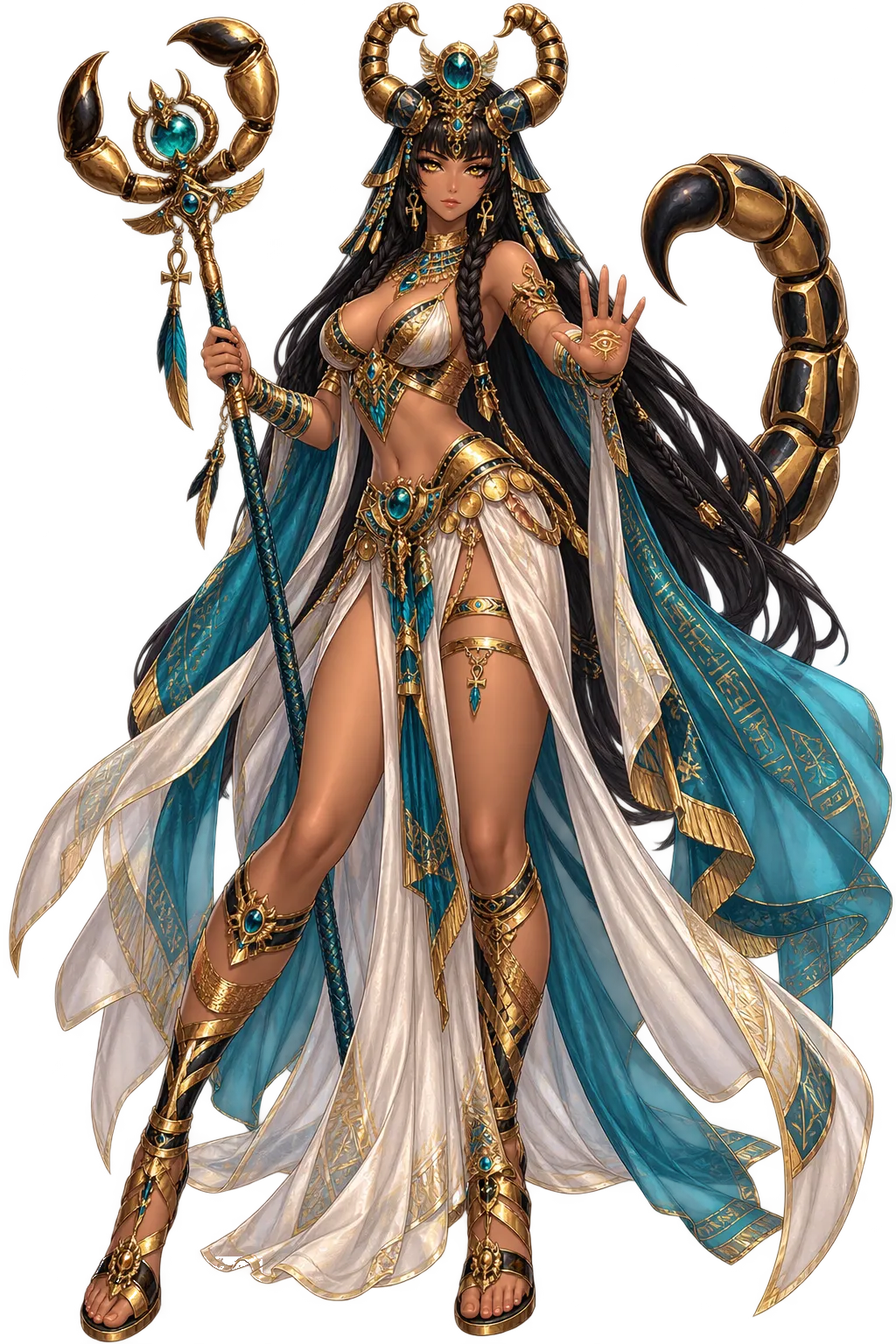
Srqt — the one true spelling, and the forms that fail it
A letter to a colleague, 31 July 2026 — on the name Srqt, and on the forms that keep failing it.
Your note said, roughly: surely the marks are a nicety. Permit me to use Srqt to show they are not.
First, the attestation. The attested form is 𓊃𓂋𓈎𓏏𓁐, from the tradition's own record. The canonical transliteration is Srqt.
Say it aloud as the sources heard it: “SAIR-ket” The marks are what carry that sound to a reader who has never heard it spoken.
On the plain form — and I want to be precise, because you pushed on this. The plain form serket is not false — it is a fallback, and the register is exact about what that means. In systems that cannot carry diacritics (legacy databases, older tooling, parts of the address-bar pipeline) the flattened form is the accepted vehicle, and the rulebook names it explicitly as the final rung of the fallback hierarchy: full restoration first, circumflex where attested, macron-only by the academic standard, an attested variant, and only then plain ASCII.
What the fallback status forbids is promotion: serket may carry the name where marks are impossible, but it may not represent the name where marks are possible. A fallback is a vehicle, never the primary.
One more thing, because it always surprises: the name did not stay home. Serket was early fused with the greater scorpion-powers of the pantheon and by the New Kingdom is barely separable from Isis in her protective aspect; some temples give her a healing consort-form of Horus. The Greeks called her Selkis and kept her as a goddess of the dead; her name entered the magical papyri of late antiquity as a power-word against poison.
And it never stopped working. Her image — woman with a scorpion on her head, arms winged out in protection — is one of the most immediately readable Egyptian glyphs of care. The Metternich Stela and the Horus cippi made her the patroness of a whole genre of healing magic that persisted into Coptic exorcistic texts.
The Convention's Own History
Egyptological transliteration exists because hieroglyphs write consonants, not vowels. The characters ꜣ (aleph) and ꜥ (ayin) are consonants — a glottal reed and a pharyngeal grip — and rendering them as vowels does not "simplify" the name, it deletes consonants from it. The conventions in use descend from nineteenth-century decipherment and the standardized Manuel de Codage: ḥ, ḫ, ḏ, ṯ each mark a distinct consonant the Egyptian wrote and a modern reader must not merge. When this register defends them, it defends the principle that a writing system older than the alphabet gets to keep its consonants.
Where Protocol Meets Practice
The technical answer is simple: the canonical marks are legal IDNA 2008 characters, encoded as punycode under `xn--`. The practical answer is messier: legal does not mean stocked (registrar inventory is partial), and stocked does not mean typeable (stacked diacritics defeat mobile keyboards).
So the register's rule is a hierarchy of attested forms — full restoration, circumflex, macron-only, attested variant, and finally plain ASCII for the systems that cannot carry marks. Every rung is defensible because every rung is attested. The forms this register rules against are not rungs; they are errors, and errors do not get rungs.
Write back when you have checked the sources; they are better company than I am.
— The Register
The Verdict
Srqt is the canonical form: attested, checkable, and enforced across the temple, the lexicon, the cards, the APIs, and this register. The plain form serket is sanctioned as the fallback vehicle and nothing more. The false forms above are documented so that no reader has to take the temple's word on faith — the violations are stated, the sources are named, and the register stands open to challenge on every line.
The temple of Srqt stands at /serket/.
The docket for this ruling: no false forms on the docket; no contested forms attested; the attestation rests on 4 cited sources — Metternich Stela (Horus cippus tradition), Pyramid and Coffin Texts (canopic guardians), Book of the Dead (protection formulae).
The Register Continues
The register holds 597 entries like this one — each temple with its own ruling. Read the temple's founding dispatch for the story, its Restoration File for the philology, its Resonance File for the industries, or the whole archive end to end.
Continue the register — previous entry: Serapis (read it) · next entry: Sšꜣt (read it).
The Canonical Register is written from the same canonical record as the lexicon itself. If a false form is missing from this page, it is because the evidence does not support calling it false — or because we have not seen it yet. Show us, with a citation, and the register will answer.