The Living Myth
Scorpions, Healing, Poison · Scorpions, Poison, Protection of the Vulnerable · She who causes the throat to breathe
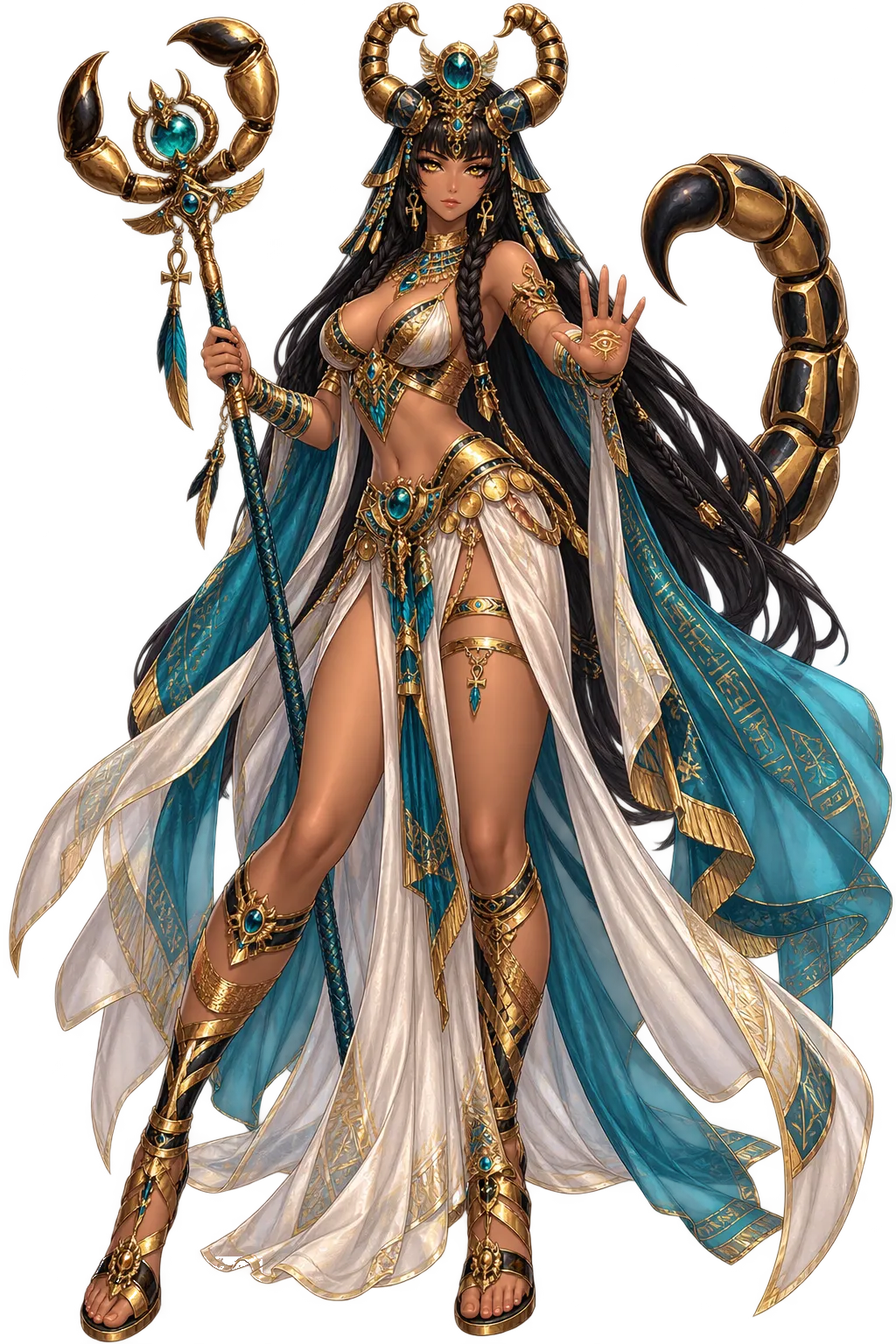
Stories of Srqt
Serket is a guardian more than a protagonist: she appears wherever protection is most needed, arms outspread over the thing she shields. Her mythic presence clusters around the dying god — she is one of the four goddesses of the canopic equipment in the Osiris cycle — and around the threatened child, above all the young Horus hidden in the Chemmis marshes.
When Isis wrapped the reassembled Osiris, the four great protective goddesses — Isis, Nephthys, Neith and Serket — took station at the corners of his bier and canopic chest. Serket’s scorpion stands for the poisoned threats of the night that must be kept from the god’s body; her arms spread in the ‘Isis-knot’ gesture frame every royal sarcophagus hall.
The great cippi of Horus the child — the Metternich Stela above all — tell how the infant god was stung by a scorpion in the marshes and revived by the divine mother's magic. Serket stands within that cycle as the power over the venom itself: the sting belongs to her, and so, therefore, does its antidote.
From the earliest dynasties the scorpion guarded the king’s name — King Scorpion of the Predynastic period took the animal as his emblem — and Serket’s image walked at the prow and stern of the royal barque. Her presence converts the desert’s deadliest small killer into a bodyguard.
In the tomb, Serket and her three sisters stand at the four sides of the sarcophagus, each uttering protection: ‘I am Serket, I encircle with my protection.’ Her protection is specifically against poison and bite — the everyday killers of the Nile valley made powerless at the moment of greatest vulnerability.
She Who Causes the Throat to Breathe
Srqt — Serket — is the scorpion’s sting turned to medicine: the goddess of venom and its cure. She guards the vulnerable — children, the poisoned, the dead in their most helpless passage — and her scorpion crawls at the feet of kings and coffins alike, holding the poison at bay by its mere presence.
Commander of the scorpion’s sting; her priests were the healers of venom bites.
One of the four goddesses protecting the canopic chest and the sarcophagus itself.
Her amulets warded nurseries; the scorpion on a wall meant “no venom enters here”.
Her name is a cure: she who lets the constricted throat of the stung breathe again.
From the original script to the living URL
𓊃𓂋𓈎𓏏𓁐
The name in its original Egyptian form. Srqt (𓊃𓂋𓈎𓏏𓁐) is attested in the source tradition — “She who causes the throat to breathe”. Its original diacritics and script distinctions carry the full phonetic and orthographic weight of the source tradition.
serket
The plain serket form is identical to the Unicode restoration. Because this name is already written in Latin letters, no diacritics, stress, or script information were lost — only capitalization differs.
Srqt
The Unicode restoration does not need to recover lost marks for Srqt. Its value is canonical spelling and consistent cataloguing, not the reconstruction of erased orthography. The domain is readable as-is to both DNS and humanity.
Srqt.com
This restoration is written entirely in ASCII letters — no Punycode encoding stands between Srqt and the DNS. The domain reads identically to machines and to human eyes.
The attested spelling family of Srqt
Srqt
Restores 𓊃𓂋𓈎𓏏𓁐. The full Unicode restoration. srqt.com is not in the PuniCodex collection — it is watched for release; if it drops, this temple upgrades to an owned flagship. Attested by Faulkner, Wb.
How Srqt was spoken
How Srqt travels from ancient script to the modern URL
Egyptian Srqt; the original vocalisation is unknown. The name means “she who causes the throat to breathe", a scorpion-goddess of healing.
The lore you have read is the living myth. Extended Lore opens the scholarly vault beneath it: the cult and its material remains, a history of the image, the name after antiquity, a meditation on what the name still means, and the full scholarly apparatus — etymology, orthography, sources.
Enter Extended Lore