
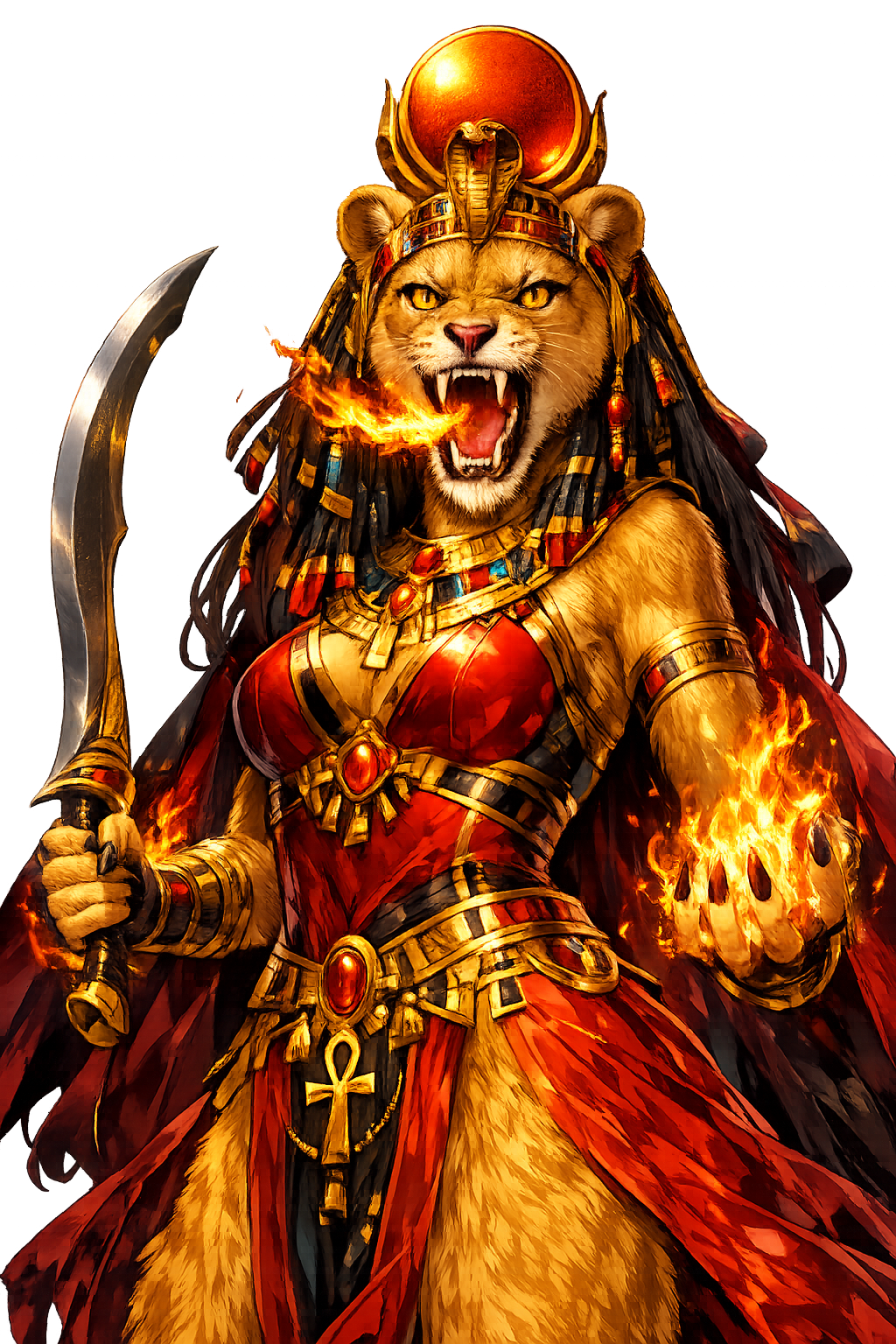
The working life of Sḫmt: from the myths to the modern trades
The myths did not retire. They moved offices. This is the file on where Sḫmt works now.
Sekhmet's mythology is dominated by one stupendous story and its aftermath: the day the sun-god sent her to punish humanity, and the trick that turned genocide into festival. Around that core the tradition built a practical theology — the statue garrisons of Thebes, the daily appeasement rites, the physicians' prayers — because a goddess of plague cannot be merely told about; she must be managed, fed, and ritually kept calm.
The pattern atlas — which maps every flagship temple to the industries its archetype demonstrably resonates with, each match argued and open to challenge — seats this temple in 4 industries. This file reads those seats the way they were earned: through the myths.
At a Glance
- Temple: Sḫmt
- Pantheon: Egyptian
- Domain of influence: War, Vengeance, Healing
- Pattern seats: 4
- Sectors touched: Commerce & Governance · Health & Wellbeing · Culture & Entertainment · Home & Lifestyle
- Strongest seat: Defense, Military & Security
- Series: The Resonance Files, No. 429 of 546
The Myth at Work
The Day the Eye Did Not Stop. In the Book of the Heavenly Cow — inscribed in the tombs of Seti I (KV17) and Ramesses VI (KV9) and on the gilded shrines of Tutankhamun (KV62) — the aging Re learns that humanity plots against him and sends his Eye, the lioness, against the rebels. Her fury is absolute, and the text's numbers are a theology of excess: seven thousand jars of salvation-brew are ordered against the slaughter. — remember the shape of that act. You will see it again, wearing a logo.
One Statue for Every Day and Night. At Karnak, in the precinct of Mut, stands Egypt's most startling devotional infrastructure: hundreds of black granite statues of Sekhmet, seated and standing, crowned with the sun disk, so many that one tradition holds a statue was dedicated for each day and night of the year, so that her protective gaze would never sleep. Most were commissioned by Amenhotep III, whose long reign also endured plague — the Amarna letters speak of pestilence in Egypt — and scholars have connected the vast program to the king's prayers for deliverance and to his sed-festivals, in which Sekhmet embodied royal power renewed. — remember the shape of that act. You will see it again, wearing a logo.
The Seats
Each of these is argued in the atlas with a weight and a why-line. What the atlas cannot fit in one line is the whole myth — so here is each seat with its story restored.
Defense, Military & Security
Defense contracting, security services, and strategic studies. (Sector: Commerce & Governance)
The lioness of the solar eye, battlefield devourer and plague-bringer — Egypt’s most terrifying expression of military force. Swap the costume and the sentence is indistinguishable from the myth. That is what a resonance seat means.
Healthcare, Pharma & Medicine
Medicine, pharmaceuticals, and public health. (Sector: Health & Wellbeing)
The Powerful One invoked by Egypt’s physicians against plague. — the atlas stops there, out of discipline. The myth keeps going: the function Sḫmt performs in the stories is precisely the function this industry sells.
Wine, Brewing & Hospitality
Vineyards, craft beverage, and hospitality venues. (Sector: Culture & Entertainment)
The why-line says it in one breath: Pacified by jars of red-dyed beer in the Destruction of Mankind; brewing literally saved the world. That is not a resemblance; it is the same act, performed in a newer building.
Pet Care & Animal Industries
Pet products, veterinary care, and animal brands. (Sector: Home & Lifestyle)
The lioness to Bastet’s house cat; Egypt’s other great feline power. Swap the costume and the sentence is indistinguishable from the myth. That is what a resonance seat means.
The Long Employment
Sekhmet strides through modern culture as the archetype of righteous rage: lioness-warrior in games and fantasy novels, patroness of a fury that protects rather than wounds, invoked in wellness and feminist spirituality as the power women are still told to suppress. Scholars of ancient medicine study her priesthood as an early case of temple healing and of ritual epidemic management — her distributed garrison of statues reads today like an ancient public-health program. The age changed. The work did not.
The Method, Stated Plainly
Skeptical? Good — the system is built for you. Every seat in this file carries its why-line and its weight, the full derivation is public at the methodology page, and the challenge process is part of the design. Falsifiable is not a posture here; it is the mechanism.
For the Ones Who Work There
If you work in defense, military & security, healthcare, pharma & medicine, or any trade this temple holds a seat in, this is the honest version of what a placement means: your industry beside the story it has been re-telling all along — on the temple floor itself, before an audience that came specifically to read it. The patron tier and the advertising terms describe the mechanics; the resonance above describes the fit.
The File Continues
One of 546 Resonance Files — the series where the pantheon goes to work. Read the founding dispatch for the name, the Restoration File for the spelling, or the whole archive end to end.
Continue the series — previous: Seirḗn (read it) · next: Selēnē (read it).
The Resonance Files are argued from the same canonical record as the pattern atlas itself: the lexicon, the lore catalog, and the cited sources. Every seat can be challenged at the methodology page — and the challenge is the point.