
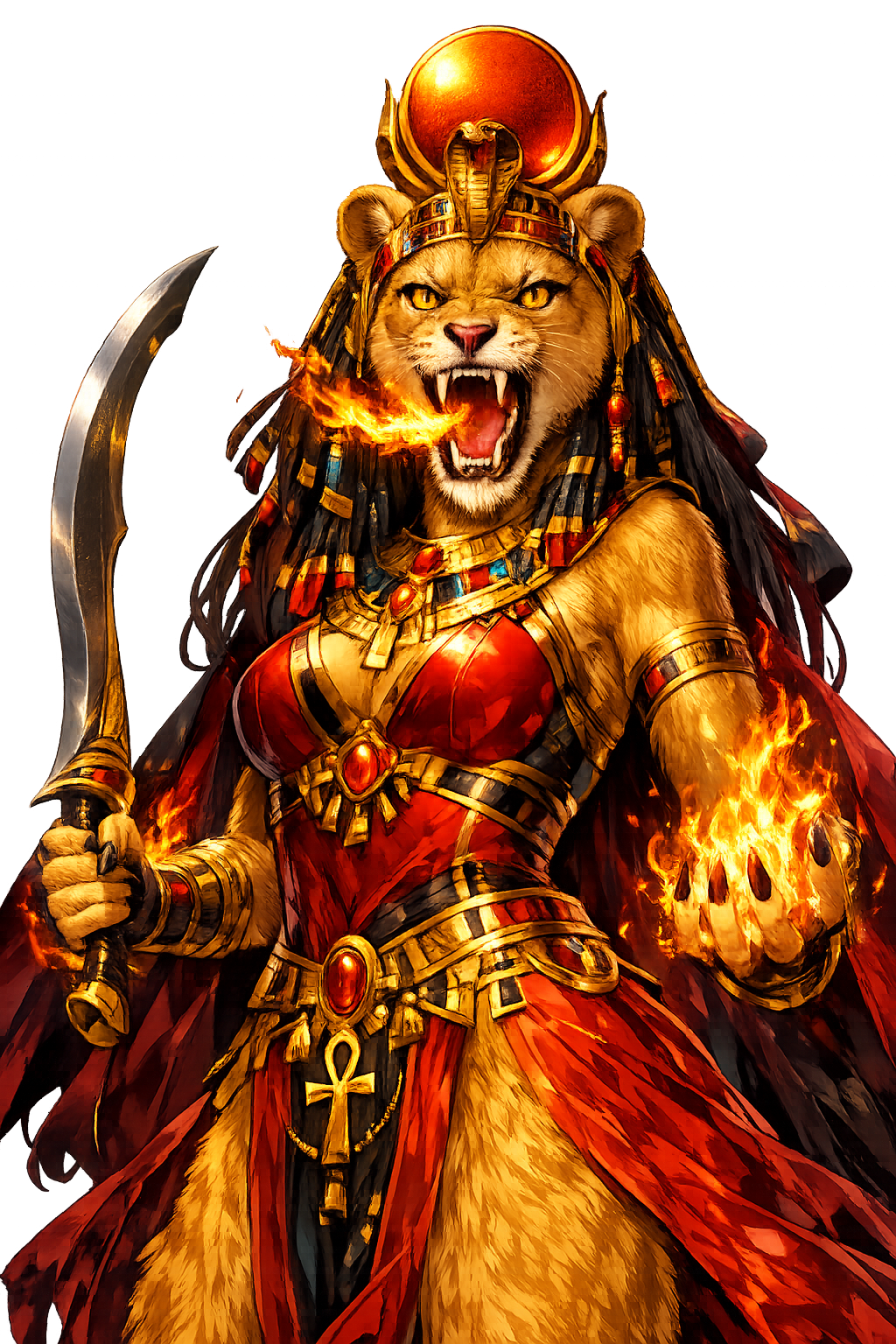
Why Sḫmt is spelled that way — and what it costs to get it right
There is a version of this name the early internet had to settle for: sekhmet. This is the file on how Sḫmt replaced it.
Sekhmet's mythology is dominated by one stupendous story and its aftermath: the day the sun-god sent her to punish humanity, and the trick that turned genocide into festival. Around that core the tradition built a practical theology — the statue garrisons of Thebes, the daily appeasement rites, the physicians' prayers — because a goddess of plague cannot be merely told about; she must be managed, fed, and ritually kept calm.
At a Glance
- Restored name: Sḫmt
- ASCII form: sekhmet
- Meaning: "The Powerful One (Egyptian sḫmt)"
- Domain of influence: War, Vengeance, Healing
- Pantheon: Egyptian
- Classification: Tier 1
- Original script: 𓃭
- Series: The Restoration Files, No. 429 of 546
The Name Before the Marks
Spoken, the name runs `/saxˈmaːt/` — 'sakh-MAHT' — 'sakh' as in 'Bach' with an s, then 'maht' with a long 'ah' and a crisp or silent final t.
The Temple That Stands Now
The restored name is not a plaque; it is an address. The temple of Sḫmt lives at /sekhmet/, with its mythology in the lore halls, its peer-reviewed record in the Scholarly Edition, and its place in the pattern atlas on the patterns floor.
Tier-1 is not a compliment; it is a measurement. This restoration keeps something the ASCII form provably loses, and the measurement is repeatable.
Where the Name Stood First
The most striking material witnesses are the hundreds of granite statues of Sekhmet from the Mut precinct at Karnak, many now in museums worldwide, including the British Museum and the Louvre, with further examples from the Luxor cache. Bronze amulets, votive ears, and healing stelae come from Saqqara, Memphis, and Deir el-Medina. The Book of the Heavenly Cow survives on the walls of the tomb of Tutankhamun (KV62), Seti I (KV17), and Ramesses VI (KV9), preserving the Destruction of Mankind narrative in royal burial contexts. Amenhotep III's statue program is documented by its own inscriptions and by the Amenhotep III colossi at the temple's entrance. The temple on the web is the newest of these addresses — the first one that fits in a pocket.
The Archetype at Work
The pattern atlas seats this temple in 4 industries, each match argued and weighted: Defense, Military & Security (the lioness of the solar eye, battlefield devourer and plague-bringer — Egypt’s most terrifying expression of military force.); Healthcare, Pharma & Medicine (the Powerful One invoked by Egypt’s physicians against plague.); Wine, Brewing & Hospitality (pacified by jars of red-dyed beer in the Destruction of Mankind; brewing literally saved the world.). The Resonance File reads those seats through the myths themselves.
In the Sacred Texts
The Egyptian tradition is not a vibe; it is a library. The Sacred Texts collection holds The Book of the Dead — the primary sources the temple's scholarship is built on. The temple is the argument; the texts are the evidence.
The File Continues
The temple's founding dispatch tells the name's story; its Resonance File reads the myths into the industries; the blog index holds the whole archive.
Continue the series — previous file: Seirḗn (read it here) · next file: Selēnē (read it here).
The Restoration Files are written from the same canonical record as the temples themselves: the lexicon, the lore catalog, the pattern atlas, and the cited scholarly sources. If a file ever disagrees with its temple, the temple is right — tell us, and the file will be corrected.