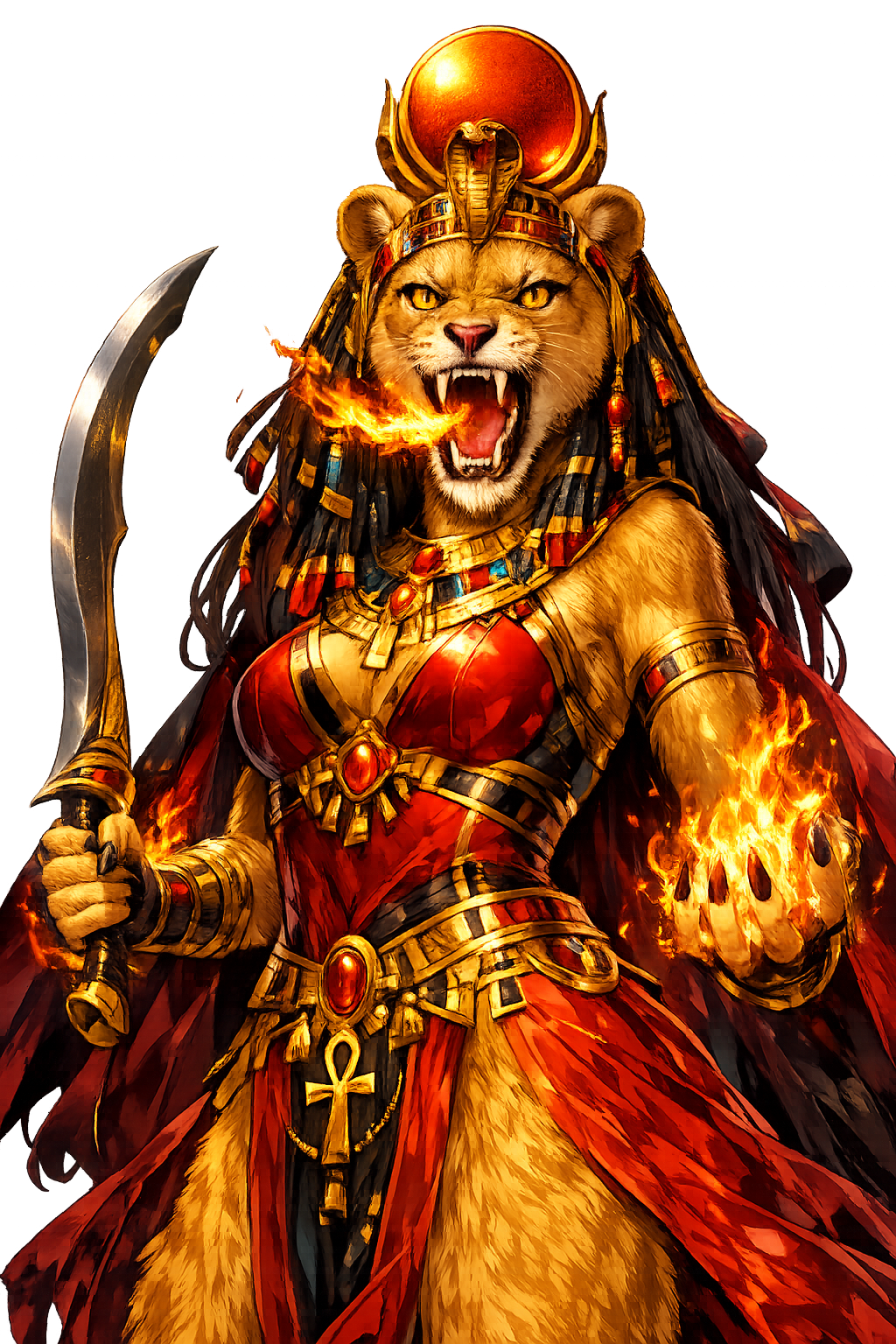
Stories of Sḫmt
Sekhmet's mythology is dominated by one stupendous story and its aftermath: the day the sun-god sent her to punish humanity, and the trick that turned genocide into festival. Around that core the tradition built a practical theology — the statue garrisons of Thebes, the daily appeasement rites, the physicians' prayers — because a goddess of plague cannot be merely told about; she must be managed, fed, and ritually kept calm.
In the Book of the Heavenly Cow — inscribed in the tombs of Seti I (KV17) and Ramesses VI (KV9) and on the gilded shrines of Tutankhamun (KV62) — the aging Re learns that humanity plots against him and sends his Eye, the lioness, against the rebels. Her fury is absolute, and the text's numbers are a theology of excess: seven thousand jars of salvation-brew are ordered against the slaughter. When even the gods grow afraid that mankind will be extinguished, Re relents and deploys Egypt's oldest technology: fermentation. The fields are flooded with beer dyed red with ochre until the land stands red as blood. The lioness, sworn to drink only blood, drinks, wakes drunk, wakes pacified; Re greets the returning eye by a new and gentler name — Hathor — while Sekhmet remains the name of her wrath. The festival of drunkenness at Thebes kept the transformation liturgically alive. The myth's mercy is a technology: brewed, dyed, and poured — violence inebriated into harmlessness and commemorated, thereafter, with a hangover.
At Karnak, in the precinct of Mut, stands Egypt's most startling devotional infrastructure: hundreds of black granite statues of Sekhmet, seated and standing, crowned with the sun disk, so many that one tradition holds a statue was dedicated for each day and night of the year, so that her protective gaze would never sleep. Most were commissioned by Amenhotep III, whose long reign also endured plague — the Amarna letters speak of pestilence in Egypt — and scholars have connected the vast program to the king's prayers for deliverance and to his sed-festivals, in which Sekhmet embodied royal power renewed. The statues were not decoration but stationed force: a distributed garrison of the goddess, each figure a sentry to be approached, addressed, and offered to daily. When Egyptologists count them by the hundred — in the British Museum, the Louvre, and the Luxor cache — they are counting the material form of a theology of vigilance: protection is not an event but a roster, and dangerous power is honored by being permanently employed.
At Memphis, where Ptah creates the world by the thought of his heart and the commanding word of his tongue — the doctrine preserved on the Shabaka Stone — Sekhmet is the creator's power made flesh, the beloved of Ptah, wed to the god whose craft is intelligence and whose bride is force. With their son Nefertem, the lotus-child of the primeval mound, they form the Memphite triad, and the pairing is itself a theological sentence: the tongue that names reality and the arm that enforces it. Memphite theology gave Sekhmet her characteristic title-set — 'the powerful one', 'the one before whom evil trembles' — and her lioness images guarded the approaches to Ptah's temple like living thresholds. The marriage of Ptah and Sekhmet says what Egyptian religion said in a hundred pairings: intelligence without force cannot rule, force without intelligence cannot create, and the city of the creator needs both at once. Their son, the fragrant lotus, is what a city smells like when the marriage works.
The same heat that burns also sterilizes, and Egyptian medicine knew it: temple prayers and magical texts invoke Sekhmet against the very demons of fever and plague she is said to send. One type of healing prayer, collected by Borghouts in Ancient Egyptian Magical Texts, petitions her by her mercy-titles — 'Sekhmet, great of magic, mistress of life' — to turn back an affliction, on the logic that the goddess who owns the disease is the only power certain to outrank it. Her cult personnel included healers, and her epithet 'lady of life' sits comfortably beside 'the slaughterer' on the same monuments. Late Period healing statues and cippi bind her ferocity to the cures of Horus, so that the lioness and the child-god fight illness as a pair. The logic is older than Egypt and newer than antibiotics: only the sender of the plague can reliably revoke it, and so the physician's first patron is the goddess of fever herself.
Temple liturgies treat Sekhmet not as a story to be told but as a fire to be banked. Hymns preserved on temple walls at Esna celebrate her as lady of the fiery breath, and offering lists from Karnak and Memphis show the daily cult that fed her statues; at the turn of the year, rites of appeasement — the 'satisfying of the goddess' — calmed the lioness whose heat was the parching wind and whose coming drought threatened the flood. No single canonical narrative survives to describe these rites from beginning to end; what survives is the discipline itself, embedded in calendars, offering lists, and priestly titles. The absence is itself instructive. For most of Egyptian history Sekhmet was not mythologized but managed — worshipped the way one maintains a dam. Her priesthoods, like good epidemiologists centuries before the word, preferred routine vigilance to storytelling: the most dangerous goddess in Egypt was also its most regularly fed.
War, Vengeance, and the Physician's Hand
Sḫmt is the solar eye when it has had enough. A lioness-headed goddess crowned with the sun disk and uraeus, she is the most terrifying expression of divine force in Egypt: plague-bringer, battlefield devourer — and, paradoxically, one of the most skilled healers in the pantheon. Her name means 'the powerful one', and power is rarely gentle.
She is the sun-god's burning gaze, sent to punish rebellion and to protect cosmic order.
The Destruction of Mankind myth tells how Re unleashed her and almost lost control.
Her priests practiced medicine; spells invoke Sekhmet to turn away disease and poison.
Heat, fever, and the parching wind of the desert are hers; so is their relief.
From the original script to the living URL
𓃭
The name in its original Egyptian form. Sḫmt (𓃭) is attested in the source tradition — “The Powerful One (Egyptian sḫmt)”. Its original diacritics and script distinctions carry the full phonetic and orthographic weight of the source tradition.
sekhmet
Reduced to plain sekhmet, the name loses everything that made it specific: original diacritics and script distinctions. What remains is an ASCII string that machines can parse but that no longer speaks with its original voice.
Sḫmt
The Unicode restoration recovers what ASCII flattened. Sḫmt restores original diacritics and script distinctions, returning the name to its original written dignity. The domain encodes to Punycode, but the browser displays the truth.
Sḫmt.com → xn--smt-b2y.com
The non-ASCII characters in Sḫmt are encoded while the ASCII remains visible. To the DNS, it is Punycode. To humanity, it is Sḫmt.
Owned, ideal, and ASCII forms of Sḫmt
Sḫmt
Restores 𓃭. The live temple domain — sḫmt.com.
sekhmet
Flattens 𓃭. The plain ASCII fallback — what DNS and legacy systems see.
How Sḫmt was spoken
How Sḫmt travels from ancient script to the modern URL
Egyptian sḫmt; the original vocalisation is unknown. The name means “the powerful/mighty one", from sḫm “to be powerful".
War, Vengeance, Healing
The Unicode restoration Sḫmt uses Egyptological characters registrable in .com; hieroglyphs are outside the .com IDN table.
The lore you have read is the living myth. Extended Lore opens the scholarly vault beneath it: the cult and its material remains, a history of the image, the name after antiquity, a meditation on what the name still means, and the full scholarly apparatus — etymology, orthography, sources.
Enter Extended Lore