
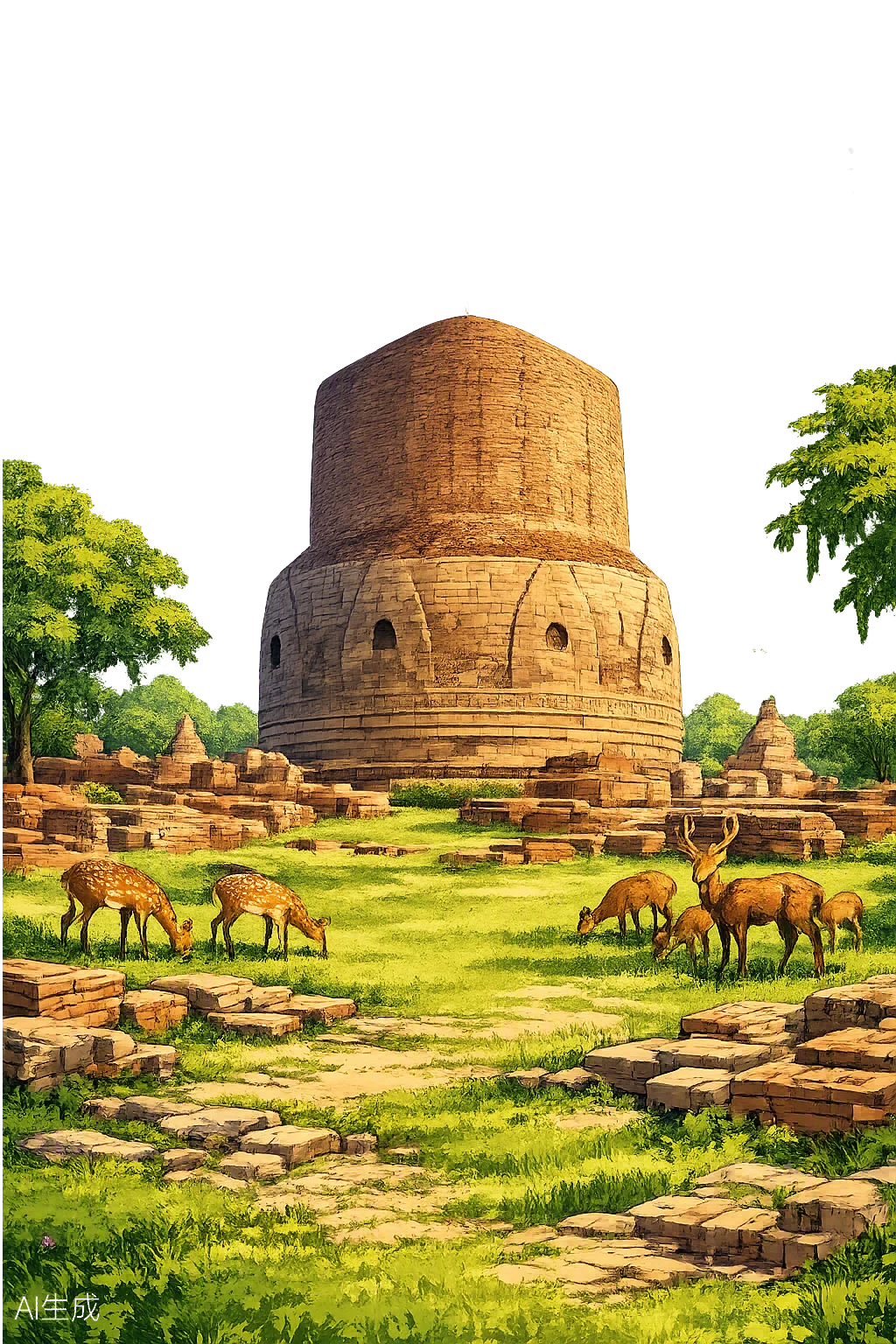
Where Sarnath works now: the myths behind the markets
The myths did not retire. They moved offices. This is the file on where Sarnath works now.
Sarnath is not a mythic battlefield but a sacred geography of events: here, tradition holds, the Buddha gave his first sermon, turned the Wheel of Dhamma, and founded the Sangha. Its lore weaves scripture, Jātaka story, and the long historical afterlife of Indian Buddhism into a single landscape.
The pattern atlas — which maps every flagship temple to the industries its archetype demonstrably resonates with, each match argued and open to challenge — seats this temple in 3 industries. This file reads those seats the way they were earned: through the myths.
At a Glance
- Temple: Sarnath
- Pantheon: Buddhist
- Domain of influence: First Sermon, Deer Park
- Pattern seats: 3
- Sectors touched: Society & Spirit · Culture & Entertainment
- Strongest seat: Education, Research & Knowledge
- Series: The Resonance Files, No. 427 of 548
The Myth at Work
Setting the Wheel in Motion. After the awakening beneath the Bodhi tree at Bodh Gayā, the tradition recorded in the Mahāvagga of the Vinaya says the Buddha hesitated to teach: the Dhamma he had seen was subtle, peaceable, beyond the net of opinion, and beings were pleasure-bent. The god Brahmā Sahampati descended from his heaven to beg him to open the doors of the Deathless, and the Buddha surveyed the world with the awakened eye and saw beings 'with little dust in their eyes' — enough to warrant the effort. — remember the shape of that act. You will see it again, wearing a logo.
Where the Sages Fell. The commentarial tradition explains the ancient name Ṛṣipatana — Pali Isipatana, 'the place where the sages fell (rained down)' — with a legend: five hundred paccekabuddhas, solitary enlightened beings, foresaw that a fully awakened Buddha would arise and preach upon that very ground. At the appointed hour they rose into the air, flew through the sky, and descended in the deer park; having paid homage to the ground and circled it, they passed into final nirvāṇa together. — remember the shape of that act. You will see it again, wearing a logo.
The Seats
Each of these is argued in the atlas with a weight and a why-line. What the atlas cannot fit in one line is the whole myth — so here is each seat with its story restored.
Education, Research & Knowledge
Schools, universities, and research institutions. (Sector: Society & Spirit)
The why-line says it in one breath: Primary seat: Sarnath embodies first sermon, deer park — the core of education. That is not a resemblance; it is the same act, performed in a newer building.
Mythic Name Restoration
Scholarly Unicode restorations of mythic names for modern identity. (Sector: Culture & Entertainment)
Resonant seat: Sarnath shares symbolic territory with mythic restoration. — the atlas stops there, out of discipline. The myth keeps going: the function Sarnath performs in the stories is precisely the function this industry sells.
Writing, Publishing & Media
Books, journalism, and content platforms. (Sector: Culture & Entertainment)
The why-line says it in one breath: Resonant seat: Sarnath shares symbolic territory with publishing media. That is not a resemblance; it is the same act, performed in a newer building.
The Long Employment
For the Buddhist world Sarnath is a first-rank pilgrimage site, paired with Bodh Gayā, Kusinārā, and Lumbinī in the circuit of the four principal sacred places. Aśvaghoṣa already celebrated the first sermon in the Buddhacarita, and the Chinese pilgrims Faxian and Xuanzang recorded the monuments when the monasteries still functioned. The age changed. The work did not.
The Method, Stated Plainly
The atlas is not a horoscope. Seats are earned from the sources — argued, weighted, published — and every one of them can be challenged at the methodology page. A match that cannot survive an argument does not survive review. That is the whole trick: the patterns are claims, and claims can be tested.
For the Ones Who Work There
If you work in education, research & knowledge, mythic name restoration, or any trade this temple holds a seat in, this is the honest version of what a placement means: your industry beside the story it has been re-telling all along — on the temple floor itself, before an audience that came specifically to read it. The patron tier and the advertising terms describe the mechanics; the resonance above describes the fit.
The File Continues
One of 548 Resonance Files — the series where the pantheon goes to work. Read the founding dispatch for the name, the Restoration File for the spelling, or the whole archive end to end.
Continue the series — previous: Sarasvatī (read it) · next: Sarutahiko (read it).
The Resonance Files are argued from the same canonical record as the pattern atlas itself: the lexicon, the lore catalog, and the cited sources. Every seat can be challenged at the methodology page — and the challenge is the point.