
Why Sarnath is spelled that way — and what it costs to get it right
There is a version of this name the early internet had to settle for: sarnath. This is the file on how Sarnath replaced it.
Sarnath is not a mythic battlefield but a sacred geography of events: here, tradition holds, the Buddha gave his first sermon, turned the Wheel of Dhamma, and founded the Sangha. Its lore weaves scripture, Jātaka story, and the long historical afterlife of Indian Buddhism into a single landscape.
At a Glance
- Restored name: Sarnath
- ASCII form: sarnath
- Meaning: "Lord of the deer"
- Domain of influence: First Sermon, Deer Park
- Pantheon: Buddhist
- Classification: Tier 2
- Original script: सर्नथ्
- Series: The Restoration Files, No. 427 of 548
The Name Before the Marks
Spoken, the name runs `/sarnath/` — sAR-nath — two even beats, the weight on the first, the final "th" pronounced with breath as in "path."
The Temple That Stands Now
The restored name is not a plaque; it is an address. The temple of Sarnath lives at /sarnath/, with its mythology in the lore halls, its peer-reviewed record in the Scholarly Edition, and its place in the pattern atlas on the patterns floor.
Tier-2 here means one preserved truth — not less important, just singular. The temple shows it and names it.
Where the Name Stood First
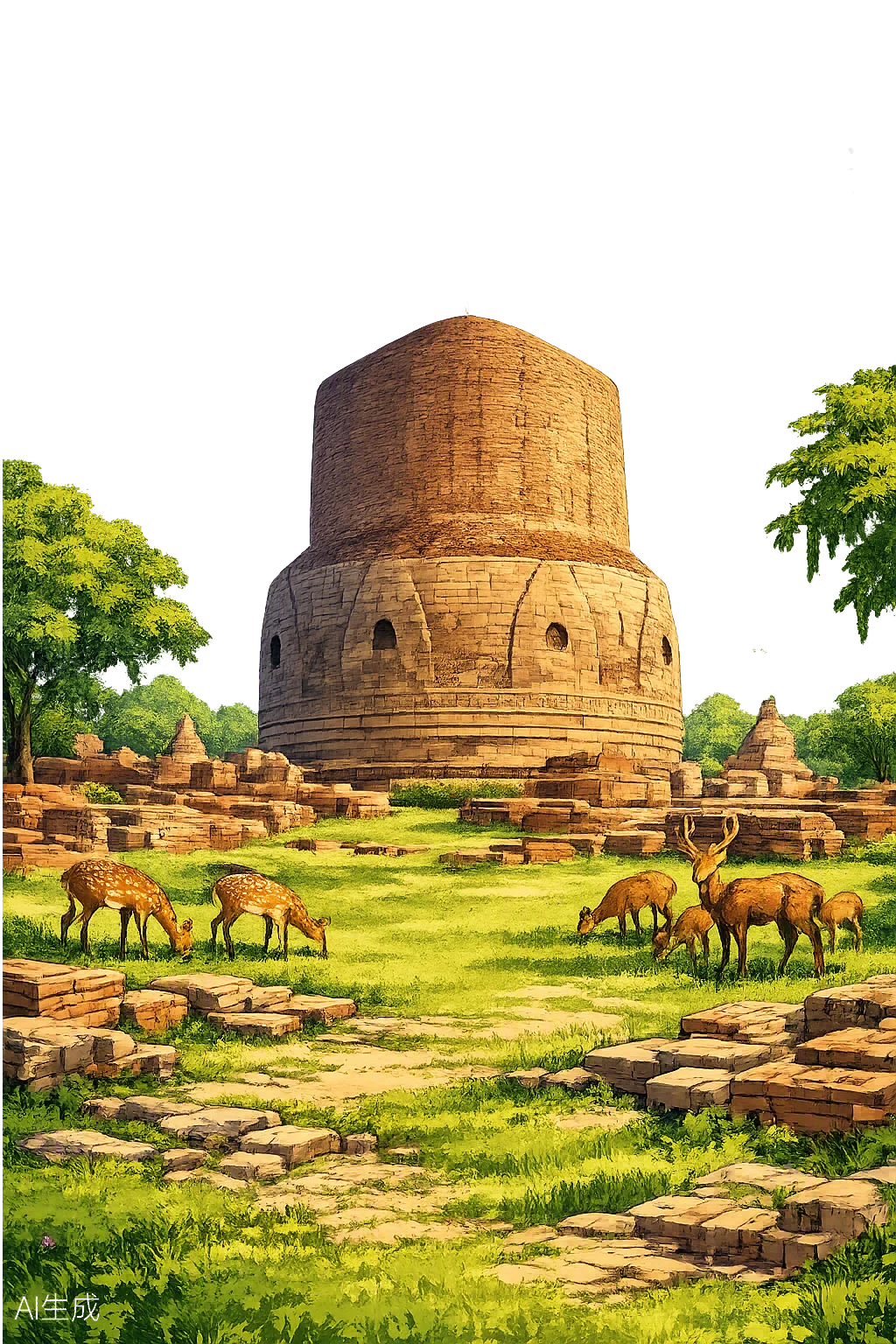
Sarnath preserves one of India's great excavation landscapes. The Dhamek stupa, a massive cylindrical brick monument with a Mauryan core, was enlarged through the Gupta period, when its lower courses were faced with carved stone panels of flowers, swastikas, and honeysuckle. Beside it stand the foundations of the Dharmarajika stupa — Aśoka's original relic monument — and the Mulagandhakuti, the main shrine where the Buddha was believed to have spent his first rainy season. Aśoka's polished sandstone pillar, erected c. 250 BCE, bore his edicts and was crowned by four addorsed lions carrying a dharma wheel; the capital is now displayed in the Sarnath Museum. Systematic excavation began with Alexander Cunningham's surveys of the 1830s–60s and culminated under Sir John Marshall's campaign of 1904–05, which cleared the great monastery and mapped the Ashokan remains. The temple on the web is the newest of these addresses — the first one that fits in a pocket.
The Archetype at Work
The pattern atlas seats this temple in 3 industries, each match argued and weighted: Education, Research & Knowledge (primary seat: Sarnath embodies first sermon, deer park — the core of education.); Mythic Name Restoration (resonant seat: Sarnath shares symbolic territory with mythic restoration.); Writing, Publishing & Media (resonant seat: Sarnath shares symbolic territory with publishing media.). The Resonance File reads those seats through the myths themselves.
In the Sacred Texts
The Buddhist tradition is not a vibe; it is a library. The Sacred Texts collection holds Lotus Sutra and Sukhāvatīvyūha Sūtras — the primary sources the temple's scholarship is built on. The temple is the argument; the texts are the evidence.
The File Continues
The temple's founding dispatch tells the name's story; its Resonance File reads the myths into the industries; the blog index holds the whole archive.
Continue the series — previous file: Sarasvatī (read it here) · next file: Sarutahiko (read it here).
The Restoration Files are written from the same canonical record as the temples themselves: the lexicon, the lore catalog, the pattern atlas, and the cited scholarly sources. If a file ever disagrees with its temple, the temple is right — tell us, and the file will be corrected.