
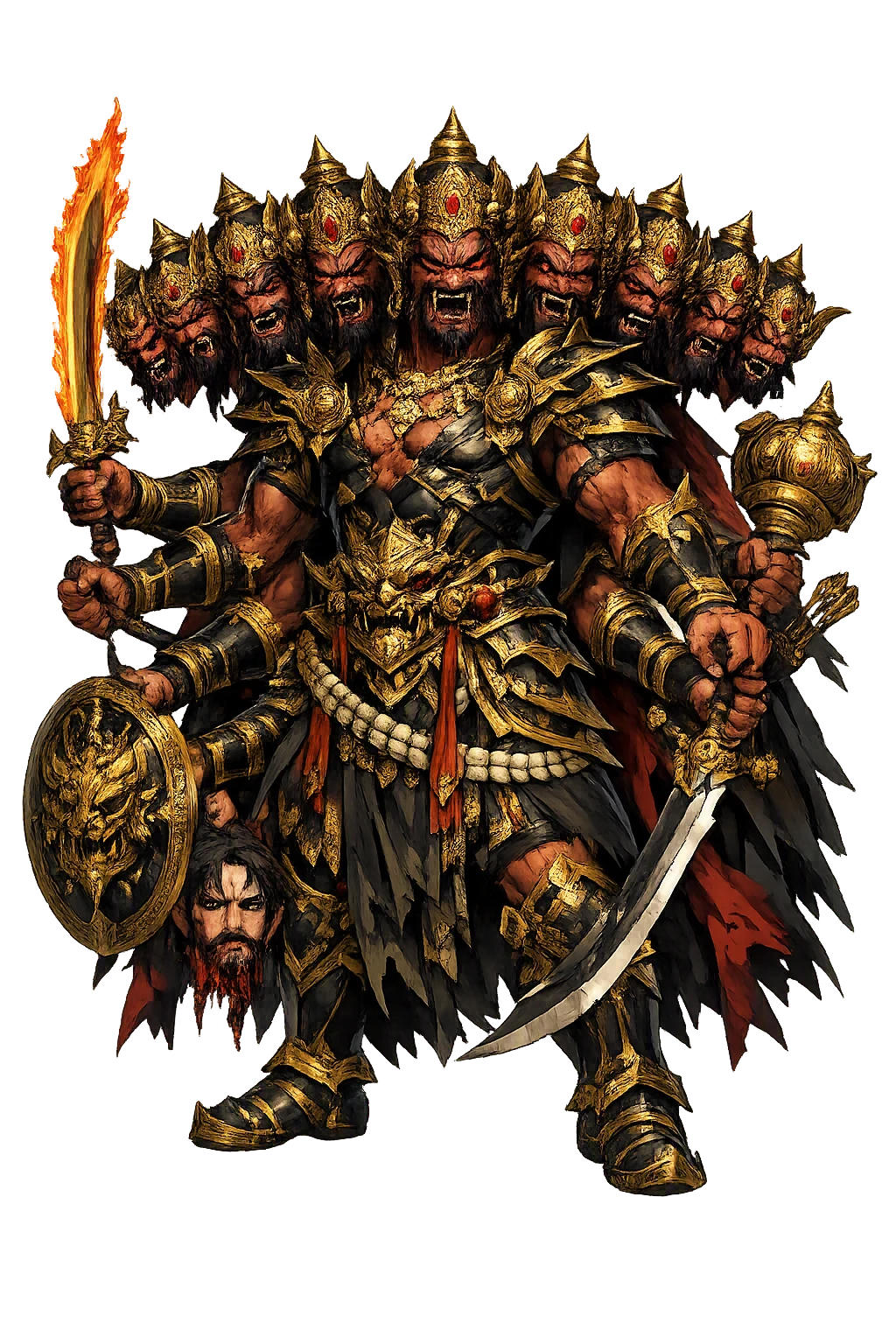
Why Rāvaṇa belongs in your address bar
Every address bar is a choice. When you type Rāvaṇa, you are not typing a novelty; you are restoring a name that the early DNS, built for English typewriters, could not carry. The plain ASCII form ravana is a leftover of that constraint, not the name itself. This post is the long version of the restoration: where the name comes from, how the Devanagari tradition wrote it, how it is pronounced, what the myths and the material record preserve, and why its Unicode form now lives as a working domain. The claim throughout is simple — the original spelling is not decoration. It is the name.
At a Glance
- Restored name: Rāvaṇa
- ASCII form: ravana
- Meaning: "The ruler of Laṅkā and chief of the Rākṣasas, whose destruction by Rāmacandra forms the subject of the Rāmāyaṇa"
- Domain of influence: Ten-Headed King, Lanka
- Pantheon: Sanskrit
- Classification: Tier 1
- Original script: रावण (Devanagari)
- Live domain: ravana.com
Overview
Rāvaṇa (ravana) — Ten-Headed King, Lanka · The ruler of Laṅkā and chief of the Rākṣasas, whose destruction by Rāmacandra forms the subject of the Rāmāyaṇa — belongs to the Sanskrit tradition, where it is catalogued under the domain "Ten-Headed King, Lanka". The name means "The ruler of Laṅkā and chief of the Rākṣasas, whose destruction by Rāmacandra forms the subject of the Rāmāyaṇa".
Rāvaṇa belongs to the Sanskrit tradition, where it is associated with ten-headed king, lanka.
PuniCodex restores the name as Rāvaṇa and serves its temple at ravana.com. The restoration preserves at least one distinctive feature — a diacritic or a distinctive letter — that the ASCII form loses, and exactly one historically valid Unicode restoration exists, which places the name in Tier 1. The plain ASCII form ravana survives as a modern convenience imposed by the early domain-name system; the restoration, not the fallback, is the form the project defends as philologically complete.
The Name
The name is attested in Devanagari as रावण. Etymologically it means "The ruler of Laṅkā and chief of the Rākṣasas, whose destruction by Rāmacandra forms the subject of the Rāmāyaṇa".
Sanskrit Rāvaṇa, from the causative of rū 'to roar, to cry'; the ten-headed king of Lanka.
The ASCII form ravana survives only because the early domain-name system could not carry diacritics; it is a technological compromise, not an ancient spelling. The Unicode restoration Rāvaṇa recovers the vowel length of the original directly in the address bar. The restoration preserves at least one distinctive feature — a diacritic or a distinctive letter — that the ASCII form loses, and exactly one historically valid Unicode restoration exists, which places the name in Tier 1.
The letter-by-letter transformation runs:
- r → R — Same, capitalized
- a → ā — Macron: long vowel
- v → v — Same
- a → a — Same
- n → ṇ — N with dot: retroflex n
- a → a — Same
The canonical temple for this name is served at ravana.com.
Etymology & Roots
The recorded derivation reads: Sanskrit Rāvaṇa, from the causative of rū 'to roar, to cry'; the ten-headed king of Lanka.
The root gloss is "the screamer."
The reconstruction is classed as attested.
The Original Script
The name is preserved in Devanagari as रावण.
The scholarly transliteration is Rāvaṇa.
The rendering proceeds step by step:
- Sanskrit Rāvaṇa is written in Devanagari as रावण
- IAST transliteration maps each Devanagari vowel and consonant to a Latin equivalent
- Macrons mark long vowels (ā, ī, ū); dots beneath consonants mark retroflex articulation (ṭ, ḍ, ṇ, ṣ)
Pronunciation
The reconstructed pronunciation of the name is /ravana/ — Sanskrit Reconstruction.
Phoneme by phoneme:
- R — Initial character of the restored form Rāvaṇa.
- āvaṇa — Remainder of the name, preserving the distinctive marks of the Sanskrit tradition.
For the modern speaker, the closest approximation is: 'RAVANA' — pronounce the restored form with attention to the preserved diacritics and length.
Kindred and historical forms of the name:
- Sanskrit — Rāvaṇa, the restored Unicode form of the name
Rāvaṇa is Tier 1 because the Sanskrit form preserves distinctive features that ASCII loses: stress, length, or special characters.
Mythology
The stories of Rāvaṇa circulate within the Sanskrit corpus, where the figure embodies ten-headed king, lanka.
Primary Attestation (Sources)
Rāvaṇa is attested in the canonical Sanskrit sources as a figure associated with ten-headed king, lanka.
Name and Meaning (Etymology)
The name means "The ruler of Laṅkā and chief of the Rākṣasas, whose destruction by Rāmacandra forms the subject of the Rāmāyaṇa" and reflects the figure's role in the tradition. Rāvaṇa is the ten-headed king of Laṅkā and the antagonist of the Rāmāyaṇa. A devout śaiva and master of the Vedas, he abducts Sītā and is ultimately defeated by Rāma, the avatāra of Viṣṇu. His character is morally complex: the epic praises his learning and power even as it condemns his lust and tyranny. His ten heads traditionally represent mastery of the four Vedas and six shastras, making him a scholar-king as well as a demon.
Symbols & Iconography
The iconography associated with Rāvaṇa concentrates in a small set of recurring attributes, each a compressed statement about the name:
- Restored Name — The Unicode form Rāvaṇa carries the original marks of the Sanskrit tradition.
- Source Script — Preserved through scholarly transliteration and canonical sources.
- Domain — Ten-Headed King, Lanka
- Etymology — The ruler of Laṅkā and chief of the Rākṣasas, whose destruction by Rāmacandra forms the subject of the Rāmāyaṇa
Archaeology & Evidence
The material record for Rāvaṇa survives in a small number of securely identified remains, catalogued below; the corpus is thin but unambiguous, and each site is tied to the name by ancient testimony.
Rāvaṇa is attested in the textual and iconographic record of the Sanskrit tradition.
Realm & Domain
Rāvaṇa belongs to the Sanskrit tradition, where it is associated with ten-headed king, lanka.
Ten-Headed King
The central domain of Rāvaṇa in the sanskrit tradition.
The ruler of Laṅkā and chief of the Rākṣ
The name signifies "The ruler of Laṅkā and chief of the Rākṣasas, whose destruction by Rāmacandra forms the subject of the Rāmāyaṇa".
Unicode Restoration
The restoration Rāvaṇa recovers what plain ASCII ravana flattens.
Original Attestation
Attested in the sources as —.
Across Cultures
Rāvaṇa appears within the Sanskrit tradition and has influenced later retellings, artistic depictions, and scholarly study. The Unicode restoration preserves the name's distinctive orthography for contemporary use.
Within the Sanskrit tradition, closely related names in the corpus include Aṃśa, Dakṣa, Dhātṛ, Durgā, Gaṇeśa, and Gaṅgā.
Cultural Legacy
Rāvaṇa continues to appear in scholarship, art, and popular reception as a significant figure of the Sanskrit tradition. Restoring the name in Unicode returns the original marks that ASCII removes. Rāvaṇa remains a commanding figure in South Asian performance, from Rāmlīlā pageants to Tamil and Sinhala retellings that offer alternative perspectives.
The Scholarly Record
The account of Rāvaṇa given in this edition rests on the witnesses and reference works listed below. Lexica and etymological dictionaries secure the form and meaning of the name; the literary and religious texts supply the narrative evidence.
- Monier Monier-Williams, A Sanskrit-English Dictionary, Oxford; Cologne Digital Sanskrit Dictionaries, 1899. Full text
- Bhagavata Purana.
- Rāmāyaṇa, Vālmīki; translated by Hari Prasad Shastri, 500 BCE. Full text
A Meditation
Rāvaṇa embodies ten-headed king, lanka in the Sanskrit imagination. The name's restoration is not merely cosmetic: it recovers the stress, length, and script that make the figure recognizable in the source tradition.
The Unicode Restoration
Rāvaṇa is classified as Tier 1: the restoration preserves at least one distinctive feature — a diacritic or a distinctive letter — that the ASCII form loses. The ASCII fallback ravana still resolves everywhere, but it is the restored form that carries the name's full information. Across the 6 characters of the name, the restoration adjusts 2: 1 mark of length (ā); 1 further adjustment (ṇ). That is the whole thesis of this temple: the marks are the message.
Character by Character
The journey from ravana to Rāvaṇa, one character at a time:
- r → R — Same, capitalized
- a → ā — Macron: long vowel
- v → v — Same
- a → a — Same
- n → ṇ — N with dot: retroflex n
- a → a — Same
The Domain Name
The restored name is live as a working domain: ravana.com. Behind the scenes the DNS carries it in punycode form — an ASCII-compatible encoding that lets a non-ASCII name travel the global network without breaking older infrastructure. The visitor sees Rāvaṇa; the machines see the encoding. That duality is the engineering compromise on which the entire restoration rests, and it is why a name written the way its own tradition wrote it in Devanagari can now be typed into any browser on earth.
The Sanskrit Pantheon
Rāvaṇa is one of 100 entries the PuniCodex lexicon catalogues under the Sanskrit pantheon. The Pantheon page gathers the tradition's major figures in one place, and the Lexicon lets you filter all 974 restorations by tradition, tier, or script — the fastest way to see where this name sits among its kin.
Frequently Asked Questions
What does Rāvaṇa mean? The traditional gloss is "The ruler of Laṅkā and chief of the Rākṣasas, whose destruction by Rāmacandra forms the subject of the Rāmāyaṇa."
Which tradition does Rāvaṇa belong to? Rāvaṇa is catalogued in the Sanskrit pantheon of the PuniCodex lexicon.
Why is Rāvaṇa classified as Tier 1? Because the restoration preserves at least one distinctive feature — a diacritic or a distinctive letter — that the ASCII form loses — and the marks in the restored spelling preserve exactly that evidence.
Is Rāvaṇa a working domain? Yes — ravana.com resolves today and routes to this temple.
Can I use Rāvaṇa in a normal browser? Yes. The DNS resolves the punycode form automatically, and the type tool on this site converts ravana to Rāvaṇa for copying and pasting.
Where does the scholarly information come from? The entry is built from lexica, inscriptional evidence, and reviewed scholarly sources listed in the Scholarly Edition. Every claim is traceable to a canonical source.
Typing Rāvaṇa
You do not need a special keyboard to use this restoration. The PuniCodex Type Tool converts the ASCII form ravana into Rāvaṇa as you type, and the browser extension offers the same conversion inside any text field. Copy the restored form, paste it into the address bar, and the DNS does the rest.
Sister Temples
Other temples in the Sanskrit pantheon include Brahmā, Brahman, and Cāmuṇḍā — each with its own restoration story, its own scholarly record, and its own place in the lexicon.
Why This Restoration Matters
Restoring Rāvaṇa is part of a larger effort to make the web multilingual by default. The PuniCodex project does not ask users to learn a new alphabet; it asks the infrastructure to respect the alphabets that already exist. Every section of this post — the script, the sound, the myths, the evidence — converges on the same point: the marks in Rāvaṇa are information, and information deserves an address of its own. A single Unicode domain is a small proof, but it is a proof that scales: every name restored makes the next one easier, and every visit to ravana.com is a vote for the restored form.
Explore Further
This post is one doorway into the temple. The home page carries the full character breakdown and the ambient canvas; the lore page tells the myths in long form; the Scholarly Edition preserves the sources, pronunciation data, and revision history; and the patron wall supports the restoration directly. For the wider map, browse the Lexicon, explore the Pantheon, or return to the PuniCodex blog.
A Closer Look at the Marks
A restored name is a small map. In Rāvaṇa, the journey from the ASCII fallback ravana to the Unicode form can be read letter by letter, and each letter tells a story. Of the 6 characters, 4 remain unchanged; they anchor the name to its modern shape. The remaining adjustments recover marks the source tradition used to distinguish this name from every other word built from the same letters.
The r stays as it is — Same, capitalized.
The a becomes ā — Macron: long vowel.
The v stays as it is — Same.
The a stays as it is — Same.
The n becomes ṇ — N with dot: retroflex n.
The a stays as it is — Same.
Together these changes are not decoration. They are the minimum set of marks needed to keep the name legible in its own tradition. Remove them and you still have a string of letters; you no longer have the name as it was written.
Rāvaṇa in Its Tradition
Rāvaṇa does not stand alone. It belongs to the Sanskrit tradition, where it is counted among 100 names in the PuniCodex lexicon. Its sphere — Ten-Headed King, Lanka — places it beside other figures who govern similar aspects of experience. The restored spelling is therefore not only a philological decision; it is a way of keeping the name in the company of its kin. When the address bar shows Rāvaṇa, it marks the boundary between a generic search term and a named entry in a living catalog of myth. That catalog is the point of the project. Every restored name is a vote for specificity: the web should know the difference between a figure and a keyword, between a tradition and a trend. Rāvaṇa is one such vote.
What You Will Find in the Temple
The temple page for Rāvaṇa is more than a landing page. The home tab presents the character breakdown, the pronunciation guide, and the live domain status in a single view. The lore tab gathers the myths and narratives that give the name its depth. The Scholarly Edition tab publishes the sources, variant forms, and review history that justify the restoration. Industry patterns show where the name appears in modern commerce and culture, while the gallery and creatives tabs collect visual and sponsor material. The patron wall lets visitors support the restoration directly. Each tab is generated from the same canonical sources, so the domain, the blog, the scholars page, and the search index all agree. The result is a single source of truth about a name, delivered through several doors.
The Restoration on the Live Web
A domain name is a kind of publication. When Rāvaṇa resolves, it proves that the restored spelling is not a theoretical exercise; it is a working address on the public internet. Search engines can index it, language models can encounter it, and anyone who copies it from a manuscript can paste it into a browser. That practical reality changes the status of the restoration. Before Unicode domains, a scholar could write the name correctly in an article while the public web flattened it to ravana. Now the public web can carry the correct form end to end. The punycode translation happens silently, so the infrastructure remains compatible while the visible name keeps its marks. That compromise — human-readable restoration, machine-readable encoding — is the foundation of every PuniCodex temple.
Related Names
Sources
The full scholarly apparatus — every citation, revision, and review — lives in the Scholarly Edition. Key references for this post:
- Monier Monier-Williams, A Sanskrit-English Dictionary, Oxford; Cologne Digital Sanskrit Dictionaries, 1899.
- Rāmāyaṇa, Vālmīki; translated by Hari Prasad Shastri, 500 BCE.
- Ṛgveda Saṃhitā (demons and divine speech).
- Upaniṣads.
- Bhagavad Gītā (on desire and the senses).
- Shiva Purana.
- Bhagavata Purana.
- Monier-Williams Sanskrit-English Dictionary.
- Macdonell, Sanskrit Grammar for Students.
- Lexicon authorities for this entry: MW, Ramayana.