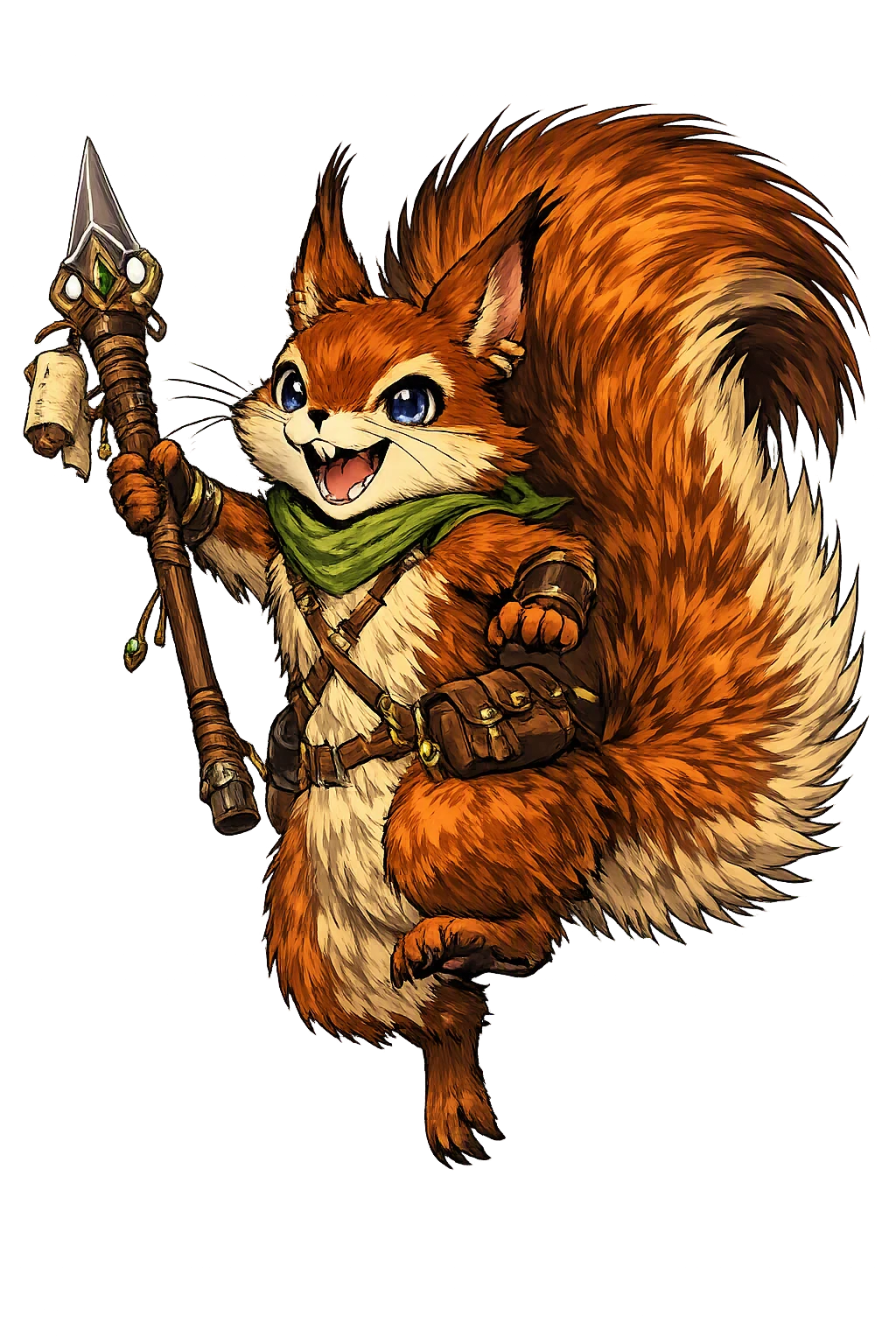
Stories of Ratatoskr
Ratatoskr's dossier is two passages long and perfectly cut: one stanza of Grímnismál and one chapter of Gylfaginning. Between them they give him a road, a cargo, and a character — and nothing else in the corpus adds a word.
In Grímnismál, Óðinn — masked and bound between the fires of King Geirrøðr — recites the inhabitants of the world-ash, and the squirrel gets his stanza: Ratatoskr is the íkorni who must run on Yggdrasill's ash; the eagle's words he must carry from above and tell to Níðhǫggr below. The verb is skal — 'shall, must': the running is not a habit but an office, written into the tree's economy as fixedly as the dew that falls from its branches. In a single stanza the Edda gives the smallest creature in the cosmos a route that spans it, from the eagle's wisdom in the crown to the dragon's malice at the root. Nothing else is said of him in the poem — no origin, no exploit, no epithet — because the route is the whole figure: Ratatoskr is the road between the highest thing and the lowest, wearing the shape of the animal that knows every branch.
The stanzas around the squirrel build the tree's full menagerie: four harts — Dáinn and Dvalinn, Duneyrr and Duraþrór — bite the new shoots; more serpents lie beneath the ash than any unwise ape would think, Góinn and Móinn, Grábakr and Grafvölluðr, Ófnir and Sváfnir, and they gnaw the roots forever; and the poem closes the survey with its most famous sentence: the ash of Yggdrasill suffers agony, more than men know — the hart bites from above, the trunk rots at the side, and Níðhǫggr gnaws from below. The squirrel does not appear in this list of devourers, which is precisely the point: Ratatoskr runs his messages through a tree that is being eaten alive at every level, adding no tooth of his own. The Edda divides the cosmos's parasites by appetite — those who bite and the one who carries — and gives the carrier a name and an office.
Snorri's prose fills out the stanza into a portrait. An eagle sits in the limbs of the ash, and it has knowledge of many things, and between its eyes sits a hawk called Veðrfölnir. A squirrel called Ratatoskr springs up and down the ash and bears öfundarorð — words of malice, slander-tidings — between the eagle and Níðhǫggr. Where Grímnismál described a messenger, Snorri describes an agent provocateur: the squirrel does not merely deliver the correspondence of the crown and the root, he keeps the feud alive, carrying each insult to the ear best placed to feel it. The four harts and the wells of Urðr and Mímir complete the chapter — but the squirrel is its only animal with an errand, and its only named speaker of any creature in the crown. Snorri's single word, öfundarorð, is the oldest surviving description of what a rumor-monger actually does.
The lower terminus of Ratatoskr's road is the worst address in the cosmos. Snorri sets the third root of the ash over Niflheimr and the spring Hvergelmir, and there Níðhǫggr gnaws the root from below while countless serpents coil with him. Völuspá gives the Malice-Striker his other aspect: in Nástrǫnd, the corpse-shore, he sucks the bodies of the dead, and the wolf tears men — and at the poem's end the dark dragon comes flying up from Niðafjǫll, bearing corpses on his wings, in the last light before the world sinks. Every word Ratatoskr carries down lands in that ear; every word he carries up rises from it. The squirrel's whole mythology is the maintenance of that terrible conversation — the axis of the world kept humming, crown to root, with the one subject on which eagle and dragon never disagree: how much they hate each other.
The Drill-Tooth, the Malicious Messages, and the Trunk of the World-Ash
Ratatoskr is the squirrel of the world-ash Yggdrasill: the small tireless runner of Grímnismál who bears the eagle's words down from the crown and carries Níðhǫggr's answers back up from the roots — and whom Snorri names as the courier of öfundarorð, malicious messages, between the two great enemies of the tree.
The world-tree itself, 'the greatest and best of all trees': Ratatoskr's whole road, from the eagle's crown to the roots over Hvergelmir.
The great eagle perched in the ash's limbs, wise in many things — with the hawk Veðrfölnir sitting between its eyes.
The Malice-Striker: the serpent at the root in Niflheimr who gnaws the ash and sucks the corpses of the dead — the eagle's eternal correspondent.
The hawk between the eagle's eyes — the watcher in the crown, witness to every word the squirrel carries down.
From the original script to the living URL
ᚱᛅᛏᛅᛏᚢᛋᚴᚱ
The name in its original Norse form. Ratatoskr (ᚱᛅᛏᛅᛏᚢᛋᚴᚱ) is attested in the source tradition — “Drill-tooth”. Its original diacritics and script distinctions carry the full phonetic and orthographic weight of the source tradition.
ratatoskr
The plain ratatoskr form is identical to the Unicode restoration. Because this name is already written in Latin letters, no diacritics, stress, or script information were lost — only capitalization differs.
Ratatoskr
The Unicode restoration does not need to recover lost marks for Ratatoskr. Its value is canonical spelling and consistent cataloguing, not the reconstruction of erased orthography. The domain is readable as-is to both DNS and humanity.
Ratatoskr.com
This restoration is written entirely in ASCII letters — no Punycode encoding stands between Ratatoskr and the DNS. The domain reads identically to machines and to human eyes.
Owned, ideal, and ASCII forms of Ratatoskr
Ratatoskr
Restores ᚱᛅᛏᛅᛏᚢᛋᚴᚱ. The full Unicode restoration. ratatoskr.com is not in the PuniCodex collection — it is watched for release; if it drops, this temple upgrades to an owned flagship.
How Ratatoskr was spoken
How Ratatoskr travels from ancient script to the modern URL
The lore you have read is the living myth. Extended Lore opens the scholarly vault beneath it: the cult and its material remains, a history of the image, the name after antiquity, a meditation on what the name still means, and the full scholarly apparatus — etymology, orthography, sources.
Enter Extended Lore