PuniCodex

Extended Lore

राम Rāma

Etymology · Orthography · Cult · Iconography · Reception · Sources

Tier 1 Rāma.com
Rāma — Virtue, Kingship, Avatar of Vishnu
01

Quick Facts

Essential information about Rāma, Virtue, Kingship, Avatar of Vishnu

Original Scriptराम
Unicode RestorationRāma
Reconstructed Pronunciation/ˈraː.mə/
PantheonSanskrit
DomainVirtue, Kingship, Avatar of Vishnu
MeaningThe beloved prince of Ayodhyā — hero of the Rāmāyaṇa and seventh avatāra of Viṣṇu (from √ram, to delight)
ClassificationTier 1
Primary DomainRāma.com
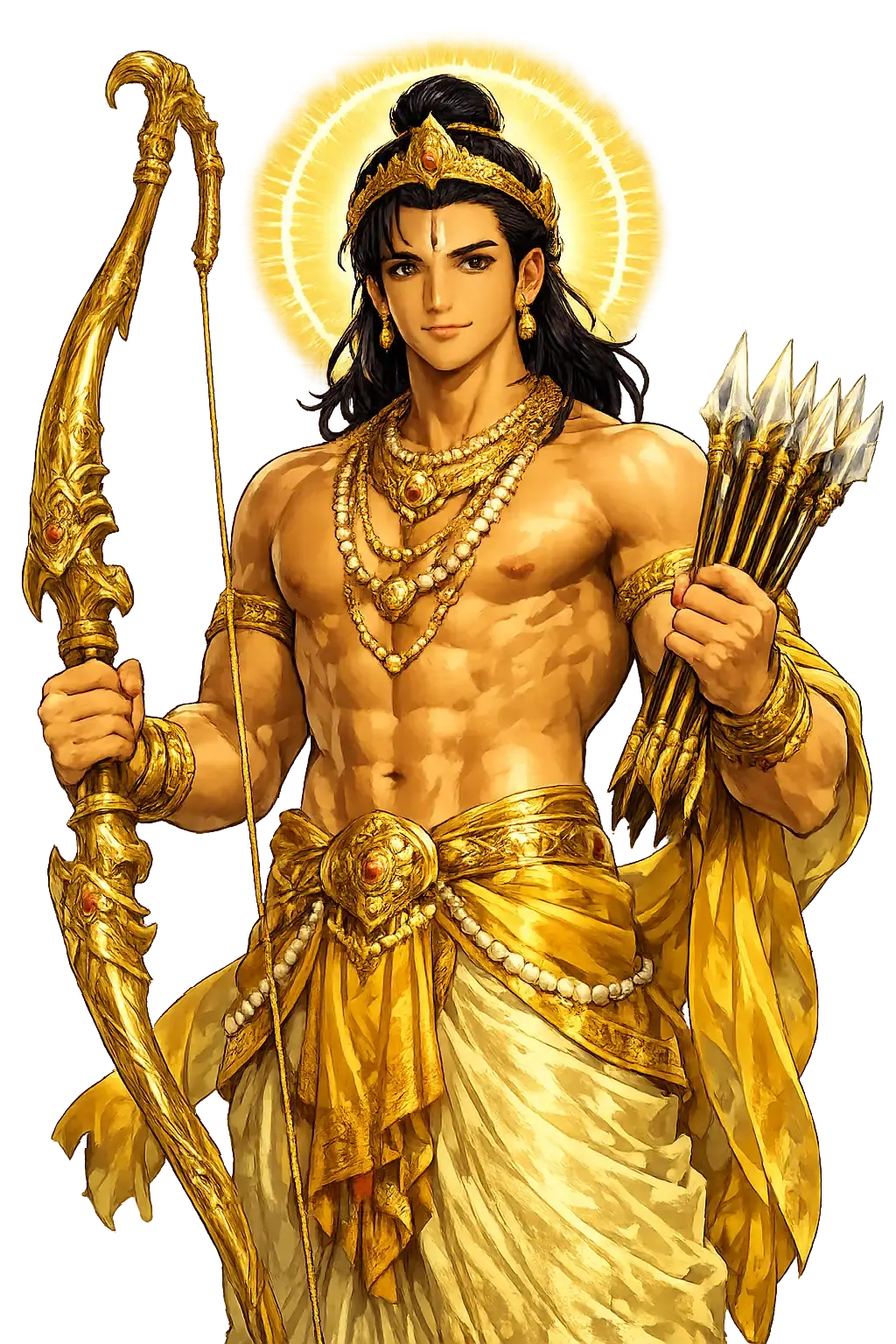
Sacred SymbolsBow and arrow (kodaṇḍa), The blue complexion, The forest (vana), The bridge to Laṅkā, The throne of Ayodhyā
02

Etymology & Word Family

From original script to Unicode restoration

Original Script राम Rāma — "The beloved prince of Ayodhyā — hero of the Rāmāyaṇa and seventh avatāra of Viṣṇu (from √ram, to delight)"
Unicode Restoration Rāma Restored stress, length, and script
Modern ASCII rama Plain-ASCII fallback

The name Rāma carries the orthographic signature of the sanskrit tradition: राम. Unicode restoration recovers what ASCII flattens.

03

Unicode Character Breakdown

Character-by-character philological analysis

CharacterUnicodeNameBlockPhonetic Role
RU+0052Latin Capital Letter RBasic LatinSame
āU+0101Latin Small Letter A with MacronLatin Extended-AMacron: long /aː/
mU+006DLatin Small Letter MBasic LatinSame
aU+0061Latin Small Letter ABasic LatinShort /a/

The Tier 1 classification reflects how much of the original phonology this restoration preserves — stress and vowel length for Greek names, distinctive letters and diacritics for every other tradition.

04

Cult & Worship

How the sacred was kept — rites, sanctuaries, remains

The Cult

Rāma's cult is the transformation of an epic hero into a god of daily religion, and it is ancient. By the Gupta age — the fifth and sixth centuries — sculptors were carving Rāma with bow and arrow on Vaiṣṇava temples, and the Purāṇas had fixed him as Viṣṇu's seventh avatāra. The sacred geography runs from Ayodhyā, his birthplace and coronation city and a place of pilgrimage for well over a millennium, south to Rāmeśvaram, where tradition holds that he worshipped Śiva before crossing to Laṅkā; his birthplace shrine anchors one of Hinduism's most visited — and most contested — holy sites. The cult's engine has been recitation: centuries of Rāmāyaṇa pāṭha, the repetition of the Rāma nāma held by Tulsīdās to outweigh every other prayer, and the Rāmānandī ascetic order — traditionally founded in the fourteenth century, today among the largest monastic bodies in India — organizing his worship as supreme God. The seasonal liturgy crowns him in spring at Rāma Navamī and, at Ramnagar on the Ganges, inside a month-long Ramlīlā pageant patronized by the Kashi royal house since the nineteenth century.

In the Earth

Archaeological and epigraphic references to Rāma appear from the early centuries CE, with Rāmāyaṇa scenes carved on Gupta-period temples and beyond. The site identified as Rāma's birthplace at Ayodhyā has been a focus of pilgrimage and, in recent decades, of legal and political contestation. Temples dedicated to Rāma are found across South and Southeast Asia, and the epic's visual narrative is a staple of Indian miniature painting, temple sculpture, and performing arts.

05

Iconography

How Rāma was imaged across the ages

The Image

Learn the bow first: Rāma stands crowned, his dark-blue skin marking the avatāra, the kodaṇḍa held upright at his side — a silhouette identifiable at a glance — usually flanked by Sītā, Lakṣmaṇa, and the kneeling Hanumān in the ensemble called Rāma darbar. The earliest surviving cycle is Gupta stone: ten Rāmāyaṇa panels once ran around the plinth of the Dashavatara temple at Deogarh (early sixth century) — the departure into exile, the Śūrpaṇakhā episode, the abduction — the epic's first monumental pictures. At Ellora, the eighth-century Kailāsa temple walls the story across its terraces. The early modern period refined him into a painter's prince: the great Mewar Rāmāyaṇa manuscript of c. 1650 and the Pahari darbar scenes of Kangra fixed the icon's gentle gravity. The bazaar print and the film frame froze it further — bow, blue, and downward gaze now identical from Varanasi to Bali.

06

Reception & Transformation

The name after its own age — transmission, translation, survival

Afterlives

Rāma's journey to us runs through two millennia of manuscript and commentary. The Sanskrit Rāmāyaṇa survives in hundreds of copies, the oldest in eleventh- and twelfth-century Nepalese palm-leaf and paper; on them rests a commentary tradition of great sophistication — Govindarāja's sixteenth-century Bhūṣaṇa, famous for defending Sītā's honor, only the best loved of the exegesis. The story crossed languages early: at Akbar's court a Persian translation with Mughal paintings was made for his commander ʿAbd al-Raḥīm Khān-e Khānān in the 1580s, its dispersed pages now in museums from Washington to Mumbai. Europe met the epic through William Jones' Homer-comparisons and the Serampore missionaries' English rendering (1806–10); F. S. Growse later carried Tulsīdās to Victorian readers. The scholarly summit was the Baroda critical edition (1951–75), seven volumes collating hundreds of manuscripts, followed by the Goldmans' Princeton translation. What had served a civilization as scripture, epic, and lawbook became, in the archive, a text with a history — read today by philologists as much as by devotees.

Identifications Across Traditions

Rāma's story migrated far beyond its Sanskrit origins. Tulsīdās's Hindi Rāmcaritmānas became the sacred text of millions in North India; Kampan's Tamil Iramāvatāram reshaped the epic for South Indian readers. Buddhist and Jain retellings reinterpret Rāma and Rāvaṇa in light of their own ethics. In Southeast Asia, the Rāmāyaṇa appears as the Rāmakien in Thailand, the Reamker in Cambodia, and the Kakawin Rāmāyaṇa in Java, with local variants that reveal the epic's extraordinary adaptability. In the modern period, Rāma has become a political and religious symbol in India, claimed by devotional movements, nationalist projects, and popular culture alike.

Modern Legacy

Rāma's name is among the most cherished in South Asia. The greeting 'Rām Rām,' the chanting of the Rāma nāma, and the observance of Rāma Navamī keep his memory present in daily life. The Rāmāyaṇa has been rendered in virtually every Indian language and performance medium: classical dance, shadow puppetry, television serials, comic books, and film. The 1987–88 television adaptation by Ramanand Sagar drew unprecedented audiences and reshaped popular devotion. The Unicode restoration Rāma preserves the long vowel that distinguishes the epic hero's name from the ordinary word for 'dark' or 'beautiful' and signals its Sanskrit dignity.

07

The Meditation

What Rāma means — beyond the dictionary

Rāma is the hero who suffers duty rather than asserting will. At every turning point — exile, the loss of Sītā, the doubt of his people — he chooses the harder path because it is the right one. His perfection is not exciting; it is austere, even heartbreaking.

That is precisely why the tradition calls him maryādā puruṣottama, the best of men within limits. Rāma teaches that freedom is not the absence of constraint but the beauty of choosing one's bonds. To love him is to accept that righteousness often costs more than we wish to pay — and that the cost, paid fully, becomes a kind of kingship over the self.

08

Screen & Culture

Where Rāma echoes through film, television, and games — and how

09

Frequently Asked Questions

Common questions about Rāma, Virtue, Kingship, Avatar of Vishnu, and Unicode restoration

01How do you pronounce Rāma?

In reconstructed pronunciation, Rāma is /ˈraː.mə/ — approximately 'RAH-muh' — roll or tap the 'r', hold the first syllable long, and let the second syllable relax.

02What does Rāma mean?

Rāma means The beloved prince of Ayodhyā — hero of the Rāmāyaṇa and seventh avatāra of Viṣṇu (from √ram, to delight) in the sanskrit tradition.

03What are the symbols of Rāma?

Rāma is associated with Bow and arrow (kodaṇḍa) (His weapons, inherited from the sage Viśvāmitra and the gods: a warrior bound by vow, shooting only when dharma itself is threatened), The blue complexion (His dark-blue skin marks him as an avatāra of Viṣṇu and the oceanic depth of his patience), The forest (vana) (The place of exile where kingship is tested and refined away from palace comfort), The bridge to Laṅkā (The causeway built by the monkey army, stone by floating stone: collective devotion overcoming impossibility), The throne of Ayodhyā (Rightful sovereignty restored after exile, war, and sacrifice — the prize Rāma wanted least and accepted most heavily).

04Why restore Rāma in Unicode?

Plain ASCII rama strips the stress, length, and script that make the name specific. Unicode restoration returns the name to its original written dignity.

05What is the most important myth about Rāma?

“The Exile” — the Ayodhyākāṇḍa story that anchors the mythology of Rāma, told in full on the lore page.

10

Scholarly Sources

The philological foundations of this restoration

Every claim on this page is grounded in established scholarship. The orthographic restorations follow disciplinary convention. The etymological chain follows the best available reference works. This is not invention — it is resurrection through scholarship.

◈

Lexicography & Philology

  • MW
  • KEWA
◎

Primary Texts

  • Viṣṇu Purāṇa, Book 4 (Rāma as Viṣṇu's avatāra)
◉

Archaeology & Art History

  • Material evidence — iconography, inscriptions, and temple archaeology — for Rāma and related cults.
✦

Religious Studies

  • Vālmīki, Rāmāyaṇa (critical edition): Ayodhyākāṇḍa 8–26; Araṇyakāṇḍa 17–49; Yuddhakāṇḍa 22–118; Uttarakāṇḍa 26–111
  • Tulsīdās, Rāmcaritmānas
  • Kampan, Iramāvatāram
  • Goldman, The Rāmāyaṇa of Vālmīki (translation and annotation)
  • Lutgendorf, The Life of a Text: Performing the Rāmcaritmānas of Tulsidas
  • Richman, ed., Many Rāmāyaṇas: The Diversity of a Narrative Tradition in South Asia
Return

The Surface Awaits

You have traced the name from its earliest attestation to its Unicode restoration. Now return to the myth. The story is where the name lives.

Back to Lore
Rāma mascot