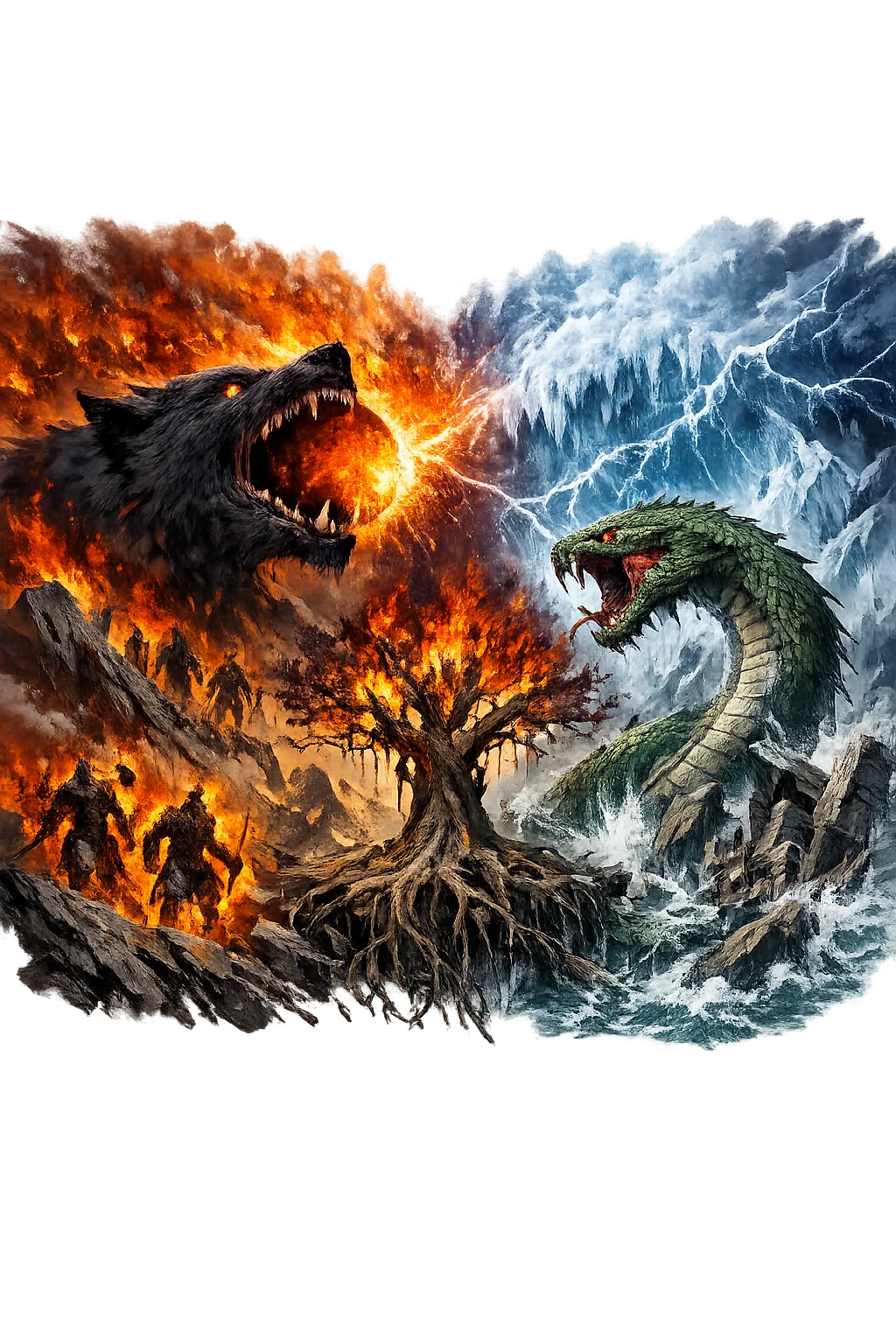
Stories of Ragnarǫk
Ragnarǫk is the end of the Norse cosmos and its secret rebirth. Foretold by the seeress of Völuspá and narrated by Snorri, it runs from fimbulvetr — three winters with no summer — through the breaking of every bond to the last battle on Vígríðr, and ends not in ash but in green grass.
The doom announces itself with weather. Völuspá 26 warns: 'a winter shall be great and fierce... snow will drive from all quarters, sharp frosts... three such winters will there be, with no summer in between.' Beneath the cold the moral world fails first: brothers kill brothers for gain, kinship is forgotten, 'woe is in the world, much whoredom, an axe-age, a sword-age, shields are cleft, a wind-age, a wolf-age, before the world sinks.' Snorri's Gylfaginning (51) keeps the picture and adds its bleakest line: men will grow so desperate that no mercy will be shown between kin. The myth means apocalypse begins not with monsters but with the collapse of trust — the climate of betrayal is the true first sign, and the wolves merely follow it.
When the winters end, every fetter fails at once. Fenrir — bound since the gods' fear outweighed their honor — snaps Gleipnir and gapes: his upper jaw touches the sky, his lower the earth. The Miðgarðsormr, released, churns the seas and floods the shore. Garmr, the hound before Gnipahellir, breaks loose and howls. Loki turns on the deck of the ship Naglfar — built, Snorri notes, from the fingernails and toenails of dead men, launched only when the last nail was found — steering toward Vígríðr with the host of Hel. The terror is in the simultaneity: the Æsir had taken Loki's own sons to forge his bonds, and now every imprisonment of the old world expires together. The myth means that in this cosmos order was always borrowed time — each binding a deferral — and the end is not an invasion from outside but the simultaneous maturity of every debt.
The two hosts meet on Vígríðr, a plain 'a hundred leagues in every direction.' Óðinn advances against Fenrir with spear raised and is swallowed whole — the father-god dying the death of a hunted man — while his son Víðarr, stepping forward in the shoe assembled from the leather scraps of every cobbler, tears the wolf's jaws apart. Freyr, swordless since he gave his blade to Skírnir, falls to Surtr. Most terrible is the mutual death of Þórr and the Miðgarðsormr: the thunder-god kills the serpent with one last hammer-blow, staggers nine paces away, and falls dead of its venom (Völuspá 56). The seeress marks each death with her refrain — 'how fare the Æsir? how fare the elves?' — until there is no one left to ask. The myth means the end is symmetrical: each god is destroyed by the specific threat he spent his life holding back.
The last actor takes the stage after the armies are spent. Surtr, the fire-giant who has waited at Múspellsheimr since before the world existed, advances 'from the south with the scourge of branches' — his sword that shines brighter than the sun — and flings fire over the whole earth. 'The sun turns black, land sinks into the sea, the bright stars are shaken from the sky; steam rises up, gushing life-heat, and the high flame reaches heaven itself' (Völuspá 57). The world-tree shudders, the mountains tumble, and the sea floods over everything. Snorri is explicit that this is the death of the cosmos as a whole, not merely of its gods: heaven and earth burn, and the flames reach the sky the dwarfs built. The myth gives Norse eschatology its starkest image: the universe does not fade — it is put to the torch by the oldest power in it.
The seeress does not end with the fire. 'I see the earth rise a second time from the sea, green again... the eagle flies over the fell, hunting fish from the mountain' (Völuspá 59). The surviving gods — Víðarr and Váli, and Baldr and Höðr returning from Hel — sit together on the new grass and speak of what was, while the golden game-pieces are found again in the grass, the very dice the Æsir once played with. From Hoddmímis holt step Líf and Lífþrasir, who fed on morning dew through the fire-winter and now repopulate the world; the sun's daughter takes her mother's course, and no one remembers the old world's sins. Snorri leaves one shadow in the closing lines: the dragon Níðhöggr, 'sucking the corpses of the dead,' is the poem's last image — a reminder that something in the ruins always survives. The myth means Norse doom was never nihilism: destruction is total, yet seed, memory, and dawn outlast it.
The domain of Ragnarǫk
Ragnarǫk is the doom of the gods — the Norse end and renewal of the cosmos, when winter swallows the sun, every bond breaks, and the Æsir make their last stand on the plain of Vígríðr. It is foretold, not chosen: the seeress of Völuspá recites it to Óðinn as accomplished fact, and Snorri retells it as history.
Three winters with no summer sever the bonds of kinship and announce the coming doom.
On the final plain, gods and giants destroy one another: Fenrir swallows Óðinn, Þórr and the serpent fall together.
The fire giant's sword burns brighter than the sun and consumes heaven, earth, and the world-tree.
After the flames subside, the earth rises green again, Baldr returns, and Líf and Lífþrasir repopulate the world.
From the original script to the living URL
ᚱᛅᚴᚾᛅᚱᚢᚴ
The name in its original Norse form. Ragnarǫk (ᚱᛅᚴᚾᛅᚱᚢᚴ) is attested in the source tradition — “Twilight of the gods (from ragna + rǫk)”. Its original diacritics and script distinctions carry the full phonetic and orthographic weight of the source tradition.
ragnarok
Reduced to plain ragnarok, the name loses everything that made it specific: original diacritics and script distinctions. What remains is an ASCII string that machines can parse but that no longer speaks with its original voice.
Ragnarǫk
The Unicode restoration recovers what ASCII flattened. Ragnarǫk restores original diacritics and script distinctions, returning the name to its original written dignity. The domain encodes to Punycode, but the browser displays the truth.
Ragnarǫk.com → xn--ragnark-fnc.com
The non-ASCII characters in Ragnarǫk are encoded while the ASCII remains visible. To the DNS, it is Punycode. To humanity, it is Ragnarǫk.
Owned, ideal, and ASCII forms of Ragnarǫk
Ragnarǫk
Restores ᚱᛅᚴᚾᛅᚱᚢᚴ. The live temple domain — ragnarǫk.com.
ragnarok
Flattens ᚱᛅᚴᚾᛅᚱᚢᚴ. The plain ASCII fallback — what DNS and legacy systems see.
How Ragnarǫk was spoken
How Ragnarǫk travels from ancient script to the modern URL
Old Norse Ragnarǫk; from regin “gods, powers" + rǫk “fate, judgement, twilight"; the doom of the gods.
Doom of the Gods
The Unicode restoration Ragnarǫk uses registrable Thorn and vowel accents; the runic form is not used because runic TLD support is impractical.
The lore you have read is the living myth. Extended Lore opens the scholarly vault beneath it: the cult and its material remains, a history of the image, the name after antiquity, a meditation on what the name still means, and the full scholarly apparatus — etymology, orthography, sources.
Enter Extended Lore