
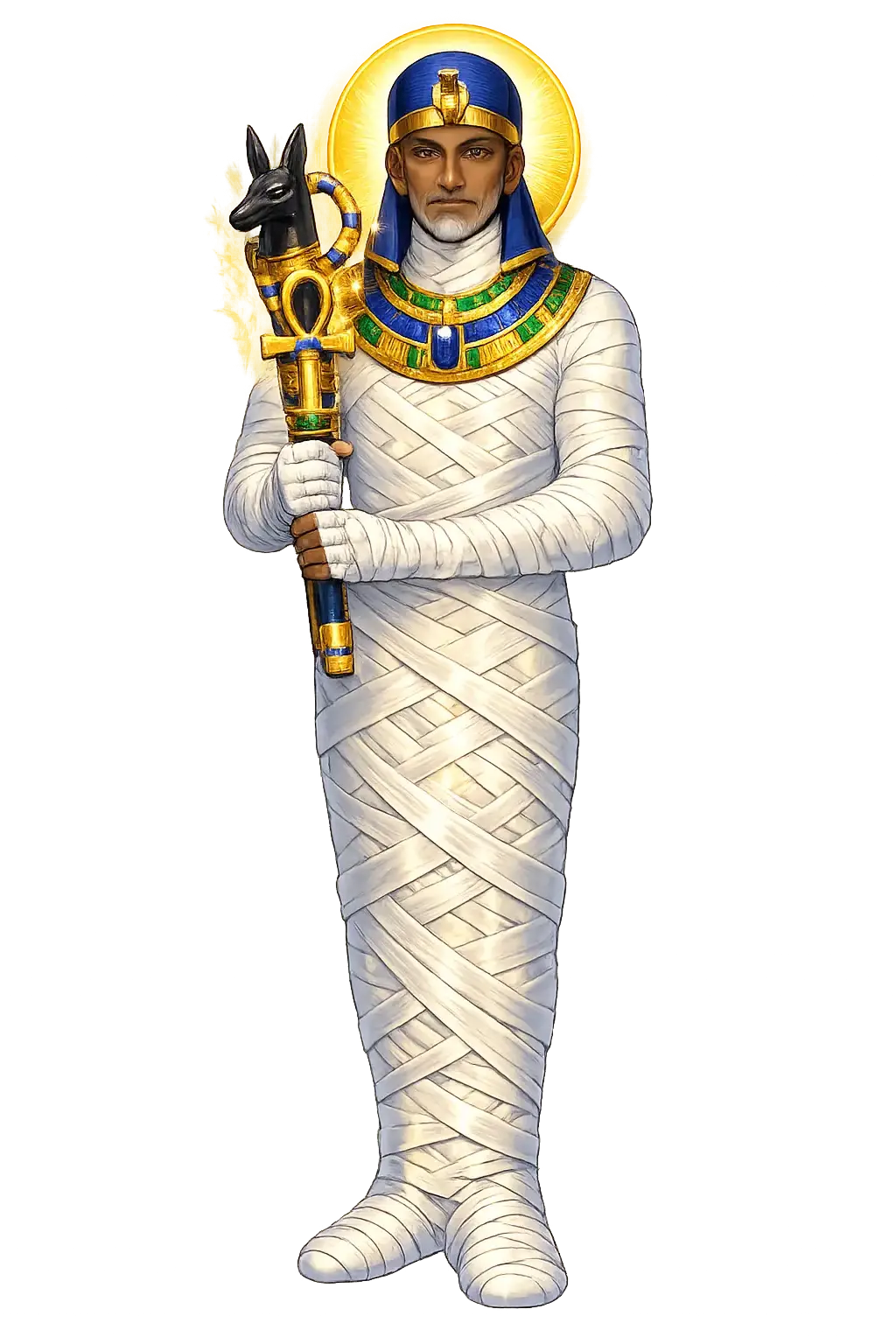
Where Ptḥ works now: the myths behind the markets
The myths did not retire. They moved offices. This is the file on where Ptḥ works now.
Ptḥ's mythology is less a cycle of adventures than a theology of making. His great text, the Memphite Theology, claims that Ptḥ's heart conceived and his tongue pronounced the gods, cities, and sacred rites of Egypt. Creation here is not a battle with chaos but an act of authoritative speech: what Ptḥ names, exists.
The pattern atlas — which maps every flagship temple to the industries its archetype demonstrably resonates with, each match argued and open to challenge — seats this temple in 4 industries. This file reads those seats the way they were earned: through the myths.
At a Glance
- Temple: Ptḥ
- Pantheon: Egyptian
- Domain of influence: Craftsmen, Creation, Memphis
- Pattern seats: 4
- Sectors touched: Technology & Innovation · Home & Lifestyle
- Strongest seat: Construction & Engineering
- Series: The Resonance Files, No. 401 of 546
The Myth at Work
The Heart and Tongue That Made the Gods. The Shabaka Stone, now in the British Museum, is a granite slab on which a Twenty-Fifth-Dynasty king had 'this writing' copied, he says, 'because it was found worm-eaten' — and posterity received the Memphite Theology, a text far older than its copyist. In it, Ptḥ of Memphis stands above Atum: the older creator made the gods 'through that which came forth from his mouth' — semen, spittle, breath — but Ptḥ creates by intention and utterance. — remember the shape of that act. You will see it again, wearing a logo.
Ptḥ and the Birth of Royalty. In royal ideology the king is the bodily son of Rē, but Memphis supplied the king's ka — and Ptḥ is its smith. Temple reliefs from Karnak to Luxor show the god leading the king by the hand, inscribing his titulary on the leaves of the ished tree so that the name cannot rot, and fashioning the royal statue into which the royal essence can descend. — that is not just a story. It is a business model, four thousand years early.
The Seats
Each of these is argued in the atlas with a weight and a why-line. What the atlas cannot fit in one line is the whole myth — so here is each seat with its story restored.
Construction & Engineering
Building, civil engineering, and the trades that raise the world. (Sector: Technology & Innovation)
The why-line says it in one breath: The creator who made the world by craft and word; Egypt’s patron of artisans and builders. That is not a resemblance; it is the same act, performed in a newer building.
Manufacturing, Craft & Automation
Fabrication, industrial craft, and robotics. (Sector: Technology & Innovation)
Patron of craftsmen whose name Egypt itself remembers. — the atlas stops there, out of discipline. The myth keeps going: the function Ptḥ performs in the stories is precisely the function this industry sells.
Architecture & Spatial Design
Architecture, interior design, and spatial harmony. (Sector: Home & Lifestyle)
The why-line says it in one breath: Craftsman-god of Memphis, patron of builders. That is not a resemblance; it is the same act, performed in a newer building.
Software, Cloud & Developer Infrastructure
Programming languages, cloud systems, and developer tools. (Sector: Technology & Innovation)
The why-line says it in one breath: What Ptah names, exists; the Memphite Theology is the oldest claim that language compiles into reality. That is not a resemblance; it is the same act, performed in a newer building.
The Long Employment
The very name Aígyptos derives from Ptḥ's temple, Hut-ka-Ptḥ. His city, Memphis, remained a religious capital for millennia, and his craftsmen shaped the temples and tombs that still define Pharaonic visual culture. The age changed. The work did not.
The Method, Stated Plainly
None of this is numerology. A seat exists only where the match can be argued from the deity’s documented domains and deeds — weighted, published, and falsifiable. The derivation, the weights, and the challenge process are public on the methodology page. If a seat in this file reads wrong, the atlas itself tells you how to prove it — and the correction becomes part of the record.
For the Ones Who Work There
If you work in construction & engineering, manufacturing, craft & automation, or any trade this temple holds a seat in, this is the honest version of what a placement means: your industry beside the story it has been re-telling all along — on the temple floor itself, before an audience that came specifically to read it. The patron tier and the advertising terms describe the mechanics; the resonance above describes the fit.
The File Continues
One of 546 Resonance Files — the series where the pantheon goes to work. Read the founding dispatch for the name, the Restoration File for the spelling, or the whole archive end to end.
Continue the series — previous: Psychḗ (read it) · next: Pūṣan (read it).
The Resonance Files are argued from the same canonical record as the pattern atlas itself: the lexicon, the lore catalog, and the cited sources. Every seat can be challenged at the methodology page — and the challenge is the point.