Stories of Ptḥ
Ptḥ's mythology is less a cycle of adventures than a theology of making. His great text, the Memphite Theology, claims that Ptḥ's heart conceived and his tongue pronounced the gods, cities, and sacred rites of Egypt. Creation here is not a battle with chaos but an act of authoritative speech: what Ptḥ names, exists.
The Shabaka Stone, now in the British Museum, is a granite slab on which a Twenty-Fifth-Dynasty king had 'this writing' copied, he says, 'because it was found worm-eaten' — and posterity received the Memphite Theology, a text far older than its copyist. In it, Ptḥ of Memphis stands above Atum: the older creator made the gods 'through that which came forth from his mouth' — semen, spittle, breath — but Ptḥ creates by intention and utterance. 'There came into being as the heart, there came into being as the tongue,' the text says: the heart conceives the thought, the tongue speaks it, and what is spoken is instantly real — every god, every nome, every offering ritual, 'down to the carving of the eye-pupil.' The claim is not poetic decoration but a philosophy of language seven centuries older than Plato's Cratylus: speech is the technology of reality, and Memphis its inventor.
In royal ideology the king is the bodily son of Rē, but Memphis supplied the king's ka — and Ptḥ is its smith. Temple reliefs from Karnak to Luxor show the god leading the king by the hand, inscribing his titulary on the leaves of the ished tree so that the name cannot rot, and fashioning the royal statue into which the royal essence can descend. The coronation liturgy makes Ptḥ 'he who establishes the King of Upper and Lower Egypt upon the throne of Horus forever'; the craftsmen's stelae make him foreman of every workshop that shaped a royal monument. The theology is quietly radical: dynasty is blood, but kingship is craft — and what is crafted can be made well or badly, which is why Egypt wanted its kings supervised by a god of quality control.
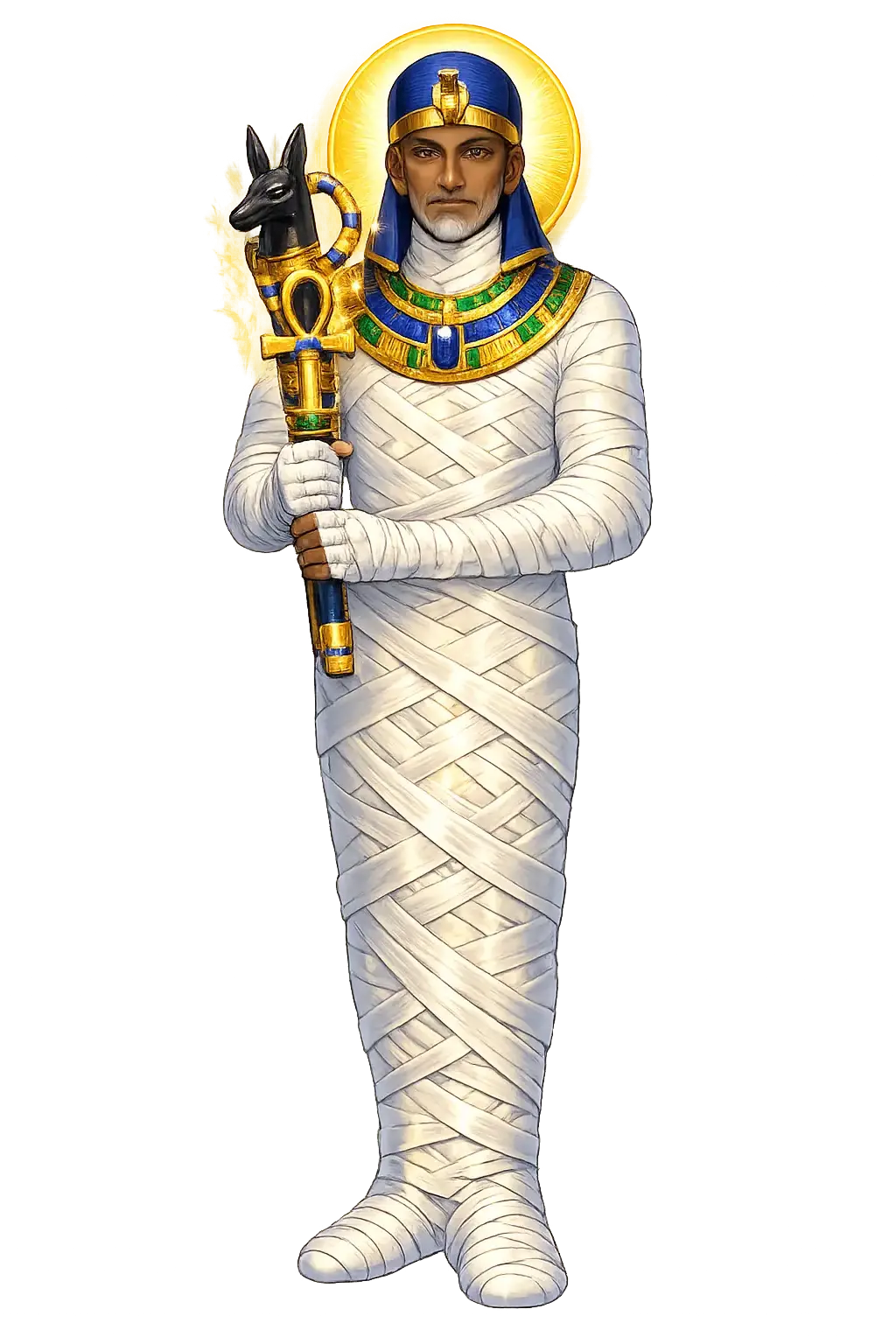
From the New Kingdom onward, Ptḥ slid toward the necropolis: fused with Sokar, the ancient falcon of the Memphite desert graveyards, and with Osiris, the dead king, he became the composite Ptḥ-Sokar-Osiris — creator, necropolis-lord, and resurrected dead in one mummiform body, often with the scarab of Khepri at its heart. Tombs from Deir el-Medina to the Theban cliffs set his composite figures in their shafts; the Late Period's Ptḥ-Sokar-Osiris statuettes and corn mummies shipped his regenerative chemistry everywhere Egyptian dead were buried, from the Delta to Nubia. The fusion absorbed Ptḥ's own Memphite geography — Sokar ruled the necropolis across the river from his temple, so the composite god literally spanned the city of the living and the city of the dead. The theological logic is Memphite: if all creation is crafting, then death is only the longest workshop — the god who shapes gods out of speech is exactly the god to re-shape a person out of a corpse.
Herodotus (3.27–29) tells how the Apis bull — the living image of Ptḥ's ka, recognized by its markings and enthroned at Memphis — became a pawn of empire: the deranged Cambyses, insulted by the Egyptian rejoicing at the bull's installation, stabbed the animal, mocked the priests for worshipping 'a calf,' and was cursed by Egypt's memory ever after; Darius, by contrast, worshipped the Apis with full ceremony. Beneath the anecdote lies the institution: a single bull, sought, enthroned, and mourned like a king, and buried in the granite sarcophagi of the Serapeum at Saqqara — where Mariette's excavations of 1851 revealed vast underground galleries, each sarcophagus carved with the name of a pharaoh and the epithet 'beloved of the Apis.' The myth gives Ptḥ something few gods possess: a regularly reincarnating body, so that the craftsman of creation keeps a living workshop in the world.
Craft, Creation, and the Speaking Heart
Ptḥ is the creator god of Memphis, the ancient capital whose white walls enclosed Egypt's foremost workshop of stone and bronze. Unlike solar creators who speak light into being, Ptḥ creates through the heart's intention and the tongue's command: every god, every city, every craft is first thought, then pronounced, then made. He is therefore the patron of sculptors, metalworkers, carpenters, and architects — the one who shapes the raw stuff of the world into enduring form.
Ptḥ fashions the gods and their kas through heart and tongue; the Memphite Theology calls him the source of every creative word.
Sculptors, goldsmiths, carpenters, and shipwrights claimed Ptḥ as their divine foreman; his priests guarded the secrets of the craft.
His temple at Hut-ka-Ptḥ, 'the mansion of the ka of Ptḥ,' gave Egypt its Greek name Aígyptos.
In mortuary cult he merges with Sokar and Osiris, guardian of mummification and the nocturnal regeneration of the dead.
From the original script to the living URL
𓁣
The name in its original Egyptian form. Ptḥ (𓁣) is attested in the source tradition — “Sculptor (Egyptian ptḥ)”. Its emphatic consonants carry the full phonetic and orthographic weight of the source tradition.
ptah
Reduced to plain ptah, the name loses everything that made it specific: emphatic consonants. What remains is an ASCII string that machines can parse but that no longer speaks with its original voice.
Ptḥ
The Unicode restoration recovers what ASCII flattened. Ptḥ restores emphatic consonants, returning the name to its original written dignity. The domain encodes to Punycode, but the browser displays the truth.
Ptḥ.com → xn--pt-tus.com
The non-ASCII characters in Ptḥ are encoded while the ASCII remains visible. To the DNS, it is Punycode. To humanity, it is Ptḥ.
Owned, ideal, and ASCII forms of Ptḥ
Ptḥ
Restores 𓁣. The live temple domain — ptḥ.com.
ptah
Flattens 𓁣. The plain ASCII fallback — what DNS and legacy systems see.
How Ptḥ was spoken
How Ptḥ travels from ancient script to the modern URL
Egyptian ptḥ; the original vocalisation is unknown. The name is conventionally rendered Ptah and may mean “sculptor, opener" or be connected with the foundation ceremony.
Craftsmen, Creation, Memphis
The Unicode restoration Ptḥ uses Egyptological characters registrable in .com; hieroglyphs are outside the .com IDN table.
The lore you have read is the living myth. Extended Lore opens the scholarly vault beneath it: the cult and its material remains, a history of the image, the name after antiquity, a meditation on what the name still means, and the full scholarly apparatus — etymology, orthography, sources.
Enter Extended Lore