PuniCodex

Extended Lore

Pandōra — The Deeper Record

Etymology · Orthography · Cult · Iconography · Reception · Sources

Preserves vowel length Pandōra.com · Pandṓra.com
Pandōra — First Woman, Box of Evils
01

At a Glance

Pandōra — every fact links to its home

PantheonGreek
DomainFirst Woman, Box of Evils
Attested470-450 BCE
Original ScriptΠανδώρα →
Primary Sources5 cited →
02

Etymology & Word Family

From original script to Unicode restoration — the full etymology page →

Proto-indo-european *pan- + *dōr- all-gifted
Original Script Πανδώρα Pandōra — "All-gifted"
Unicode Restoration Pandōra Restored stress, length, and script
Modern ASCII pandora Plain-ASCII fallback

Greek Πανδώρα 'all-gifted', from πᾶν 'all' and δῶρον 'gift'; the first woman in Hesiod's Theogony.

03

Unicode Character Breakdown

Character-by-character philological analysis

CharacterUnicodeNameBlockPhonetic Role
PU+0050Latin Capital Letter PBasic LatinSame
aU+0061Latin Small Letter ABasic LatinSame
nU+006ELatin Small Letter NBasic LatinSame
dU+0064Latin Small Letter DBasic LatinSame
ōU+014DLatin Small Letter O with MacronLatin Extended-AMacron: long omega
rU+0072Latin Small Letter RBasic LatinSame
aU+0061Latin Small Letter ABasic LatinSame

More than one historically valid Unicode spelling of Pandōra exists — each variant is a real, attested restoration, and the owned forms live as temples.

04

Cult & Worship

How the sacred was kept — rites, sanctuaries, remains

The Cult

No sanctuary, festival, priesthood, or votive of Pandōra is attested — the evidence is as thin as the record can honestly be, and this field should say so. Her ritual footprint, if the word is allowed, is funerary and Athenian: white-ground oil-flasks of c. 470–450 BCE show her rising from the earth, a scheme at home in graves but implying no cult. Later tradition gave her none either; she lived entirely inside Hesiod's two poems.

In the Earth

No sanctuary of Pandōra is known; her archaeology is iconographic and Attic. White-ground lekythoi of ca. 470-450 BCE — fine funerary oil-flasks — show her emergence from the earth with Hephaistos standing by, hammer still raised, a motif unique to Athens and plausibly tied to the contemporary stage. Later red-figure vases show her simply as a bride, which is Hesiod's bitter point made visible: the gods' punishment arrives wearing wedding clothes. The imagery dies with the classical period and returns only in Renaissance and Romantic painting, where she is reborn as the tragic first woman.

05

Iconography

How Pandōra was imaged across the ages

The Image

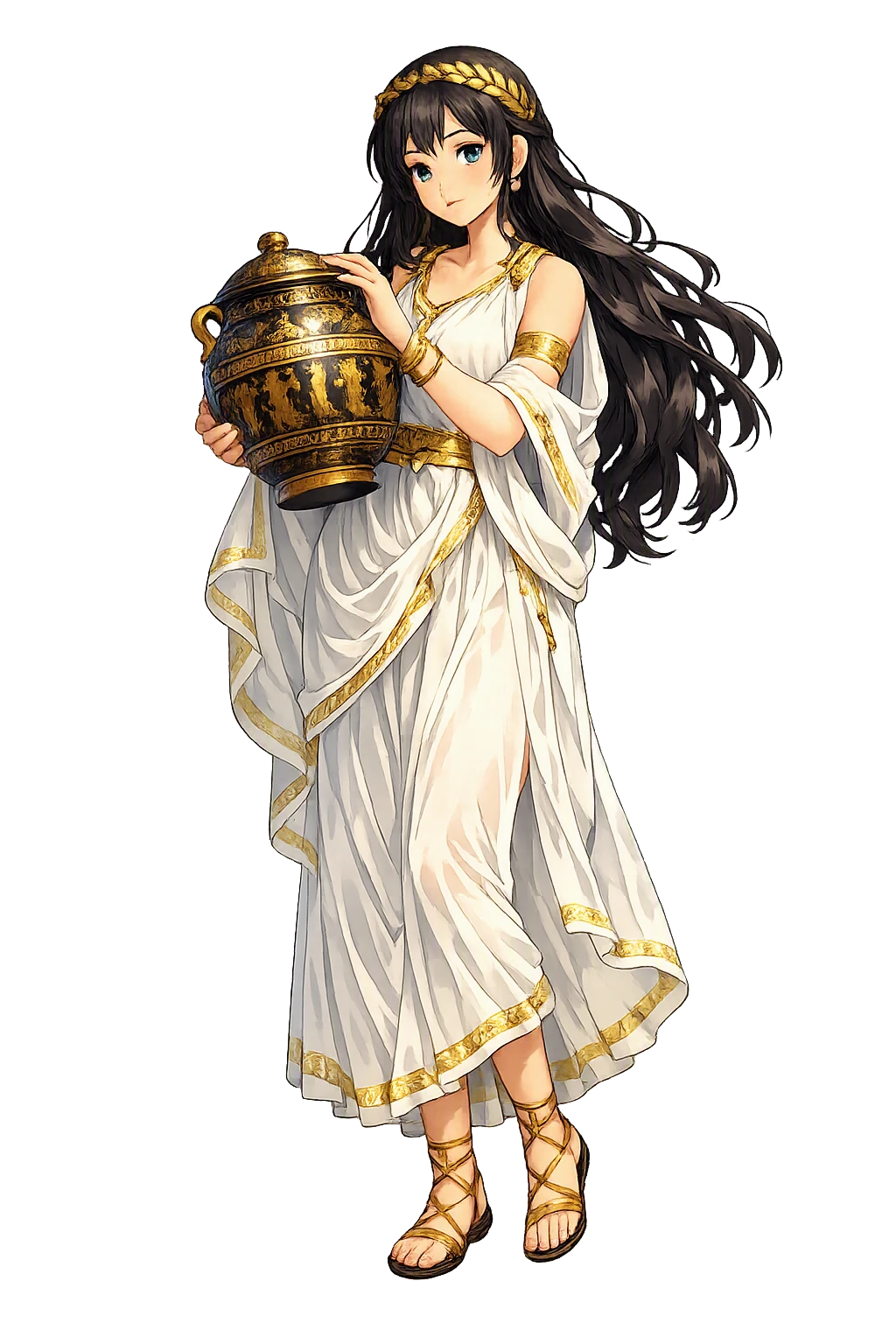
Pandōra's image is one of the strangest in Greek art, because her first portraits show her not yet born. On Attic white-ground lekythoi of c. 470–450 BCE she rises half-length from the ground like a plant or a ghost, while Hephaistos stands by with hammer raised — the moment of manufacture, painted on funerary ware. An Attic painter of the next generation is even named for her: modern scholarship calls him the 'Pandora Painter' after just such a birth scene. The text supplies her wardrobe and the painters followed it: veil, crown of flowers, golden necklace, bridal robes — Hesiod's bitter joke that the punishment arrives dressed for a wedding. The jar, her defining attribute in every later age, is surprisingly rare on the vases. Later red-figure simply shows a bride; the scheme dies with the classical period, and the image everyone now knows — a woman lifting a decorated lid — belongs to the post-Erasmian box and to later painting, not to antiquity.

06

Reception & Transformation

The name after its own age — transmission, translation, survival

Afterlives

Pandōra's transmission is the biography of a text — Hesiod's — and of one mistranslation. Antiquity added almost nothing: Apollodorus condenses the Works and Days, Hyginus condenses Apollodorus, and a second Pandōra in the Hesiodic Catalogue shows the tradition branching early. Print then changed her fate: the editio princeps of Hesiod (Milan, c. 1480) put the poems into every schoolman's hands, and Renaissance mythography — Natale Conti's Mythologiae (1551), Cartari's Imagini degli dei (1556) — spread a learned, allegorical Pandora across Europe. Erasmus' pyxis (1508) conquered the vernaculars, and by the seventeenth century 'Pandora's box' was proverbial in English. Goethe worked her into an unfinished festival play (Pandora, 1807–08). The nineteenth-century criticism born of the Homeric Question made Hesiod's text a battleground, and she rode the debate into modern scholarship, where the scapegoat reading finally found her.

Identifications Across Traditions

The Romans had no native equivalent and simply kept her Greek name; Hyginus (Fabulae 142) condenses Hesiod for handbook readers, and Ovid passes over her fashioning in silence while retelling the flood around her in-laws. Her great metamorphosis is philological: in 1508 Erasmus, rendering a proverb about ill-considered gifts, translated Hesiod's pithos — a storage-jar — as pyxis, a box, and 'Pandora's box' entered every European language. The Renaissance and Romantic eras remade her as the tragic first woman; Rossetti painted her as a burning-haired femme fatale; modern feminist and psychoanalytic rereading has reclaimed her as the scapegoat of a male poet's misogyny — a reading the text half-invites, since the gods, not she, built the jar and its contents.

Modern Legacy

'To open Pandora's box' is among the most durable idioms in English and the European languages — for any act that releases consequences no one can recall. The name branded a global jewelry house, a moon of Saturn, and countless works of science fiction; her jar launched the forbidden-container trope that runs from Eden's tree to Bluebeard's chamber. In myth scholarship she remains the case study of how a didactic fable about work and women became the West's default image of unintended consequence. Restoring Pandōra — stress and long omega — restores the name as Hesiod's audience heard it: 'All-gifted,' a phrase that has never stopped meaning two things at once.

09

The Original Script Note

What the written record preserves — and what it does not

Original Script

The name is written in Greek as Πανδώρα, 'All-gifted' — πᾶν + δῶρον — and Hesiod says why: because all the Olympians gave her a gift (Theogony 81–82), the fatal dowry of the first woman. The circumflex on the long omega marks the name's stem; the first alpha is short. The myth is told twice by Hesiod — in the Theogony and the Works and Days — and the famous jar, not box, is hers: pithos, a storage jar, until Erasmus's Latin made it a box in 1558. The canonical form Pandōra marks the omega's length with a macron, following the fallback that keeps the label typeable; the circumflex, stress and length in one mark, is what the domain system cannot carry. The ASCII 'pandora' shows neither.

10

The Meditation

What Pandōra means — beyond the dictionary

Pandōra is a story about storytelling. Hesiod, a didactic poet singing to farmers, needed a reason the world demands labor, and he built it from a name: 'all-gifted.' Everything the gods each contributed, she is a bundle of divine functions wearing a bridal veil. It is one of the most misogynistic passages in Greek literature — and one of the most analyzed, because the cruelty is so visibly constructed. Pandōra did not choose to open the jar in any version Hesiod tells with blame; the evils simply fly, and hope simply stays, and the poet leaves both facts standing.

What she means beyond the dictionary is this: every culture narrates its troubles into being, and the vessel of those troubles always turns out to be someone who had no part in making them. To read her carefully is to unmake the scapegoat and see, instead, the hands that built the jar.

11

Frequently Asked Questions

Deep-dives into the cult, attestation, reception, and sources of Pandōra

01How do we know how Pandōra was worshipped?

No sanctuary of Pandōra is known; her archaeology is iconographic and Attic. The full cult record →

02Where do the earliest attestations of Pandōra come from?

The record rests on Hesiod, Works and Days 60-105, Hesiod, Theogony 570-616, Hesiod, Catalogue of Women fr. 5 M-W (the second Pandōra), among 6 cited works. The full source apparatus →

03How did later traditions reinterpret Pandōra?

Pandōra's transmission is the biography of a text — Hesiod's — and of one mistranslation. Reception & transformation →

04What do the surviving images of Pandōra actually show?

Pandōra's image is one of the strangest in Greek art, because her first portraits show her not yet born. The iconography →

05What does the written record of Pandōra actually preserve?

The name is written in Greek as Πανδώρα, 'All-gifted' — πᾶν + δῶρον — and Hesiod says why: because all the Olympians gave her a gift (Theogony 81–82), the fatal dowry of the first woman. The Original Script note →

12

Scholarly Sources

The philological foundations of this restoration

Every claim on this page is grounded in established scholarship. The orthographic restorations follow disciplinary convention. The etymological chain follows the best available reference works. This is not invention — it is resurrection through scholarship.

◈

Lexicography & Philology

  • Liddell, H. G., Scott, R., & Jones, H. S. A Greek-English Lexicon. Oxford: Clarendon Press, 9th ed. 1996.
  • Pape, W., & Benseler, G. E. Wörterbuch der griechischen Eigennamen. Braunschweig: Vieweg, 1884.
  • Beekes, R. S. P. Etymological Dictionary of Greek. Leiden: Brill, 2010.
◎

Primary Texts

  • Hesiod, Works and Days 60-105
  • Hesiod, Theogony 570-616
  • Hesiod, Catalogue of Women fr. 5 M-W (the second Pandōra)
  • Apollodorus, Library 1.7.2
  • Erasmus, Adagia (1508) — source of the 'box' mistranslation; West, Hesiod: Works and Days, ad 80-105
◉

Archaeology & Art History

  • Boardman, J. Greek Sculpture: The Classical Period; Carpenter, T. H. Art and Myth in Ancient Greece.
✦

Religious Studies

  • Hyginus, Fabulae 142
Return

The Surface Awaits

You have traced the name from its earliest attestation to its Unicode restoration. Now return to the myth. The story is where the name lives.

Back to Lore
Pandōra mascot