
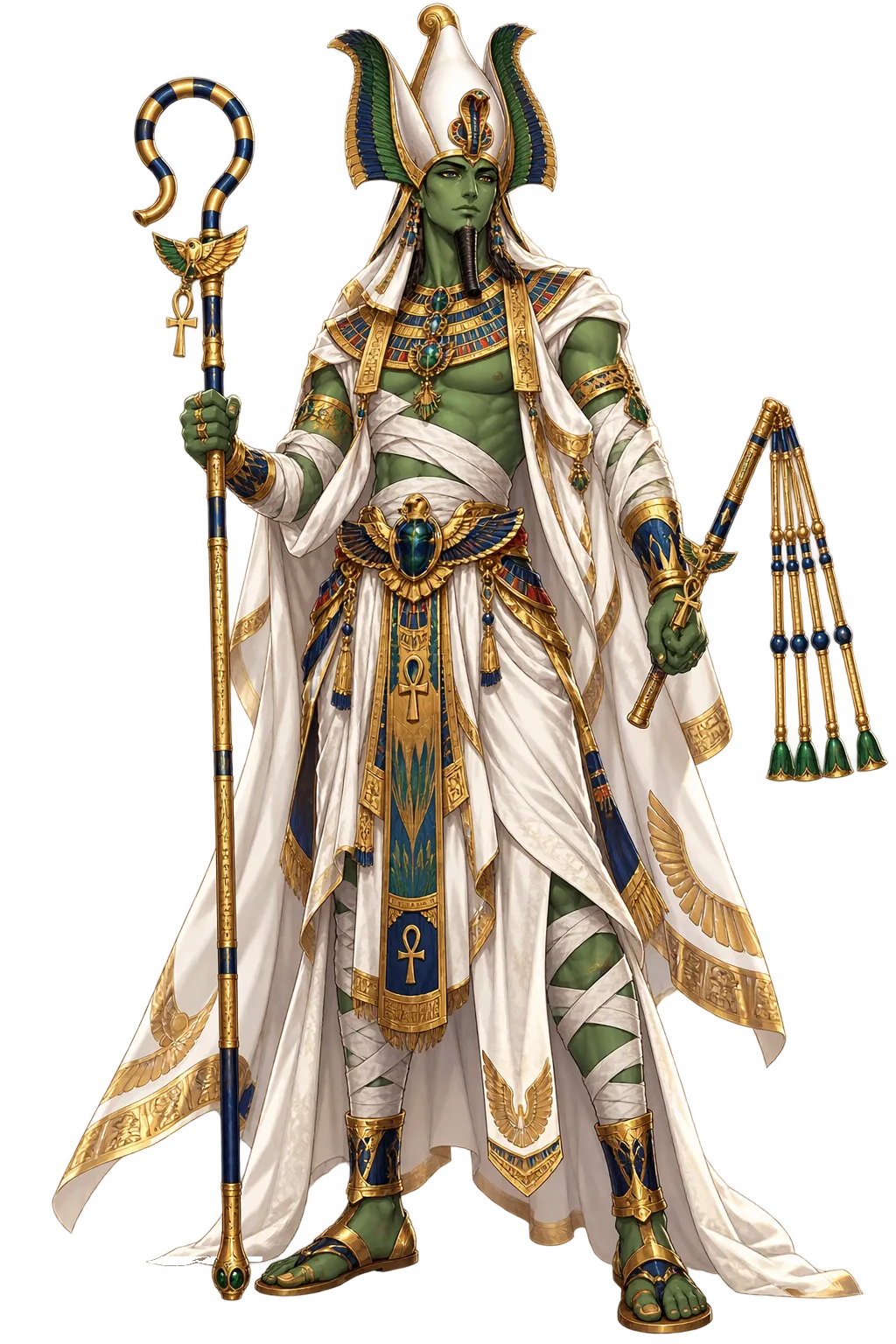
Why Wsjr is spelled that way — and what it costs to get it right
There is no broken version of this name to repair. There is a record to preserve: Wsjr, exactly as the scholarly convention supports it.
The Osiris cycle is the best-preserved Egyptian myth, known from the Pyramid Texts onward: the good king murdered by his brother, the faithful wife who recovers him, the son who avenges him. It is simultaneously a story about kingship, about the flood that dies and returns, and about every human being who hoped to be judged worthy.
At a Glance
- Canonical name: Wsjr
- ASCII form: osiris
- Meaning: "Mighty One (Egyptian wsjr)"
- Domain of influence: Afterlife, Resurrection, Vegetation
- Pantheon: Egyptian
- Restoration: ASCII-equivalent form
- Original script: 𓁥
- Series: The Restoration Files, No. 405 of 597
The Name, Plain and Exact
Spoken, the name runs `/ˈwɛzɪər/ (conventional)` — “WES-ir” — the form the Greeks heard as Ὄσιρις (Ósiris)
The Temple That Stands Now
The canonical name is not a plaque; it is an address. The temple of Wsjr lives at /osiris/, with its mythology in the lore halls, its peer-reviewed record in the Scholarly Edition, and its place in the pattern atlas on the patterns floor.
The displayed form is ASCII-equivalent.
Where the Name Stood First
The Osireion at Abydos, excavated by Naville and Frankfort, is a cenotaph-temple flooded symbolically with groundwater; the Dynasty XIX temples of Seti I preserve the finest Osiris chapels and the Abydos King List. Fourteen supposed relic-sites of his body were listed by the Abydos and Mendes traditions, giving a physical geography to the dismemberment myth. The temple on the web is the newest of these addresses — the first one that fits in a pocket.
The Archetype at Work
The pattern atlas seats this temple in 5 industries, each match argued and weighted: Agriculture, Food & Harvest (the green god of the Nile's return: his resurrection is the flood that fertilises the field — agriculture's founding myth.); Funerary & Memorial Services (the weighing of the heart and the first mummy are the canonical warrant for every funerary rite after them — Osiris IS the judged dead.); Waste, Recycling & the Circular Economy (dismembered and reassembled, the god proved that what is broken can be made whole and fertile again.). The Resonance File reads those seats through the myths themselves.
In the Sacred Texts
The Egyptian tradition is not a vibe; it is a library. The Sacred Texts collection holds The Book of the Dead — the primary sources the temple's scholarship is built on. The temple is the argument; the texts are the evidence.
The File Continues
The temple's founding dispatch tells the name's story; its Resonance File reads the myths into the industries; the blog index holds the whole archive.
Continue the series — previous file: Ọṣun (read it here) · next file: Ouranía (read it here).
The Restoration Files are written from the same canonical record as the temples themselves: the lexicon, the lore catalog, the pattern atlas, and the cited scholarly sources. If a file ever disagrees with its temple, the temple is right — tell us, and the file will be corrected.