PuniCodex

Extended Lore

𓁥 Wsjr

Etymology · Orthography · Cult · Iconography · Reception · Sources

ASCII-equivalent form Wsjr
Wsjr — Afterlife, Resurrection, Vegetation
01

Quick Facts

Essential information about Wsjr, Afterlife, Resurrection, Vegetation

Original Script𓁥
Unicode RestorationWsjr
Reconstructed Pronunciation/ˈwɛzɪər/ (conventional)
PantheonEgyptian
DomainAfterlife, Resurrection, Vegetation
MeaningMighty One (Egyptian wsjr)
ClassificationASCII-equivalent form
Primary DomainWsjr
Sacred SymbolsKing of the Duat, The First Mummy, The Green God, Father of Horus
02

Etymology & Word Family

From original script to Unicode restoration

Original Script 𓁥 Wsjr — "Mighty One (Egyptian wsjr)"
Unicode Restoration Wsjr Canonical scholarly spelling — ASCII-identical
Modern ASCII osiris Plain-ASCII fallback

The name Wsjr reaches the modern world through scholarly transliteration of the egyptian tradition. Because the conventional spelling uses only Latin letters, its Unicode and ASCII forms coincide — the tradition it carries is in the name itself, not in diacritics.

03

Unicode Character Breakdown

Character-by-character philological analysis

CharacterUnicodeNameBlockPhonetic Role
WU+0057Latin Capital Letter WBasic LatinInitial w: bilabial glide
sU+0073Latin Small Letter SBasic LatinSame
jU+006ALatin Small Letter JBasic LatinJ: palatal approximant
rU+0072Latin Small Letter RBasic LatinSame
—N/ADropped characterEgyptian orthographyDropped: absorbed in j
—N/ADropped characterEgyptian orthographyDropped: not in standard translit

This restoration reflects fidelity to the attested tradition, not recovered diacritics: every character of Wsjr already survives in ASCII. What the restoration preserves is the canonical spelling itself — the form scholarship standardised.

04

Cult & Worship

How the sacred was kept — rites, sanctuaries, remains

The Cult

Abydos was the cult centre without rival, where the annual mysteries of Osiris staged the god’s death and revival with a processional boat (neshmet bark). Every dead person was ‘an Osiris’ — the name-title itself was the engine of personal religion, making the god’s cult indistinguishable from the Egyptian hope for the afterlife itself.

In the Earth

The Osireion at Abydos, excavated by Naville and Frankfort, is a cenotaph-temple flooded symbolically with groundwater; the Dynasty XIX temples of Seti I preserve the finest Osiris chapels and the Abydos King List. Fourteen supposed relic-sites of his body were listed by the Abydos and Mendes traditions, giving a physical geography to the dismemberment myth.

05

Iconography

How Wsjr was imaged across the ages

The Image

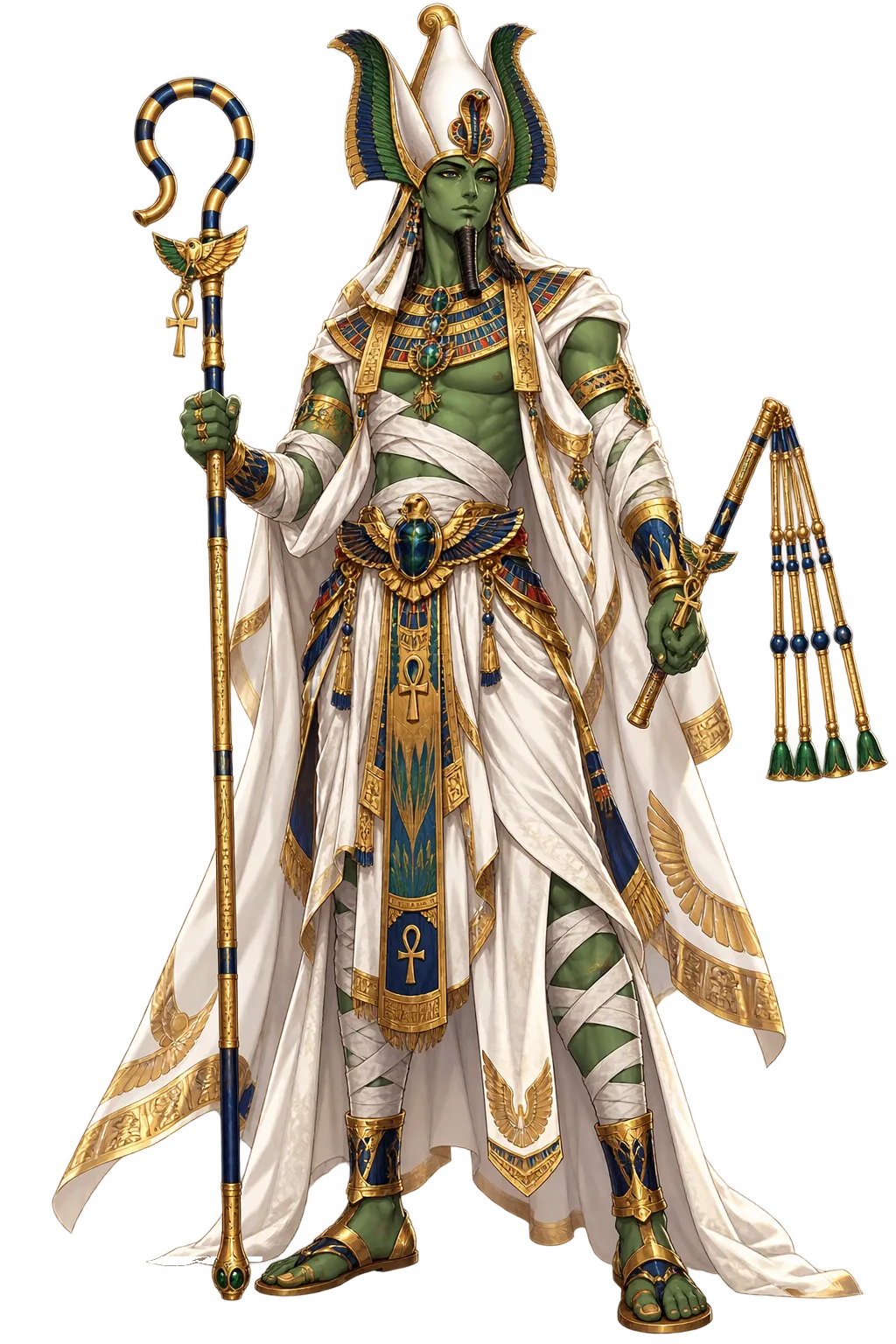
Mummiform, arms crossed on the chest holding the crook and flail, wearing the tall white crown of Upper Egypt flanked by ostrich feathers; his skin is green or black — the colours of the flood-borne earth. As the Lunar deity he can be wrapped entirely as a moon-disc within a mummiform body, but the judge of the dead remains his definitive form.

06

Reception & Transformation

The name after its own age — transmission, translation, survival

Afterlives

Classical authors — Herodotus, Diodorus, Plutarch — transmitted the Osiris myth to Europe, where it shaped early theories of the ‘dying god’ and, through them, the modern study of religion itself. His weighing-of-the-heart scene, spell 125, is today the single most reproduced image of Egyptian religion, familiar far beyond scholarship.

Identifications Across Traditions

Under the Ptolemies the Greeks mapped Osiris onto their own dying gods — Dionysus above all, whom Herodotus already calls “Osiris” — and the identification fed the later figure of Hellenistic Serapis. Through the Abydos cult his resurrection drew comparison with Christ in late-antique apologetics in both directions. The Coptic Church still preserves his name in ⲟⲩⲥⲓⲣⲉ as a theophoric element.

Modern Legacy

Osiris gave the West its archetype of the dying-and-rising god and Egyptology one of its oldest debates: Frazer’s “Osiris as vegetation deity” reading dominated a century before J. Gwyn Griffiths and others restored his identity as dead king and judge. Abydos, his chief sanctuary, remained a pilgrimage goal for two millennia; the Osireion there, with its island surrounded by water, staged his myth in stone.

07

The Meditation

What Wsjr means — beyond the dictionary

The name on this temple is the consonantal skeleton the Egyptians themselves wrote — wsjr — because the vowels were never recorded and any vocalisation is an act of scholarship. That uncertainty is the point of the restoration: the god who embodies resurrection survives in a name we must partially reconstruct, held together by the determinative of a seated deity at the end of his own word.

08

Screen & Culture

Where Wsjr echoes through film, television, and games — and how

09

Frequently Asked Questions

Common questions about Wsjr, Afterlife, Resurrection, Vegetation, and Unicode restoration

01How do you pronounce Wsjr?

In reconstructed pronunciation, Wsjr is /ˈwɛzɪər/ (conventional) — approximately “WES-ir” — the form the Greeks heard as Ὄσιρις (Ósiris).

02What does Wsjr mean?

Wsjr means Mighty One (Egyptian wsjr) in the egyptian tradition.

03What are the symbols of Wsjr?

Wsjr is associated with King of the Duat (Sovereign of the underworld and judge of every soul weighed against the feather of Maat.), The First Mummy (The drowned, dismembered god rewrapped by Anubis — the prototype of all mummification.), The Green God (Lord of vegetation and the inundation; his green or black skin is the fertile flood-plain.), Father of Horus (Posthumous father of the sky-falcon; the succession struggle with Seth is Egypt’s central myth.).

04Why are there different spellings of Wsjr?

Each form is a historically attested restoration rather than a mistake: Osíris is the alt-stress form (Acute on iota: alternate stress position). PUNICODEX registers the full set so the tradition is preserved under every defensible spelling.

05Why restore Wsjr in Unicode?

Wsjr is written entirely in ASCII letters, so its restoration is about canonical fidelity rather than recovered diacritics: the temple fixes the name in its scholarly standard spelling, attested in the source tradition, instead of leaving it to drift.

06What is the most important myth about Wsjr?

“The Death of the Good King” — the Pyramid Texts story that anchors the mythology of Wsjr, told in full on the lore page.

10

Scholarly Sources

The philological foundations of this restoration

Every claim on this page is grounded in established scholarship. The orthographic restorations follow disciplinary convention. The etymological chain follows the best available reference works. This is not invention — it is resurrection through scholarship.

◈

Lexicography & Philology

  • Faulkner, R. O. A Concise Dictionary of Middle Egyptian. Oxford: Griffith Institute, 1962.
  • Wb
◎

Primary Texts

  • Pyramid Texts (Old Kingdom, utterances of the Osiris king)
  • Book of the Dead, spell 125 (the weighing of the heart)
  • Plutarch, De Iside et Osiride (the fullest narrative of the cycle)
  • Memphite Theology (Shabaka Stone)
◉

Archaeology & Art History

  • Material evidence — iconography, inscriptions, and temple archaeology — for Wsjr and related cults.
✦

Religious Studies

  • Griffiths, The Origins of Osiris and his Cult
  • Herodotus, Histories 2.170–171 (the Abydos cult)
Return

The Surface Awaits

You have traced the name from its earliest attestation to its Unicode restoration. Now return to the myth. The story is where the name lives.

Back to Lore
Wsjr mascot