
Why Wsjr belongs in the scholarly record
A name can be complete without carrying a single diacritic. Wsjr is a canonical scholarly spelling, not a damaged form waiting for decoration. This post follows the evidence behind that spelling: the Hieroglyphs record, the reconstructed sound, the myths, the material culture, and the reasons this particular romanization became the public reference. The plain ASCII letters already contain the whole form. The scholarly work is to prove their provenance, preserve their capitalization, and keep the name attached to its history.
At a Glance
- Restored name: Wsjr
- ASCII form: osiris
- Meaning: "Mighty One (Egyptian wsjr)"
- Domain of influence: Afterlife, Resurrection, Vegetation
- Pantheon: Egyptian
- Restoration: ASCII-equivalent form
- Original script: 𓁥 (Hieroglyphs)
Overview
Wsjr (osiris) — The Dead, Resurrection, the Nile's Return · Mighty One — belongs to the Egyptian tradition, where it is catalogued under the domain "Afterlife, Resurrection, Vegetation". The name means "Mighty One (Egyptian wsjr)".
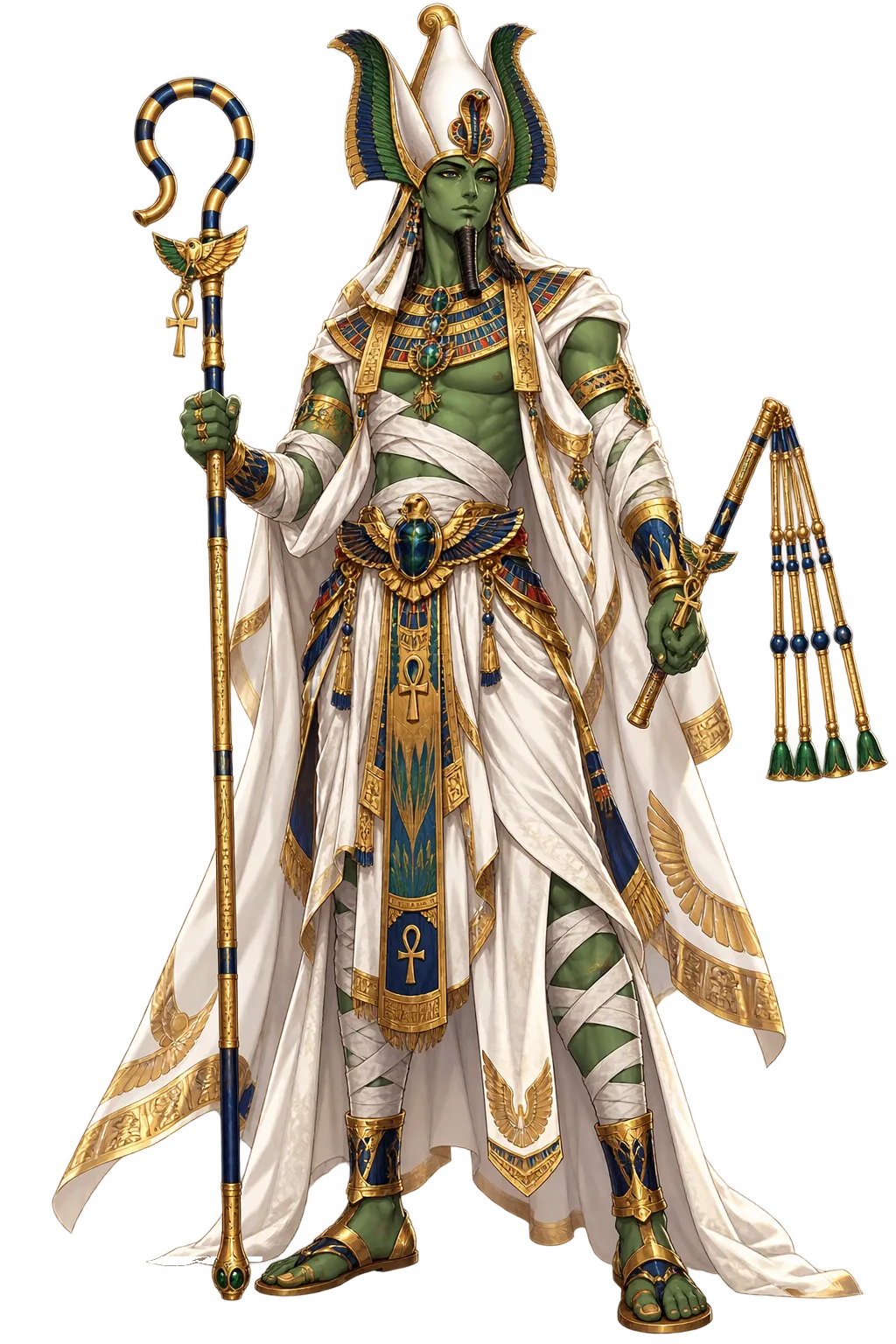
Wsjr — Osiris to the Greeks — is the god who died and returned, and in returning became the pattern every Egyptian hoped to follow. Murdered by his brother, reassembled by his wife, enthroned as judge of the dead, he rules the Duat while his son Horus rules the living world above.
PuniCodex records the canonical scholarly spelling Wsjr and serves its temple at its temple. The displayed form is ASCII-equivalent — a description computed from the displayed form itself. The plain ASCII form osiris contains the same letters: no recovered diacritics or special encoding is claimed. The work here is consistent citation, capitalization, provenance, and cultural context.
The Name
The name is attested in Hieroglyphs as 𓁥. Etymologically it means "Mighty One (Egyptian wsjr)".
The canonical spelling Wsjr matches the conventional scholarly romanization. The plain ASCII form osiris contains the same letters, so no lost diacritics or encoding transition is claimed. The editorial work is to fix one reviewed reference spelling, preserve capitalization and provenance, and keep the original evidence visible. The displayed form is ASCII-equivalent — a description computed from the displayed form itself.
The letter-by-letter transformation runs:
- o → W — Initial w: bilabial glide
- s → s — Same
- i → j — J: palatal approximant
- r → r — Same
- i → — — Dropped: absorbed in j
- s → — — Dropped: not in standard translit
Attested and derived spellings of the name:
- Osíris — alternate stress, scholarly variant: Acute on iota: alternate stress position
The Original Script
The name is preserved in Hieroglyphs as 𓁥 — Egyptian hieroglyphs, attested Egyptian hieroglyphic, c. 3200 BCE – 4th century CE, in Nile Valley, Egypt. The script is written right-to-left / top-to-bottom / multidirectional.
The scholarly transliteration is Wsjr (Egyptological transliteration), giving the normalized reading Original vocalisation unknown; Egyptological /uː.ˈsiː.rɪs/ or /oː.ˈsiː.rɪs/..
The rendering proceeds step by step:
- Throne (ws) + eye (jr) ideogram, conventionally read Wsjr
- The exact vocalisation is unknown; Coptic ⲟⲩⲥⲓⲣⲉ supplies a late reflex
- God of the underworld and resurrection
Pronunciation
The reconstructed pronunciation of the name is /ˈwɛzɪər/ (conventional) — Conventional reading — Egyptian vocalisation not attested.
Phoneme by phoneme:
- Ws- — The name is written wsjr; the initial w is a weak consonant (w or u) whose vowel is unwritten.
- -jr — The god-determinative follows; the final r is consonantal. Egyptologists conventionally vocalise the name “Wesir”.
For the modern speaker, the closest approximation is: “WES-ir” — the form the Greeks heard as Ὄσιρις (Ósiris)
Kindred and historical forms of the name:
- Greek — Ósiris
- Coptic — ⲟⲩⲥⲓⲣⲉ (Ousire)
Egyptian hieroglyphs record consonants, not vowels; every vocalisation is a modern convention.
Mythology
The Osiris cycle is the best-preserved Egyptian myth, known from the Pyramid Texts onward: the good king murdered by his brother, the faithful wife who recovers him, the son who avenges him. It is simultaneously a story about kingship, about the flood that dies and returns, and about every human being who hoped to be judged worthy.
The Death of the Good King (Pyramid Texts)
The earliest sources already presuppose the story: Osiris ruled as a beneficent king until his brother Seth, envious of his power, contrived his death — in the classical telling (Plutarch’s De Iside et Osiride, the fullest narrative we have) sealed in a chest and thrown into the Nile, the river carrying him to Byblos where a tamarisk grew to engulf the coffin.
Isis the Faithful (Plutarch)
Isis searched for the body, recovered it from Byblos, and hid it — but Seth found it by night, cut it into fourteen pieces, and scattered them through Egypt. Isis and Nephthys wandered the land gathering the fragments. Every place that claimed a fragment became an Osiris sanctuary; the myth is a map of Egyptian pilgrimage.
The Weighing of the Heart (Book of the Dead)
Anubis conducts the dead to the Hall of Two Truths, where the heart is set on the scale against the feather of Maat and the tally is read aloud by Thoth. Wsjr, enthroned in the next chamber, receives those who pass. The formula “I am Osiris” in the Book of the Dead identifies the deceased with him — his resurrection becomes the template of theirs.
The Succession of Horus (Memphite Theology)
Isis, by magic, conceived a son on the briefly reanimated body: Horus, raised in secret in the marshes of Chemmis, who grew to challenge Seth for the throne. The tribunal of the gods awarded Egypt’s rule to Horus and the underworld’s to Osiris — the mythic charter for the division between the living king and his dead father.
Symbols & Iconography
The iconography associated with Wsjr concentrates in a small set of recurring attributes, each a compressed statement about the name:
- King of the Duat — Sovereign of the underworld and judge of every soul weighed against the feather of Maat.
- The First Mummy — The drowned, dismembered god rewrapped by Anubis — the prototype of all mummification.
- The Green God — Lord of vegetation and the inundation; his green or black skin is the fertile flood-plain.
- Father of Horus — Posthumous father of the sky-falcon; the succession struggle with Seth is Egypt’s central myth.
Archaeology & Evidence
The Osireion at Abydos, excavated by Naville and Frankfort, is a cenotaph-temple flooded symbolically with groundwater; the Dynasty XIX temples of Seti I preserve the finest Osiris chapels and the Abydos King List. Fourteen supposed relic-sites of his body were listed by the Abydos and Mendes traditions, giving a physical geography to the dismemberment myth.
Realm & Domain
Wsjr — Osiris to the Greeks — is the god who died and returned, and in returning became the pattern every Egyptian hoped to follow. Murdered by his brother, reassembled by his wife, enthroned as judge of the dead, he rules the Duat while his son Horus rules the living world above.
King of the Duat
Sovereign of the underworld and judge of every soul weighed against the feather of Maat.
The First Mummy
The drowned, dismembered god rewrapped by Anubis — the prototype of all mummification.
The Green God
Lord of vegetation and the inundation; his green or black skin is the fertile flood-plain.
Father of Horus
Posthumous father of the sky-falcon; the succession struggle with Seth is Egypt’s central myth.
Across Cultures
Under the Ptolemies the Greeks mapped Osiris onto their own dying gods — Dionysus above all, whom Herodotus already calls “Osiris” — and the identification fed the later figure of Hellenistic Serapis. Through the Abydos cult his resurrection drew comparison with Christ in late-antique apologetics in both directions. The Coptic Church still preserves his name in ⲟⲩⲥⲓⲣⲉ as a theophoric element.
Kindred figures in the PuniCodex cross-tradition index include Baldr (death / rebirth) and Diónysos (rebirth / vegetation).
Cultural Legacy
Osiris gave the West its archetype of the dying-and-rising god and Egyptology one of its oldest debates: Frazer’s “Osiris as vegetation deity” reading dominated a century before J. Gwyn Griffiths and others restored his identity as dead king and judge. Abydos, his chief sanctuary, remained a pilgrimage goal for two millennia; the Osireion there, with its island surrounded by water, staged his myth in stone.
The Scholarly Record
The account of Wsjr given in this edition rests on the witnesses and reference works listed below. Lexica and etymological dictionaries secure the form and meaning of the name; the literary and religious texts supply the narrative evidence.
- Pyramid Texts (Old Kingdom, utterances of the Osiris king).
- Book of the Dead, spell 125 (the weighing of the heart).
- Plutarch, De Iside et Osiride (the fullest narrative of the cycle).
- Memphite Theology (Shabaka Stone).
- Griffiths, The Origins of Osiris and his Cult.
- Herodotus, Histories 2.170–171 (the Abydos cult).
A Meditation
The name on this temple is the consonantal skeleton the Egyptians themselves wrote — wsjr — because the vowels were never recorded and any vocalisation is an act of scholarship. That uncertainty is the point of the restoration: the god who embodies resurrection survives in a name we must partially reconstruct, held together by the determinative of a seated deity at the end of his own word.
The Canonical Spelling
Wsjr is the canonical spelling used by this temple. The plain ASCII form osiris contains the same letters, so there are no lost diacritics to recover and no special encoding transition to explain. What the temple preserves is the reviewed reference form: capitalization, conventional romanization, original evidence, and a stable place to inspect them. The value here is not added decoration; it is fidelity to the attested record.
Name Variations
The lexicon records 1 additional form of the name:
- Osíris (alt-stress) — Acute on iota: alternate stress position
The temple uses Wsjr as its primary form because the evidence and the relevant scholarly convention make it the clearest public reference.
Character by Character
The canonical form Wsjr and the plain ASCII form osiris share the same letters. The character list therefore documents continuity rather than recovery: every character is carried forward deliberately, with capitalization serving as the proper-noun convention. No additional mark is inserted merely to make the restoration appear more elaborate.
The Egyptian Pantheon
Wsjr is one of 66 entries the PuniCodex lexicon catalogues under the Egyptian pantheon. The Pantheon page gathers the tradition's major figures in one place, and the Lexicon lets you filter all 983 restorations by tradition or script — the fastest way to see where this name sits among its kin.
Frequently Asked Questions
What does Wsjr mean? The traditional gloss is "Mighty One (Egyptian wsjr)."
Which tradition does Wsjr belong to? Wsjr is catalogued in the Egyptian pantheon of the PuniCodex lexicon.
Does this name need recovered diacritics? No. Wsjr is already an ASCII-form canonical spelling. The scholarly work is to preserve the attested convention and its evidence, not to add marks.
Can I use Wsjr in a normal browser? Yes. The spelling works directly in an ordinary browser, and the type tool can confirm and copy the canonical form.
Where does the scholarly information come from? The entry is built from lexica, inscriptional evidence, and reviewed scholarly sources listed in the Scholarly Edition.
Typing Wsjr
You do not need a special keyboard to use this name. Wsjr already uses ordinary Latin letters. The PuniCodex Type Tool lets you confirm the canonical spelling and copy it cleanly, while the original-script notes in the temple show the evidence behind the romanization.
Sister Temples
Other temples in the Egyptian pantheon include sjꜣ, Ḏḥwtj, and Ꜣḫ — each with its own restoration story, its own scholarly record, and its own place in the lexicon.
Why This Record Matters
Recording Wsjr accurately is part of a larger effort to make the web more faithful to the names it carries. This spelling needs no recovered marks; it needs a defensible chain of evidence. The script, sound, myths, and material record converge on the same point: the canonical form is information, and information deserves an address of its own. The temple keeps that address connected to the scholarship that justifies it.
Explore Further
This post is one doorway into the temple. The home page carries the full character breakdown and the ambient canvas; the lore page tells the myths in long form; the Scholarly Edition preserves the sources, pronunciation data, and revision history; and the patron wall supports the restoration directly. For the wider map, browse the Lexicon, explore the Pantheon, or return to the PuniCodex blog.
A Closer Look at the Spelling
A canonical name is a small map. In the case of Wsjr, the route does not lead through diacritics or special letters, because the conventional scholarly spelling already uses the Latin alphabet. The original evidence — 𓁥 in Hieroglyphs — carries semantic and phonetic information that no romanization can fully reproduce.
By fixing one reviewed spelling as the public reference, the project prevents the drift that occurs when a name is romanized differently in every article, map, and database. The character list shows exactly what is carried forward. "No change" here means a deliberate choice to keep the name stable, searchable, and faithful to the record.
Wsjr in Its Tradition
Wsjr does not stand alone. It belongs to the Egyptian tradition, where it is counted among 66 names in the PuniCodex lexicon. Its sphere — Afterlife, Resurrection, Vegetation — places it beside other figures who govern similar aspects of experience. The canonical spelling keeps the name in the company of its kin and gives researchers one stable reference across the temples, the APIs, and the scholarly record.
What You Will Find in the Temple
The temple page for Wsjr is more than a landing page. The home tab presents the character breakdown, pronunciation guide, and digital address. Lore gathers the myths and narratives that give the name its depth. The Art room brings together the historical collection, Commons works, and Creatives. The Scholarly Edition publishes the sources, variant forms, and review history that justify the canonical spelling.
Industry patterns show where the name appears in modern commerce and culture, while the patron wall lets visitors support the work directly. Each surface is generated from the same canonical sources, so the temple, the blog, the scholars page, and the search index agree.
The Canonical Name on the Live Web
A digital address is a kind of publication. When Wsjr resolves, it proves that the canonical spelling is not a theoretical exercise; it is a working reference on the public internet. Search engines can index it, language models can encounter it, and anyone who copies it from a manuscript can paste it into a browser.
The address already uses Latin letters, so there is no special encoding narrative to tell. Its practical value is continuity: the same reviewed form appears in the temple, the lexicon, the API, and the address bar.
Editorial Notes
Recording a name is not a single decision; it is a sequence of smaller decisions, each backed by a different kind of evidence. For Wsjr, the chain begins with the attested form in Hieroglyphs, continues through the standard scholarly romanizations, and ends with the canonical spelling used by this temple.
The meaning "Mighty One (Egyptian wsjr)" anchors the name in its semantic field and helps explain why this particular convention was retained. The plain ASCII letters already contain the complete reference form. The task is to preserve that form consistently, publish the reasoning, and let the original evidence remain available for challenge.
Related Names
Sources
The full scholarly apparatus — every citation, revision, and review — lives in the Scholarly Edition. Key references for this post:
- James P. Allen, Middle Egyptian: An Introduction to the Language and Culture of Hieroglyphs, Cambridge University Press, 2000.
- Pyramid Texts (Old Kingdom, utterances of the Osiris king).
- Book of the Dead, spell 125 (the weighing of the heart).
- Plutarch, De Iside et Osiride (the fullest narrative of the cycle).
- Memphite Theology (Shabaka Stone).
- Lexicon authorities for this entry: Faulkner, Wb.