
Pronouncing Omphalós: a guide for the curious
Saying Omphalós aloud is harder than reading it on a screen, and more rewarding. The restored spelling is a compressed pronunciation guide: every accent and macron is an instruction. This post unpacks those instructions — the reconstructed sound, the phoneme-by-phoneme record, the kindred forms in neighboring languages — and then zooms out to the full record around the name: its Greek writing, its mythology, its cult, and its modern life as a Unicode domain. Whether you arrive as a linguist, a reader of myth, or a domainer, you will leave able to say the name the way the evidence suggests it was said — and able to type it the way it was written.
At a Glance
- Restored name: Omphalós
- ASCII form: omphalos
- Meaning: "Navel (of the earth); the stone at Delphi regarded as the centre of the world"
- Domain of influence: Navel, Center, Delphi
- Pantheon: Greek
- Restoration: Preserves stress
- Original script: ὀμφαλός (Greek)
- Live domain: omphalós.com
Overview
Omphalós (omphalos) — Navel, Center, Delphi · Navel (of the earth); the stone at Delphi regarded as the centre of the world — belongs to the Greek tradition, where it is catalogued under the domain "Navel, Center, Delphi". The name means "Navel (of the earth); the stone at Delphi regarded as the centre of the world".
Omphalós belongs to the Greek tradition, where it is associated with navel, center, delphi.
PuniCodex restores the name as Omphalós and serves its temple at omphalós.com. The original preserves one prosodic feature — stress or vowel length — rather than both. The plain ASCII form omphalos survives as a modern convenience imposed by the early domain-name system; the restoration, not the fallback, is the form the project defends as philologically complete.
The Name
The name is attested in Greek as ὀμφαλός. Etymologically it means "Navel (of the earth); the stone at Delphi regarded as the centre of the world".
The reconstructed proto-form is h₃mbʰ- (proto-indo-european, "navel"). Greek ὀμφαλός 'navel, boss, centre'; the Delphic omphalos marked the world's centre in archaic Greek geography.
The ASCII form omphalos survives only because the early domain-name system could not carry diacritics; it is a technological compromise, not an ancient spelling. The Unicode restoration Omphalós recovers the stress accent of the original directly in the address bar. The original preserves one prosodic feature — stress or vowel length — rather than both.
The letter-by-letter transformation runs:
- o → O — Omicron
- m → m — Mu
- p → p — Pi
- h → h — Eta aspiration (rough breathing marker in source)
- a → a — Alpha
- l → l — Lambda
- o → ó — Acute on omicron
- s → s — Sigma
The project holds the domain omphalós.com (xn--omphals-q0a.com) as the canonical home of this name.
Etymology & Roots
The recorded derivation reads: Greek ὀμφαλός 'navel, boss, centre'; the Delphic omphalos marked the world's centre in archaic Greek geography.
The reconstructed proto-form is *h₃mbʰ- (proto-indo-european), glossed as "navel".
The reconstruction is classed as attested.
The Original Script
The name is written in Greek as ὀμφαλός. This original script is the form against which the ASCII fallback omphalos and the PuniCodex restoration Omphalós are measured: the restoration preserves its pitch accent of the written form, so that a reader typing the modern address still speaks the ancient name.
Pronunciation
The reconstructed pronunciation of the name is /omphalos/ — Greek Reconstruction.
Phoneme by phoneme:
- O — Initial character of the restored form Omphalós.
- mphalós — Remainder of the name, preserving the distinctive marks of the Greek tradition.
For the modern speaker, the closest approximation is: 'OMPHALOS' — pronounce the restored form with attention to the preserved diacritics and length.
Kindred and historical forms of the name:
- Greek — Omphalós, the restored Unicode form of the name
Omphalós is a simpler restoration because the Greek form preserves distinctive features that ASCII loses: stress, length, or special characters.
Mythology
The stories of Omphalós circulate within the Greek corpus, where the figure embodies navel, center, delphi.
Primary Attestation (Sources)
Omphalós is attested in the canonical Greek sources as a figure associated with navel, center, delphi.
Name and Meaning (Etymology)
The name means "Navel (of the earth); the stone at Delphi regarded as the centre of the world" and reflects the figure's role in the tradition. The Omphalos stone at Delphi was revered as the navel of the inhabited world. According to Hesiodic and Delphic tradition, Zeus released two eagles from opposite ends of the earth; they met at Delphi, and the spot was marked by the stone. The Pythia, Apollo's oracular priestess, sat beside it when she spoke. The stone thus binds together cosmography, kingship, and prophetic speech: to stand at the omphalos was to stand at the axis of order.
The Eagles of Zeus (The Center)
In the story told at Delphi, Zeus wished to know where the exact center of the earth lay. He released two eagles — some say from the eastern and western edges of the world — and bade them fly toward each other; they met above Delphi, and where they met the god fixed the omphalós, the navel-stone. The tale is preserved in the geographical tradition that culminates in Strabo (9.3.6), who repeats it as the sanctuary's own account of itself. The myth is a cartography in miniature: instead of measuring the world, the Greeks let two birds draw its diagonals and set a stone where the lines crossed. Delphi did not claim to be everywhere; it claimed to be the middle — the one point from which the whole could be surveyed, and the one point, therefore, where a god might conveniently speak to all mortals at once. Every subsequent oracle of the sanctuary traded on this founding geometry.
The Stone in the Innermost Room (The Adyton)
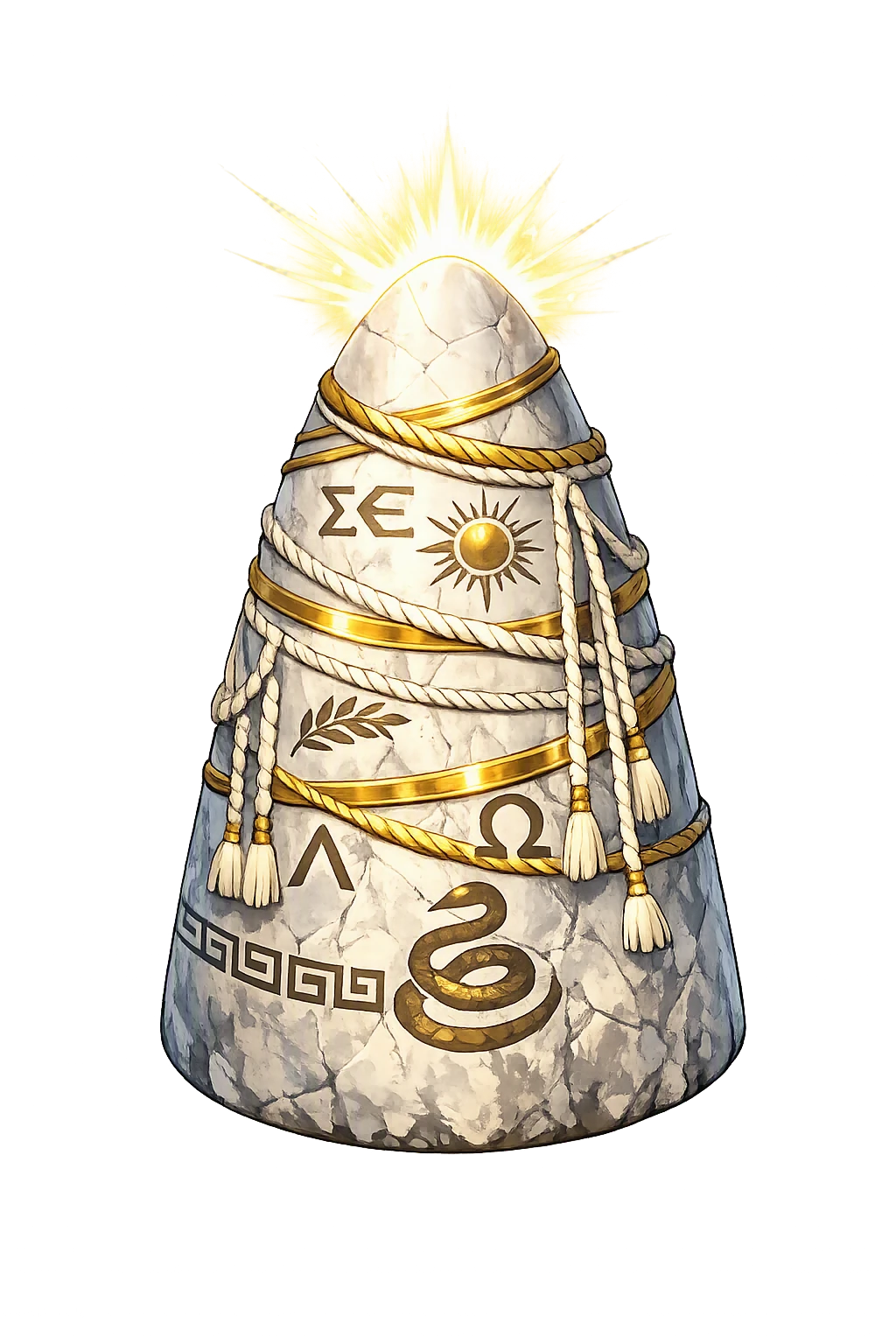
Pausanias (10.16.3) describes what the visitor could actually see: in the innermost sanctuary of Apollo's temple, the adyton, lay the omphalos, covered — the Delphians said — with the net thrown over it, with two golden eagles standing upon it. Beside it, in the same most-holy space, stood the tripod on which the Pythia mounted to give her responses, and the ever-burning hearth of the sanctuary. The stone was thus not a cult statue but a boundary-marker of the cosmos, kept in the room where heaven and earth touched. Its material facts are modest — a carved marble boss a little over a meter high — but its placement was the whole argument: the center of the world was a place you could stand next to, touch, and consult. Pausanias's description is the one fixed point on which the identification of the surviving stone rests.
What Kronos Swallowed (The Swaddled Stone)
Hesiod (Theogony 485–497) tells how Rhea, pregnant with Zeus, asked her parents Gaia and Ouranos to save the child from Kronos, who devoured each of his newborns. They gave her a great stone wrapped in swaddling clothes; Kronos 'seized it in his hands and thrust it down into his belly, the wretch, nor did he know in his heart that in place of his son his invincible, unshaken stone was left.' The later tradition — reported at Delphi itself and recorded by Pausanias (10.24.6) — identified this very stone with the omphalos at Delphi. The world's center thus conceals a substitution: where a god should have been destroyed, a stone was swallowed instead, and Zeus lived to overthrow his father. The navel of the earth is also the stone of rescue — the dummy that fooled Time and made the present order of the cosmos possible.
Symbols & Iconography
The iconography associated with Omphalós concentrates in a small set of recurring attributes, each a compressed statement about the name:
- Restored Name — The Unicode form Omphalós carries the original marks of the Greek tradition.
- Source Script — Attested in the original script as ὀμφαλός.
- Domain — Navel, Center, Delphi
- Etymology — Navel (of the earth); the stone at Delphi regarded as the centre of the world
The omphalós is represented as a rounded stone or beehive-shaped monument, often wrapped in a woolen net (ethla) or topped with a butterfly-shaped ornament. Vase painters show Apollo seated beside it, marking the seat of prophecy.
Its form evokes a navel or world-egg, making it one of the few Greek cult objects whose shape is itself a theological statement.
- The net-covered stone — The omphalos itself, wrapped in the woolen agrenon net that veiled the world's center (Pausanias 10.16.3)
- The two golden eagles — Zeus's birds, set one on either side of the stone as witnesses to the center-finding
- The navel of a newborn — The body's own center — ὀμφαλός is the infant's navel, the mark where nourishment once entered
- The cleft of Delphi — The rock fissure beneath the temple where Apollo's arrows struck Python and the prophetic power rose
Epithets & Cult Titles
The omphalós shares Apollo's Delphic epithets: Πύθιος (Pythios, of the rotting serpent), Δελφίνιος (Delphinios, linked to the dolphin-shaped priest Cretan voyage), and Λοξίας (Loxias, of the oblique oracle). The stone itself is called γῆς ὀμφαλός (gēs omphalos), the navel of the earth, in Pindar and later writers.
These titles identify the omphalós not as a separate god but as the concentrated point of Apollo's oracular authority.
The Homeric Hymns
The Delphic omphalós is named implicitly in the Homeric Hymn to Pythian Apollo, where Apollo declares that no other shrine shall be as honoured as Delphi, the fixed centre of the Greek world. Pindar's Pythian odes reinforce the claim, calling Delphi the place where the axes of earth and heaven meet.
No independent Homeric Hymn is addressed to the stone itself, yet the hymnic corpus treats the omphalós as the physical proof that Apollo's oracle stands at the cosmic navel.
Oracle Sites & Sanctuaries
The omphalós stood in the adytum of Apollo's temple at Delphi, beside the tripod from which the Pythia spoke. Pilgrims consulted the oracle about colonies, wars, and purifications; the stone served as the ritual centre from which Apollo's voice radiated.
Pausanias describes the omphalós as the object that proved Delphi was the middle of the earth, a claim tested mythically when Zeus released eagles from the world's edges and they met above it.
Archaeology & Evidence
The material record for Omphalós survives in a small number of securely identified remains, catalogued below; the corpus is thin but unambiguous, and each site is tied to the name by ancient testimony.
Omphalós is attested in the textual and iconographic record of the Greek tradition.
Realm & Domain
Omphalós belongs to the Greek tradition, where it is associated with navel, center, delphi.
Navel
The central domain of Omphalós in the greek tradition.
Navel (of the earth); the stone at Delph
The name signifies "Navel (of the earth); the stone at Delphi regarded as the centre of the world".
Unicode Restoration
The restoration Omphalós recovers what plain ASCII omphalos flattens.
Original Attestation
Attested in the sources as ὀμφαλός.
The Navel of the Earth
Zeus released two eagles from the ends of the world; where they met, at Delphi, the stone marked the center of all lands (Strabo 9.3.6).
The Swaddled Stone
The stone Kronos swallowed in place of the infant Zeus was, in the later tradition, set up at Delphi as a wonder and a sign (Hesiod, Theogony 485–497; Pausanias 10.24.6).
The Seat of Prophecy
Apollo's oracle spoke beside the stone, in the sanctuary where the god had struck down the serpent Python (Homeric Hymn to Apollo 300ff.).
Across Cultures
Omphalós appears within the Greek tradition and has influenced later retellings, artistic depictions, and scholarly study. The Unicode restoration preserves the name's distinctive orthography for contemporary use.
Within the Greek tradition, closely related names in the corpus include Achérōn, Achilleús, Adámas, Aḗr, Aithḗr, and Anánkē.
Cultural Legacy
Omphalós continues to appear in scholarship, art, and popular reception as a significant figure of the Greek tradition. Restoring the name in Unicode returns the original marks that ASCII removes. The image of the omphalos persists in later art, literature, and cartography as a symbol of the world center; Byzantine and Renaissance maps still echoed the Delphic idea of a sacred midpoint.
The Scholarly Record
The account of Omphalós given in this edition rests on the witnesses and reference works listed below. Lexica and etymological dictionaries secure the form and meaning of the name; the literary and religious texts supply the narrative evidence.
- Liddell-Scott-Jones Greek-English Lexicon, 9th ed. with 1996 supplement, 1940. Full text
- Wörterbuch der griechischen Eigennamen, 3rd ed., 1863. Full text
- Etymological Dictionary of Greek, 2 vols., Brill, 2010. Full text
A Meditation
Omphalós embodies navel, center, delphi in the Greek imagination. The name's restoration is not merely cosmetic: it recovers the stress, length, and script that make the figure recognizable in the source tradition.
The Unicode Restoration
Omphalós preserves stress. The ASCII fallback omphalos still resolves everywhere, but it is the restored form that carries the name's full information. Across the 8 characters of the name, the restoration adjusts 1: 1 mark of stress (ó). That is the whole thesis of this temple: the marks are the message.
Character by Character
The journey from omphalos to Omphalós, one character at a time:
- o → O — Omicron
- m → m — Mu
- p → p — Pi
- h → h — Eta aspiration (rough breathing marker in source)
- a → a — Alpha
- l → l — Lambda
- o → ó — Acute on omicron
- s → s — Sigma
The Domain Name
The restored name is live as a working domain: omphalós.com, which the DNS carries in punycode form as xn--omphals-q0a.com — an ASCII-compatible encoding that lets a non-ASCII name travel the global network without breaking older infrastructure. The visitor sees Omphalós; the machines see the encoding. That duality is the engineering compromise on which the entire restoration rests, and it is why a name written the way its own tradition wrote it in Greek can now be typed into any browser on earth.
The Greek Pantheon
Omphalós is one of 269 entries the PuniCodex lexicon catalogues under the Greek pantheon. The Pantheon page gathers the tradition's major figures in one place, and the Lexicon lets you filter all 983 restorations by tradition or script — the fastest way to see where this name sits among its kin.
Frequently Asked Questions
What does Omphalós mean? The traditional gloss is "Navel (of the earth); the stone at Delphi regarded as the centre of the world."
Which tradition does Omphalós belong to? Omphalós is catalogued in the Greek pantheon of the PuniCodex lexicon.
What does Omphalós preserve that ASCII cannot show? The form itself answers: Omphalós preserves stress — and the marks in the restored spelling are exactly that evidence.
Is Omphalós a working domain? Yes — omphalós.com resolves today and routes to this temple.
What is the punycode for omphalós.com? The DNS encoding is xn--omphals-q0a.com; browsers perform the translation automatically, so visitors only ever see the restored name.
Can I use Omphalós in a normal browser? Yes. The DNS resolves the punycode form automatically, and the type tool on this site converts omphalos to Omphalós for copying and pasting.
Where does the scholarly information come from? The entry is built from lexica, inscriptional evidence, and reviewed scholarly sources listed in the Scholarly Edition. Every claim is traceable to a canonical source.
Typing Omphalós
You do not need a special keyboard to use this restoration. The PuniCodex Type Tool converts the ASCII form omphalos into Omphalós as you type, and the browser extension offers the same conversion inside any text field. Copy the restored form, paste it into the address bar, and the DNS does the rest.
Why This Restoration Matters
Pronunciation turns out to be the heart of the matter. The marks in Omphalós are instructions for the voice, and a web that strips them is a web that mispronounces the past at scale. The restoration hands the instructions back: say it as the evidence suggests, type it as the tradition wrote it, and let the punycode machinery do the quiet translation in between. That is all the PuniCodex project asks of the infrastructure — and everything it asks of you, the reader, is to use the whole name.
Explore Further
This post is one doorway into the temple. The home page carries the full character breakdown and the ambient canvas; the lore page tells the myths in long form; the Scholarly Edition preserves the sources, pronunciation data, and revision history; and the patron wall supports the restoration directly. For the wider map, browse the Lexicon, explore the Pantheon, or return to the PuniCodex blog.
Related Names
Sources
The full scholarly apparatus — every citation, revision, and review — lives in the Scholarly Edition. Key references for this post:
- Liddell-Scott-Jones Greek-English Lexicon, 9th ed. with 1996 supplement, 1940.
- Wörterbuch der griechischen Eigennamen, 3rd ed., 1863.
- Etymological Dictionary of Greek, 2 vols., Brill, 2010.
- Homeric Hymn to Pythian Apollo.
- Pindar, Pythian Odes.
- Pausanias, Description of Greece 10.16.3 (the omphalos at Delphi).
- Lexicon authorities for this entry: LSJ, Pausanias.