The Living Myth
Navel, Center, Delphi · Navel (of the earth); the stone at Delphi regarded as the centre of the world
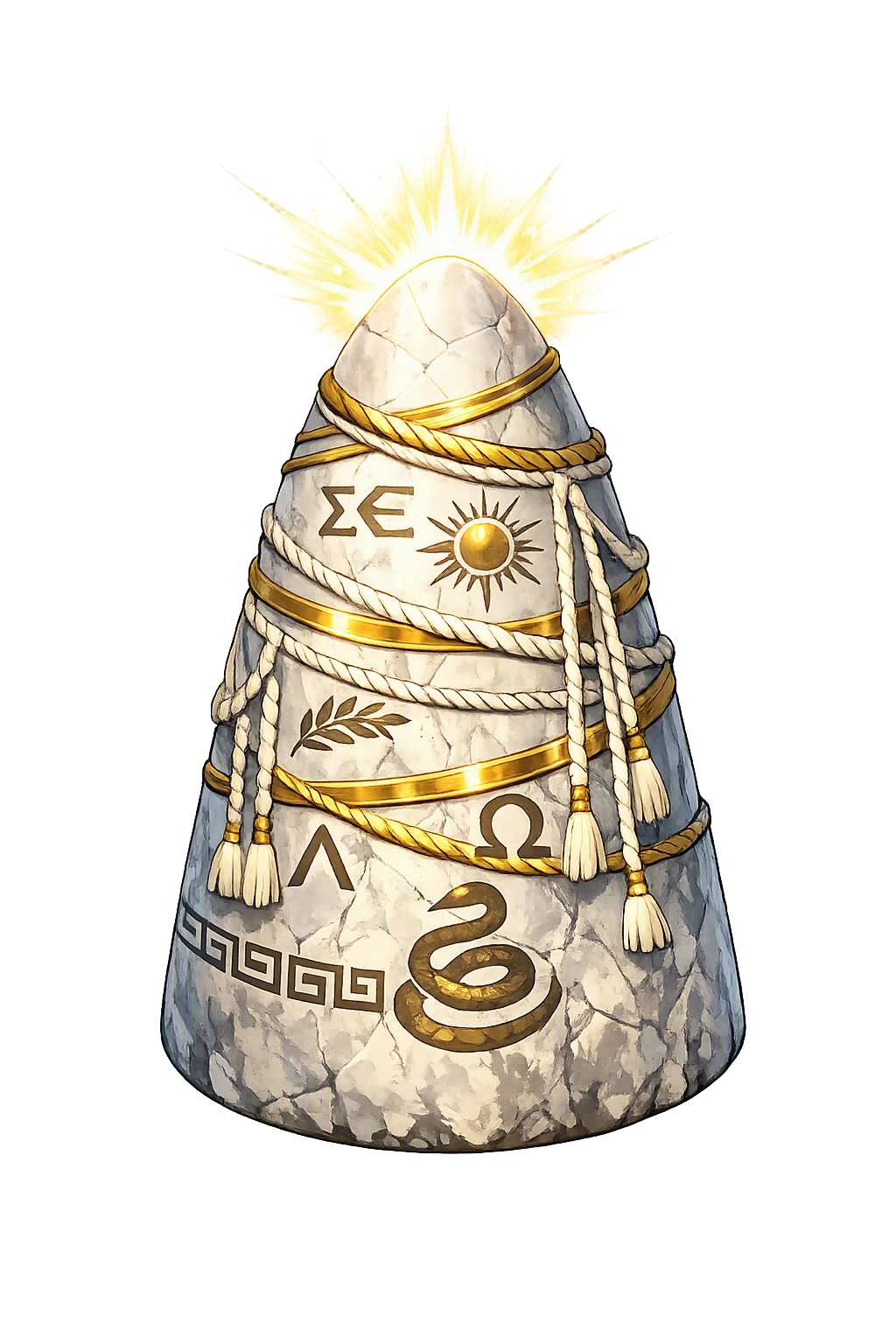
Stories of Omphalós
The omphalós has no biography because it is a place made stone: the story of Delphi's navel is the story of how the Greeks decided where the middle of the world was — by eagle, by oracle, and by the stone that stood for the infant god.
In the story told at Delphi, Zeus wished to know where the exact center of the earth lay. He released two eagles — some say from the eastern and western edges of the world — and bade them fly toward each other; they met above Delphi, and where they met the god fixed the omphalós, the navel-stone. The tale is preserved in the geographical tradition that culminates in Strabo (9.3.6), who repeats it as the sanctuary's own account of itself. The myth is a cartography in miniature: instead of measuring the world, the Greeks let two birds draw its diagonals and set a stone where the lines crossed. Delphi did not claim to be everywhere; it claimed to be the middle — the one point from which the whole could be surveyed, and the one point, therefore, where a god might conveniently speak to all mortals at once. Every subsequent oracle of the sanctuary traded on this founding geometry.
Pausanias (10.16.3) describes what the visitor could actually see: in the innermost sanctuary of Apollo's temple, the adyton, lay the omphalos, covered — the Delphians said — with the net thrown over it, with two golden eagles standing upon it. Beside it, in the same most-holy space, stood the tripod on which the Pythia mounted to give her responses, and the ever-burning hearth of the sanctuary. The stone was thus not a cult statue but a boundary-marker of the cosmos, kept in the room where heaven and earth touched. Its material facts are modest — a carved marble boss a little over a meter high — but its placement was the whole argument: the center of the world was a place you could stand next to, touch, and consult. Pausanias's description is the one fixed point on which the identification of the surviving stone rests.
Hesiod (Theogony 485–497) tells how Rhea, pregnant with Zeus, asked her parents Gaia and Ouranos to save the child from Kronos, who devoured each of his newborns. They gave her a great stone wrapped in swaddling clothes; Kronos 'seized it in his hands and thrust it down into his belly, the wretch, nor did he know in his heart that in place of his son his invincible, unshaken stone was left.' The later tradition — reported at Delphi itself and recorded by Pausanias (10.24.6) — identified this very stone with the omphalos at Delphi. The world's center thus conceals a substitution: where a god should have been destroyed, a stone was swallowed instead, and Zeus lived to overthrow his father. The navel of the earth is also the stone of rescue — the dummy that fooled Time and made the present order of the cosmos possible.
The Homeric Hymn to Apollo (300ff.) tells how the young god came to the rocky cleft at Delphi, where a spring flowed and a she-dragon, Python, lay — 'there the son of Leto with his mighty bow slew the bloated, mighty beast.' The dragon's name gave the place its older name, Pytho, and the goddess who had held the oracle there yielded it to him. On the foundation of Apollo's temple the omphalos stood beside the very chasm from which — in the later tradition reported by the sources — the prophetic power rose to the Pythia enthroned above it. The myth makes the center of the world a conquered place: the middle is not given but won by an arrow, and the stone that marks it stands where a dragon's breath once rose. Delphi's claim to centrality is thus also a claim of legitimacy — the oracle speaks from the exact spot where the god's victory made speech divine.
Navel, Center, Delphi
The omphalós was the stone at Delphi regarded as the navel — the exact center — of the world. Set in the innermost sanctuary, wrapped in a woolen net and flanked by golden eagles, it was not an image of a god but a marker of where the world's middle lay, and the Pythia prophesied beside it.
A rounded Hymettian-marble boss, carved with a net pattern, that stood in the adyton where the Pythia gave her oracles (Pausanias 10.16.3).
Zeus released two eagles from the ends of the world; where they met, at Delphi, the stone marked the center of all lands (Strabo 9.3.6).
The stone Kronos swallowed in place of the infant Zeus was, in the later tradition, set up at Delphi as a wonder and a sign (Hesiod, Theogony 485–497; Pausanias 10.24.6).
Apollo's oracle spoke beside the stone, in the sanctuary where the god had struck down the serpent Python (Homeric Hymn to Apollo 300ff.).
From the original script to the living URL
ὀμφαλός
The name in its original Greek form. Omphalós (ὀμφαλός) is attested in the source tradition — “Navel (of the earth); the stone at Delphi regarded as the centre of the world”. Its aspirated consonants and acute accents carry the full phonetic and orthographic weight of the source tradition.
omphalos
Reduced to plain omphalos, the name loses everything that made it specific: aspirated consonants and acute accents. What remains is an ASCII string that machines can parse but that no longer speaks with its original voice.
Omphalós
The Unicode restoration recovers what ASCII flattened. Omphalós restores aspirated consonants and acute accents, returning the name to its original written dignity. The domain encodes to Punycode, but the browser displays the truth.
Omphalós.com → xn--omphals-q0a.com
The non-ASCII characters in Omphalós are encoded while the ASCII remains visible. To the DNS, it is Punycode. To humanity, it is Omphalós.
Owned, ideal, and ASCII forms of Omphalós
Omphalós
Restores ὀμφαλός. The live temple domain — omphalós.com.
omphalos
Flattens ὀμφαλός. The plain ASCII fallback — what DNS and legacy systems see.
How Omphalós was spoken
How Omphalós is preserved in writing
A bespoke provenance study for Omphalós is being prepared by the PUNICODEX scholarly team.
Contribute scholarly provenance →The lore you have read is the living myth. Extended Lore opens the scholarly vault beneath it: the cult and its material remains, a history of the image, the name after antiquity, a meditation on what the name still means, and the full scholarly apparatus — etymology, orthography, sources.
Enter Extended Lore