
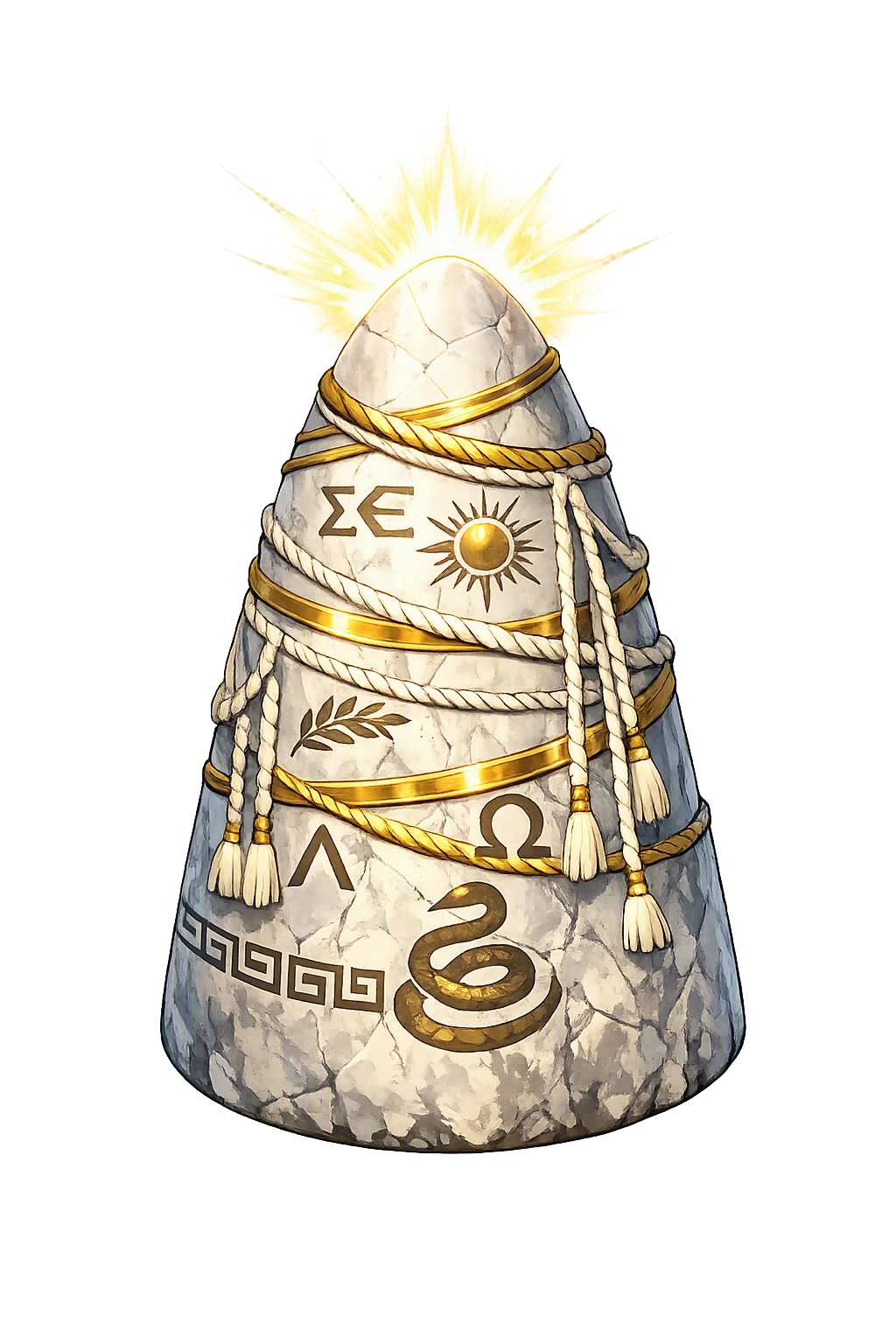
How Omphalós was rebuilt, mark by mark
The workshop file for Omphalós. Every rejected form is recorded here too — that is the point of keeping notes.
What We Found
The attestation, as LSJ and Pape-Benseler record: ὀμφαλός. Meaning: "Navel (of the earth); the stone at Delphi regarded as the centre of the world".
The figure behind the name: The omphalós has no biography because it is a place made stone: the story of Delphi's navel is the story of how the Greeks decided where the middle of the world was — by eagle, by oracle, and by the stone that stood for the infant god.
What the Name Carried In
The Eagles of Zeus. In the story told at Delphi, Zeus wished to know where the exact center of the earth lay. He released two eagles — some say from the eastern and western edges of the world — and bade them fly toward each other; they met above Delphi, and where they met the god fixed the omphalós, the navel-stone.
The Stone in the Innermost Room. Pausanias (10. 16.
A spelling that has to carry stories like these is not a label. It is equipment.
Where It Stood Before Us
The omphalos survives in the Delphi Archaeological Museum: a Hymettian-marble boss carved with a net pattern, a little over a meter high, found in the temple precinct and conventionally identified with the stone Pausanias saw in the adyton. The temple of Apollo — its fourth, stone, phase — still shows the foundations of the inner sanctuary where the stone and the Pythia's tripod stood. The form appears on imperial-period coins of Delphi, always with the net pattern and flanking eagles, and Roman copies of the omphalos type are known from the city of Rome itself. No inscription names the stone; its identification rests on the match between Pausanias's description and the carved marble found on site. The bench inherits all of it — the web temple is the newest site, not the first.
What We Kept
The evidence, mark by mark — 1 feature the keyboard form omphalos cannot hold:
- o → ó — Acute on omicron. Kept.
What We Rejected
The plain ASCII omphalos — admissible as a fallback, never as the primary. A wrong accent would have been worse: the rulebook is explicit that a misplaced mark is worse than none.
What We Set Down
Omphalós — The restoration keeps one feature the ASCII form drops. One is enough to matter, and the label says so plainly: Tier-2.
For the voice: 'om-fah-LOSS' — the accent falls on the last syllable; classical phi is an aspirated p, not the modern f.
The temple stands at /omphalos/ — the notes above are public in its Scholarly Edition, sources and all.
At a Glance
- Restored name: Omphalós
- ASCII form: omphalos
- Meaning: "Navel (of the earth); the stone at Delphi regarded as the centre of the world"
- Domain of influence: Navel, Center, Delphi
- Pantheon: Greek
- Classification: Tier 2
- Original script: ὀμφαλός
- Series: The Restoration Files, No. 366 of 548
The File Continues
The temple's founding dispatch tells the name's story; its Resonance File reads the myths into the industries; the blog index holds the whole archive.
Continue the series — previous file: Omononushi (read it here) · next file: Óneiros (read it here).
The Restoration Files are written from the same canonical record as the temples themselves: the lexicon, the lore catalog, the pattern atlas, and the cited scholarly sources. If a file ever disagrees with its temple, the temple is right — tell us, and the file will be corrected.