
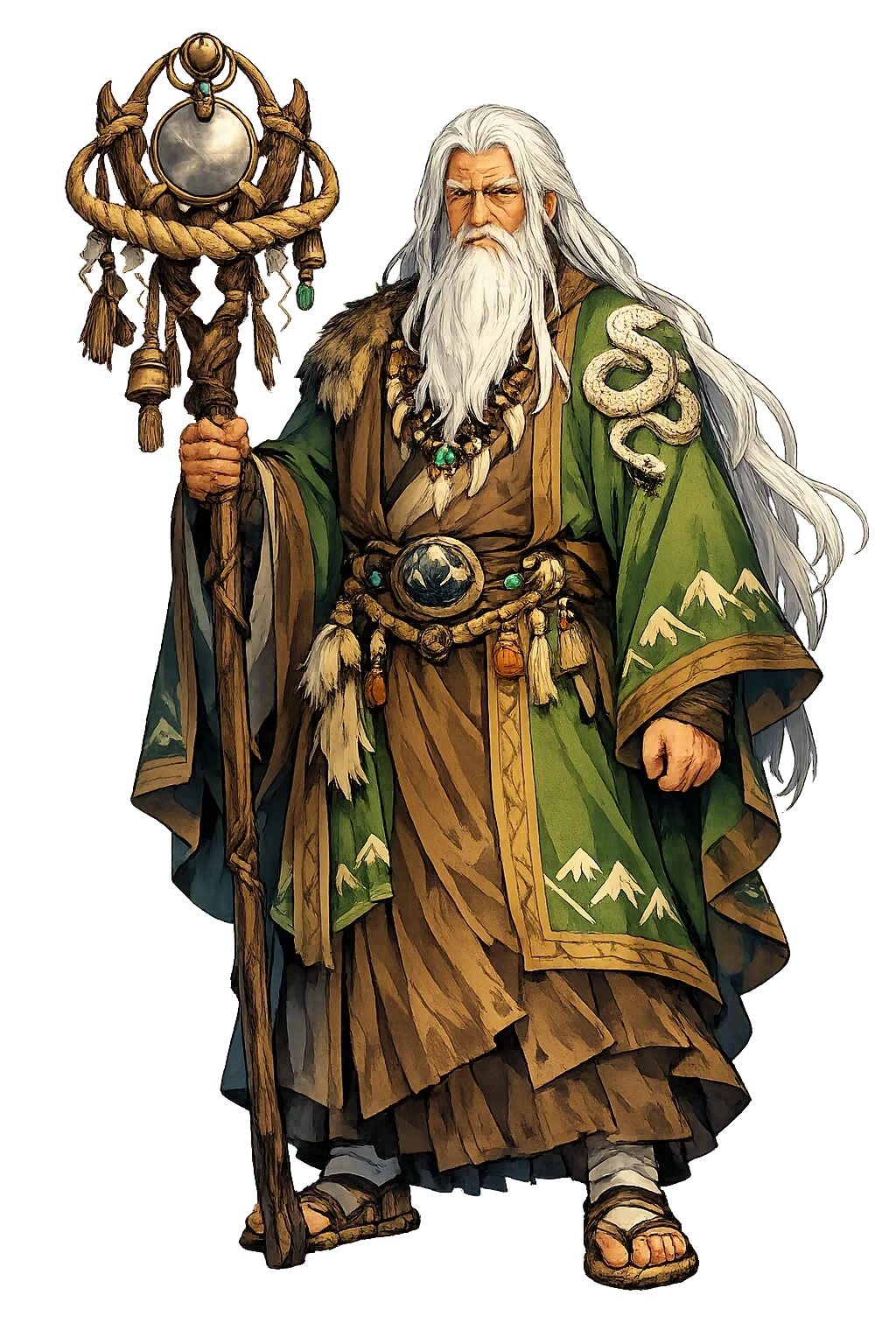
How Omononushi was rebuilt, mark by mark
Bench notes, Omononushi: what we found, what we rejected, and what we finally set down. Kept in the open, because a restoration you cannot audit is just a spelling with confidence.
What We Found
The attestation, in the attestation Kojiki — the Ikutamayori serpent legend, the land-transfer oracle, the marriage to Seyadatarahime, the Sujin plague cycle and Nihon Shoki — parallel land-transfer and Sujin accounts; Ōnamuji 'also called Ōmononushi' give us: 大物忌神. Meaning: "Great thing lord".
The figure behind the name: Ōmononushi's mythology is preserved in strange, archaic tales of snakes, possession, and oracles — the Kojiki's strangest marriage, the constitution of Japan's sovereignty, and a shrine with no god-house, because the mountain is the god.
What the Name Carried In
The Serpent Husband of Ikutamayori. A maiden named Ikutamayori was visited each night by a beautiful man who came unseen. When she bore his child, her parents demanded to know the father.
The Oracle of the Land. When the heavenly emissary Takemikazuchi descended to demand the land from the earthly god Ōnamuji (Ōkuninushi), Ōnamuji consulted his children. Kotoshironushi, away at Cape Miwa, answered that resistance to the heavenly grandson was hopeless — and then all eyes turned to the mountain.
A spelling that has to carry stories like these is not a label. It is equipment.
Where It Stood Before Us
The Engishiki shrine register (927 CE) already lists Ōmiwa among the great sanctuaries, and the site's archaeology is deep: excavations around Miwa have yielded ritual deposits and prestige objects — bronze mirrors, swords, and beads — from the Yayoi-to-Kofun transition, indicating a sanctuary of unusual antiquity at the mountain's foot, and the great keyhole tomb Hashihaka nearby marks the district as an early center of power. No honden has ever stood at Ōmiwa; worship runs toward the peak through the unique Miwa-torii, whose third central pillar frames the mountain as the true sanctuary. The 'artifact' of this god is thus geological and botanical at once — bedrock, cedar, and the spring-water sake that the shrine has brewed since the rite began. The bench inherits all of it — the web temple is the newest site, not the first.
What We Rejected
Any form invented for availability. The rule on the bench: if the evidence does not carry it, the domain does not get it — whatever the registrar has in stock.
What We Set Down
Omononushi — One decisive feature survives — a single, honest mark — which places the restoration in Tier-2: exact, and exactly labeled.
For the voice: 'OH-moh-noh-noo-shee' — even syllables, with soft final vowels.
The temple stands at /omononushi/ — the notes above are public in its Scholarly Edition, sources and all.
At a Glance
- Restored name: Omononushi
- ASCII form: omononushi
- Meaning: "Great thing lord"
- Domain of influence: Mountains, Deity of Miwa
- Pantheon: Japanese
- Classification: Tier 2
- Original script: 大物忌神
- Series: The Restoration Files, No. 365 of 548
The File Continues
The temple's founding dispatch tells the name's story; its Resonance File reads the myths into the industries; the blog index holds the whole archive.
Continue the series — previous file: Oṃ (read it here) · next file: Omphalós (read it here).
The Restoration Files are written from the same canonical record as the temples themselves: the lexicon, the lore catalog, the pattern atlas, and the cited scholarly sources. If a file ever disagrees with its temple, the temple is right — tell us, and the file will be corrected.