PuniCodex

Extended Lore

Omononushi — The Deeper Record

Etymology · Orthography · Cult · Iconography · Reception · Sources

ASCII-equivalent form Omononushi
Omononushi — Mountains, Deity of Miwa
01

At a Glance

Omononushi — every fact links to its home

PantheonJapanese
DomainMountains, Deity of Miwa
Attested927 CE
Original Script大物忌神 →
Primary Sources6 cited →
02

Etymology & Word Family

From original script to canonical restoration — the full etymology page →

Original Script 大物忌神 Omononushi — "Great thing lord"
Canonical Restoration Omononushi Canonical scholarly spelling — ASCII-identical
Modern ASCII omononushi Plain-ASCII fallback

The name Omononushi reaches the modern world through scholarly transliteration of the japanese tradition. Because the conventional spelling uses only Latin letters, its canonical and ASCII forms coincide — the tradition it carries is in the name itself, not in diacritics.

03

Character breakdown

Character-by-character philological analysis

CharacterUnicodeNameBlockPhonetic Role
OU+004FLatin Capital Letter OBasic LatinSame, capitalized
mU+006DLatin Small Letter MBasic LatinSame
oU+006FLatin Small Letter OBasic LatinSame
nU+006ELatin Small Letter NBasic LatinSame
oU+006FLatin Small Letter OBasic LatinSame
nU+006ELatin Small Letter NBasic LatinSame
uU+0075Latin Small Letter UBasic LatinSame
sU+0073Latin Small Letter SBasic LatinSame
hU+0068Latin Small Letter HBasic LatinSame
iU+0069Latin Small Letter IBasic LatinSame

This restoration reflects fidelity to the attested tradition, not recovered diacritics: every character of Omononushi already survives in ASCII. What the restoration preserves is the canonical spelling itself — the form scholarship standardised.

04

Cult & Worship

How the sacred was kept — rites, sanctuaries, remains

The Cult

Ōmononushi was one of the most ancient and politically potent kami cults of the Yamato region. Ōmiwa Shrine at the foot of Mount Miwa — listed in the 927 Engishiki as a great shrine — had no honden main hall in the classical period; the mountain itself was worshipped as the deity's body, a pattern known as shintai-zoku ('body-of-the-kami' worship). The shrine received court emissaries, imperial offerings, and seasonal festivals tied to the agricultural year. Oracles delivered through the ikupasuy drinking tube and the serpent legend preserved in the Kojiki point to a rite in which possession and libation mediated the god's will. Pilgrimage to Miwa continues today, and the mountain is still treated as sacred.

In the Earth

The Engishiki shrine register (927 CE) already lists Ōmiwa among the great sanctuaries, and the site's archaeology is deep: excavations around Miwa have yielded ritual deposits and prestige objects — bronze mirrors, swords, and beads — from the Yayoi-to-Kofun transition, indicating a sanctuary of unusual antiquity at the mountain's foot, and the great keyhole tomb Hashihaka nearby marks the district as an early center of power. No honden has ever stood at Ōmiwa; worship runs toward the peak through the unique Miwa-torii, whose third central pillar frames the mountain as the true sanctuary. The 'artifact' of this god is thus geological and botanical at once — bedrock, cedar, and the spring-water sake that the shrine has brewed since the rite began.

05

Iconography

How Omononushi was imaged across the ages

The Image

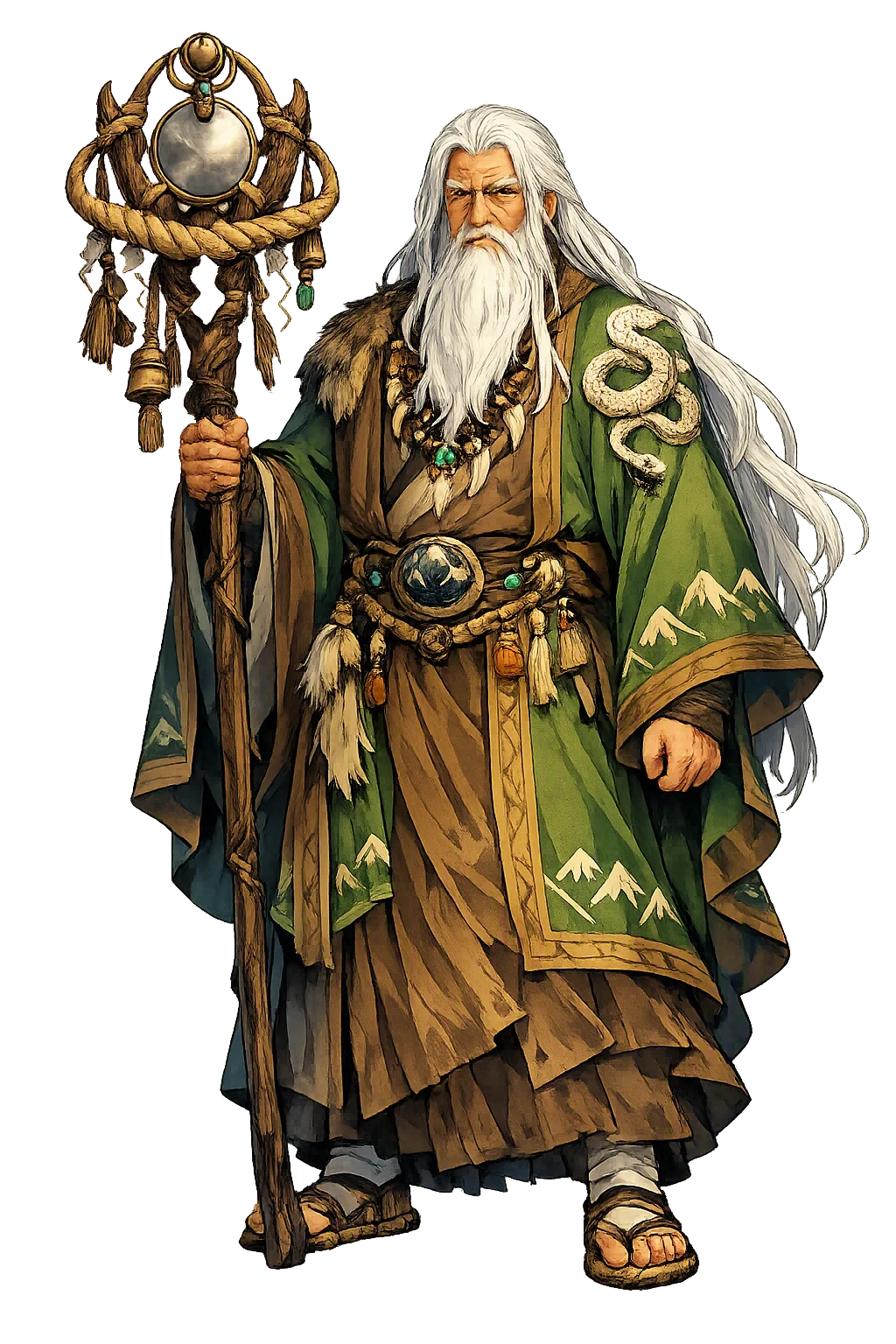
Classical Ōmononushi was not represented by an anthropomorphic statue; Mount Miwa itself, together with the great sakaki tree and the ritual objects of Ōmiwa Shrine, served as his visible presence. Later Shinto painting and shrine mandala nevertheless supplied humanoid forms when narrative demanded them: a courtly male figure, sometimes entwined with a serpent or accompanied by the deity Ōkuninushi, appears in illustrated Kojiki and pilgrimage scrolls. The three mitamashiro (spirit representatives) — sword, mirror, and jewel — functioned as his portable icons. Modern imagery returns to the mountain and the shrine's distinctive torii, making landscape rather than figuration his signature.

06

Reception & Transformation

The name after its own age — transmission, translation, survival

Afterlives

Ōmononushi's reception is a study in cultic continuity and political appropriation. Already powerful in the Yayoi-to-Kofun transition, his shrine became a charter sanctuary of Yamato kingship and was later folded into the imperial Engishiki register. Medieval Shinto-Buddhist synthesis identified him with the buddha Yakushi and with the kami Ōkuninushi, creating a layered reception that persisted until the Meiji separation of kami and buddhas. The Kojiki land-transfer narrative made him a foundational figure of Japanese sacred geography. Modern scholarship reads the Miwa cult as a window onto archaic Yamato religion, while contemporary pilgrims and shrine rites preserve a living, if transformed, devotion.

Identifications Across Traditions

Ōmononushi never left Shinto, but he was folded into it from two directions. The Nihon Shoki already identifies him with Ōkuninushi — the local Miwa kami gathered into the imperial land-myth — and medieval honji suijaku doctrine went further: Mount Miwa's deity, as Miwa Daimyōjin, was given the Buddhist original ground of Śākyamuni Buddha, and Miwa mandalas picture the mountain with Buddhist cosmography laid over it. Under the mountain, ascetics of the Shugendō tradition practiced until the modern period, treating the peak itself as the object of cult. The serpent, the sake, and the oracle — archaic, local, and oracular — are precisely the features a centralizing mythology needed to absorb rather than erase: Ōmononushi survives because he was useful, first to the court that took his oracle, then to the Buddhism that crowned him, then to the brewers who still hang cedar balls for him.

Modern Legacy

Ōmiwa Shrine still stands where the myth says it must: at the foot of Mount Miwa, without a main hall, prayer aimed at the peak. The surrounding district remains sacred geography — Isonokami, one of Japan's oldest shrines, close by, and the great early kofun of Hashihaka on the horizon. Miwa sake is still brewed under the god's patronage, and brewers across Japan hang sugitama cedar balls in his honor. The mountain appears in Nara-period poetry, and the Miwa-torii's third pillar is studied wherever shrine architecture is taught. For modern Shinto, Ōmononushi is the standing proof that the kami need not be anthropomorphic: his 'image' is a modest ridge of green rock and cedar, and on clear mornings the faithful still bow toward it before entering the shrine.

08

The Original Script Note

What the written record preserves — and what it does not

Original Script

The Kojiki writes 大物忌神 — 大 'great' + 物忌 mono-imi 'the awe-inspiring numinous that is avoided' + 主 nushi 'lord'. The compound is usually rendered 'great lord of the numinous', though the precise force of 物忌 — avoidance, taboo, or the shudder of the sacred — has been argued over for centuries. In the medieval period the Miwa cult preferred the Buddhist title 三輪明神 (Miwa Myōjin), and that title, not the native name, dominates the shrine's pre-modern documents.

09

The Meditation

What Omononushi means — beyond the dictionary

Ōmononushi is the god who refuses to be a person. Every other great kami of Japan acquired a face, a genealogy, a palace in the poems; Ōmononushi acquired a mountain, and the mountain — unportable, unburnable, unshippable — has guarded his integrity ever since. He enters myth only as a voice or a snake: the two forms in which the sacred appears without becoming an idol. His oracle teaches a politics as well: the land changed hands because he consented, and consent, not conquest, is what his cult claims as the first principle of sovereignty. Even his marriage reads like an essay in legitimacy, wedding the mountain's line to the dynasty that received the mountain's realm. And because there is no statue, every visit to Ōmiwa is a small reenactment of the discovery of the sacred — you look up from the torii, past the sake casks, at green rock and cedar, and understand that you have been inside the shrine since the road.

10

Frequently Asked Questions

Deep-dives into the cult, attestation, reception, and sources of Omononushi

01How do we know how Omononushi was worshipped?

The Engishiki shrine register (927 CE) already lists Ōmiwa among the great sanctuaries, and the site's archaeology is deep: excavations around Miwa have yielded ritual deposits and prestige objects — bronze mirrors, swords, and beads — from the Yayoi-to-Kofun transition, indicating a sanctuary of unusual antiquity at the mountain's foot, and the great keyhole tomb Hashihaka nearby marks the district as an early center of power. The full cult record →

02Where do the earliest attestations of Omononushi come from?

The record rests on Kojiki — the Ikutamayori serpent legend, the land-transfer oracle, the marriage to Seyadatarahime, the Sujin plague cycle, Nihon Shoki — parallel land-transfer and Sujin accounts; Ōnamuji 'also called Ōmononushi', Engishiki Jinmyōchō (927) — Ōmiwa among the registered great shrines, among 5 cited works. The full source apparatus →

03How did later traditions reinterpret Omononushi?

Ōmononushi's reception is a study in cultic continuity and political appropriation. Reception & transformation →

04What do the surviving images of Omononushi actually show?

Classical Ōmononushi was not represented by an anthropomorphic statue; Mount Miwa itself, together with the great sakaki tree and the ritual objects of Ōmiwa Shrine, served as his visible presence. The iconography →

05What does the written record of Omononushi actually preserve?

The Kojiki writes 大物忌神 — 大 'great' + 物忌 mono-imi 'the awe-inspiring numinous that is avoided' + 主 nushi 'lord'. The Original Script note →

11

Scholarly Sources

The philological foundations of the record

Every claim on this page is grounded in established scholarship. The orthographic restorations follow disciplinary convention. The etymological chain follows the best available reference works. This is not invention — it is resurrection through scholarship.

◎

Primary Texts

  • Kojiki
  • Nihon Shoki
  • Kojiki — the Ikutamayori serpent legend, the land-transfer oracle, the marriage to Seyadatarahime, the Sujin plague cycle
  • Nihon Shoki — parallel land-transfer and Sujin accounts; Ōnamuji 'also called Ōmononushi'
  • Engishiki Jinmyōchō (927) — Ōmiwa among the registered great shrines
  • Philippi, The Kojiki (1968)
◉

Archaeology & Art History

  • Guth, C. Art of Edo Japan; Kidder, J. E. Early Japanese Art.
✦

Religious Studies

  • Aston, Nihongi: Chronicles of Japan (1896)
Return

The Surface Awaits

You have traced the name from its earliest attestation to its canonical restoration. Now return to the myth. The story is where the name lives.

Back to Lore
Omononushi mascot